By the KRL Power Industrial Mobility & Robotics Engineering Team · Last reviewed: November 2026
In a 24/7 automated warehouse, a loaded autonomous mobile robot (AMR) that shuts down in the middle of a narrow high-bay aisle halts the entire fleet behind it. In many field failures, the root cause traces back to one of two mistakes made during chassis design: selecting the wrong lithium cell chemistry for the duty cycle, or pairing the pack with a generic battery management system (BMS) that loses state-of-charge (SOC) accuracy under opportunity charging.
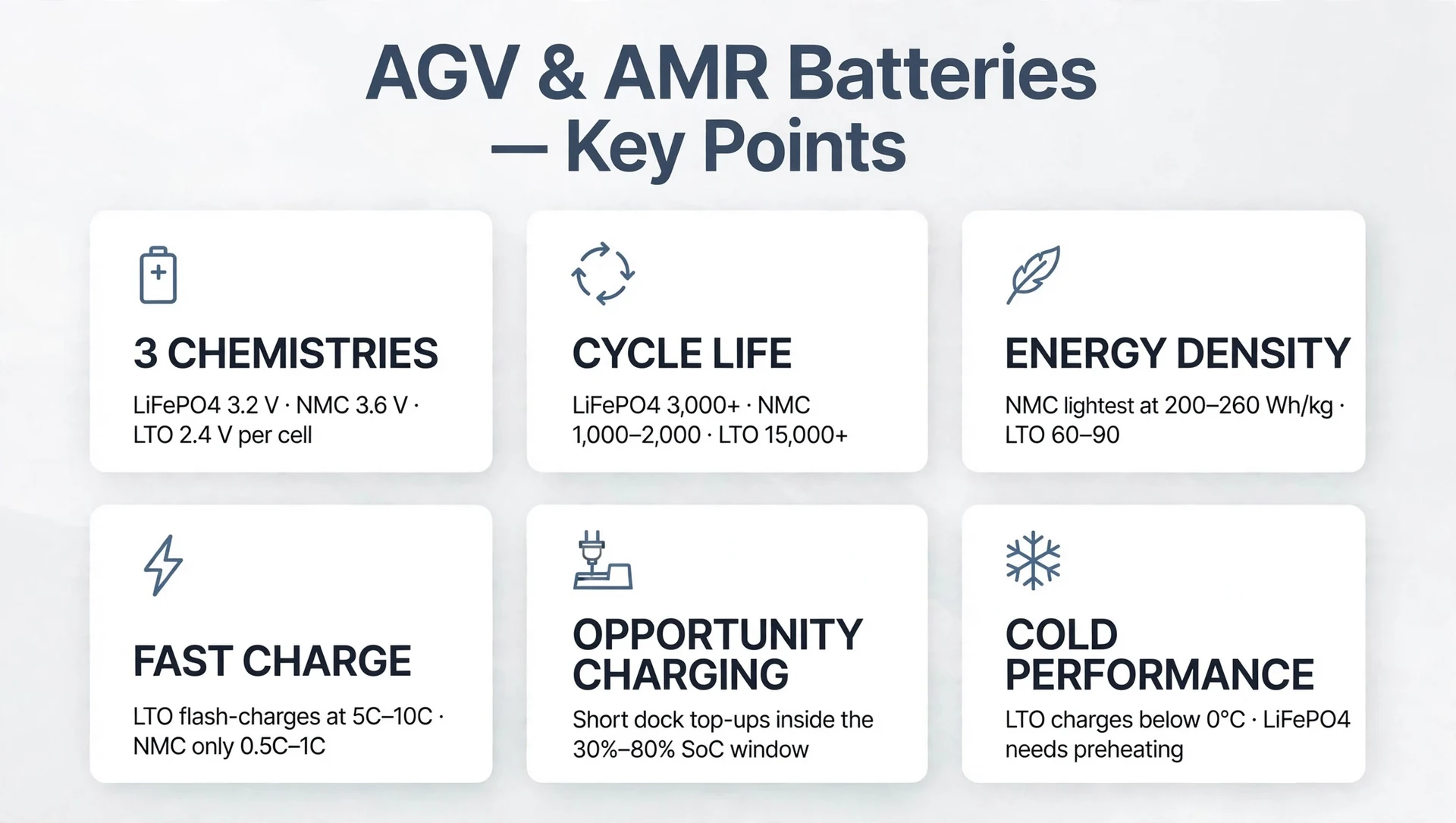
Robotics OEMs and warehouse automation integrators weigh three lithium chemistries for 24V and 48V mobile platforms: LiFePO4 (Lithium Iron Phosphate), NMC (Nickel Manganese Cobalt), and LTO (Lithium Titanate). Each chemistry involves trade-offs across chassis envelope, charging C-rate, thermal safety and total cost of ownership (TCO).
Below is the 10-dimension engineering comparison table, the boundary conditions that separate LiFePO4 from LTO and NMC, an illustrative opportunity-charging sizing method, and key hardware considerations for custom AGV, RGV and AMR battery packs.
1. LiFePO4 vs. NMC vs. LTO: 10-Dimension AGV & AMR Battery Comparison
Note: Figures below represent general industry chemistry characteristics; exact pack specifications depend on the selected cell model and BMS design.
| Evaluation Metric | LiFePO4 (Warehouse Robotics Mainstream) | NMC (Compact Light-Duty) | LTO (Extreme Cold & Ultra-Fast Charge) |
|---|---|---|---|
| Nominal cell voltage | 3.20V (24V = 8S; 48V = 15S or 16S) | 3.60V / 3.70V (24V = 7S; 48V = 13S) | 2.40V (24V = 10S; 48V = 20S) |
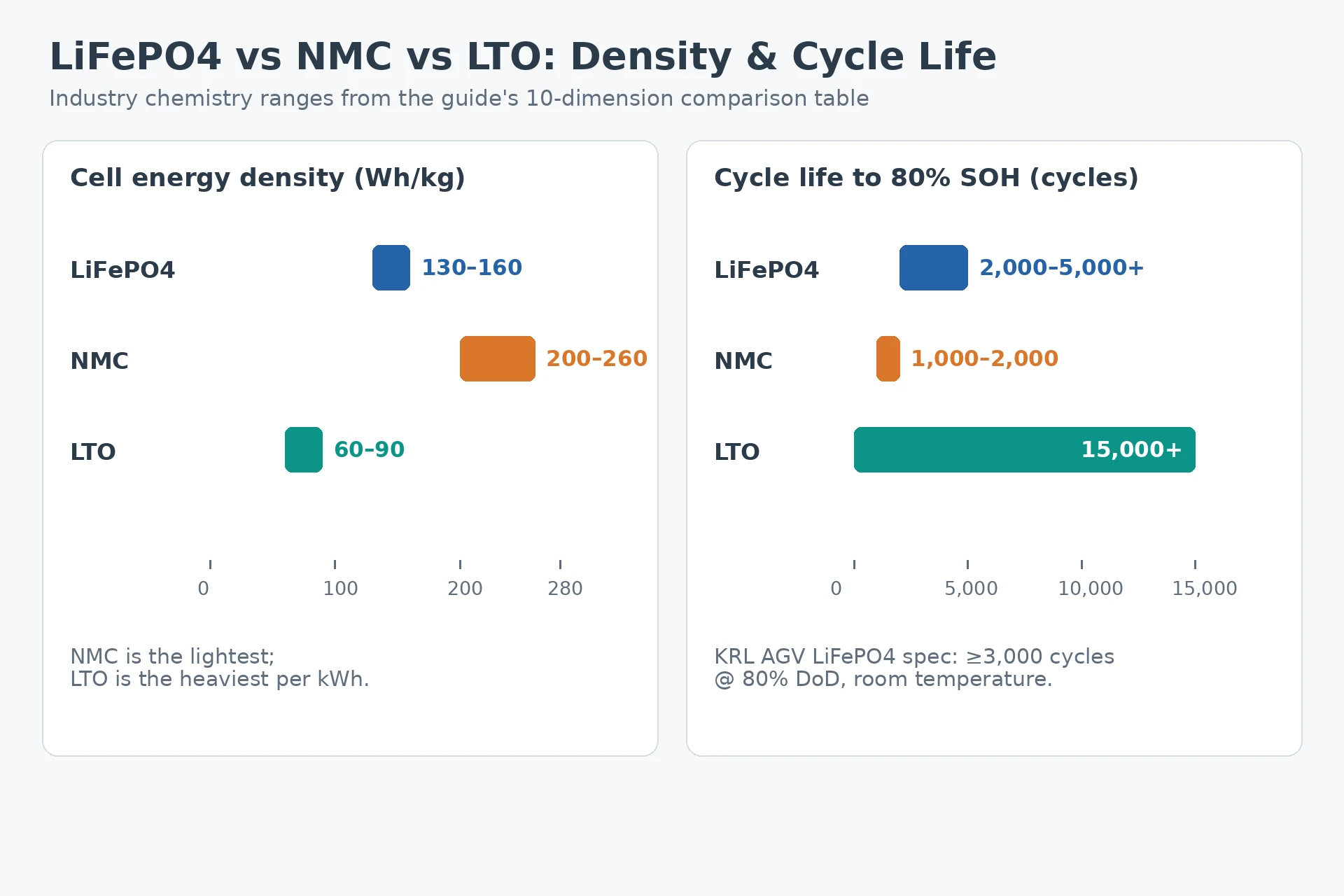
| Gravimetric energy density (cell) | 130 – 160 Wh/kg | 200 – 260 Wh/kg (lightest weight) | 60 – 90 Wh/kg (heaviest, largest volume) |
| Fast-charge capability | High-rate charging configurable by project (exact C-rate depends on cell & BMS design) | Typically 0.5C – 1C | 5C – 10C (industry typical for flash charging) |
| Cycle life (to 80% SOH) | 2,000 – 5,000+ cycles industry range (KRL AGV standard spec: ≥3,000 cycles @ 80% DoD, room temperature) | 1,000 – 2,000 cycles (industry typical) | 15,000+ cycles (industry chemistry benchmark) |
| Thermal stability | Higher thermal stability than conventional NMC (olivine crystal structure) | Lower thermal runaway threshold than LiFePO4; higher fire-propagation risk | High intrinsic thermal stability (spinel anode structure) |
| Low-temperature charging | 0°C bare cell (custom low-temperature packs with preheating are available) | 0°C bare cell | Native sub-zero charging capability (chemistry benchmark) |
| Relative pack CAPEX | Baseline (cost-effective per kWh) | Moderate CAPEX | Typically higher CAPEX per kWh |
| Service life in multi-shift operation | Long service life suited to multi-shift warehouse duty cycles | Shorter service life under continuous daily cycling | Extended cycle life for continuous flash-charge loops |
| Warehouse fire-risk & compliance considerations | Widely adopted for indoor warehouse fleets due to thermal stability | May face restrictions depending on site fire-risk assessment and insurer requirements | Suitable for high-safety or extreme-duty environments |
| Primary robotics applications | Under-ride AMRs, RGV shuttles, autonomous forklifts, heavy tuggers | Weight-critical compact shuttle bots | Deep-freeze rail shuttles, ultra-high-frequency sorting loops |
(For a full breakdown of 48V pack voltages across 13S NMC, 15S LiFePO4 and 16S LiFePO4 strings, see our 48V 13S/15S/16S lithium battery voltage chart.)
2. Chemistry Boundaries: Why Most Warehouse Fleet Designs Standardise on LiFePO4
Fire-risk considerations for NMC vs. LiFePO4 in automated warehouses
Early goods-to-person AMRs often used 13S or 7S NMC packs to fit higher watt-hours into thin chassis profiles. However, some warehouse automation projects restrict NMC depending on the facility's fire-risk assessment and property insurer requirements.
In a high-bay automated storage and retrieval system (AS/RS) or multi-tier mezzanine rack, thermal stability is a primary safety criterion. Olivine-structure LiFePO4 (LiFePO4) provides higher thermal and chemical stability than conventional layered-oxide NMC cells, making LiFePO4 the preferred choice for indoor AGV, RGV and industrial robot deployments where fire safety and long cycle life are prioritized.
Where LTO fits — and where LiFePO4 is more cost-effective
Lithium Titanate (LTO) replaces the graphite anode with spinel Li4Ti5O12 crystals, supporting ultra-high charge rates and sub-zero charging without lithium plating.
Those characteristics come with two trade-offs for a robotics OEM:
- 1. Weight and installation space: At 60–90 Wh/kg and 2.40V per cell, a 48V LTO pack requires 20 cells in series and generally demands a larger weight and installation space budget than a 16S LiFePO4 pack of equal capacity, with exact dimensions determined by cell format and pack structure.
- 2. Upfront cost: LTO cells carry a substantially higher CAPEX per kWh than LiFePO4 cells.
LTO is typically reserved for two specialized scenarios:
- In-rack deep-freeze shuttles that remain permanently inside sub-zero cold rooms and must fast-charge on the rail without a preheating cycle.
- Ultra-high-throughput sorting loops where vehicles can spare only a minute or two per cycle at a flash-charging contact rail.
In ambient and chilled warehouses (+2°C to +40°C) where AMRs can dock for opportunity charging between missions, a project-engineered LiFePO4 pack lowers battery BOM cost and reduces weight and installation space requirements compared with LTO, while delivering ≥3,000 cycles at 80% DoD (KRL AGV official specification; 2,000 to 5,000+ cycles across general LiFePO4 cell grades and duty cycles).
3. Sizing Opportunity Charging for 24/7 Fleet Availability
Shifting from deep cycling to the 30%–80% SOC operating window
Swapping depleted batteries by hand or parking an AGV for a multi-hour slow charge requires buying extra backup batteries or adding spare robots to the fleet. Many modern fleets use opportunity charging instead: when an AMR pauses at a pick station, conveyor transfer point or idle zone for 5 to 12 minutes, it docks at an automatic charger and tops up within the 30% to 80% SOC band.
Keeping LiFePO4 packs between 30% and 80% SOC can reduce high-SOC and deep-discharge stress on the cells compared with 0%–100% full cycling.
The Run-to-Charge current balance formula
The following values are an illustrative sizing example, not a rated KRL battery specification.
To check whether an AGV or AMR can maintain charge balance over three shifts, the amp-hours restored during opportunity charging must cover the amp-hours consumed during the active work window:
I_charge × T_charge × η_charge ≥ I_avg_work × T_work × k_safety
- I_charge: Charge current supplied during docking (A).
- T_charge: Available charging time per cycle (minutes).
- η_charge: Coulombic charging efficiency of LiFePO4 (0.96–0.98 as an illustrative assumption).
- I_avg_work: Time-weighted average current draw across driving, lifting and idling (A).
- T_work: Active operating time per cycle (minutes).
- k_safety: Scheduling buffer for traffic delays and peak queues (1.10–1.20 as an illustrative assumption).
Illustrative Example: 600 kg Payload Under-Ride AMR (5:1 Run-to-Charge Ratio)
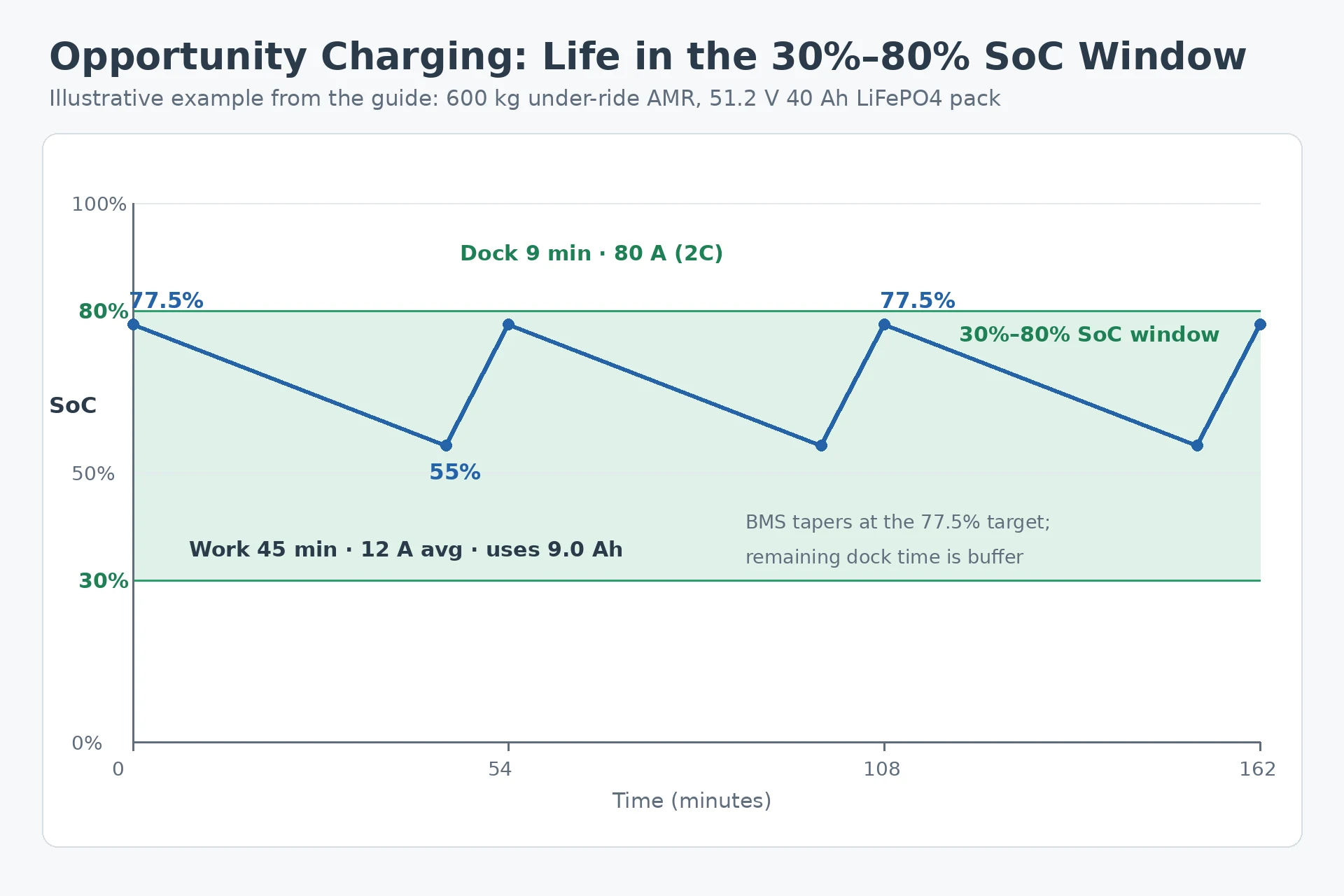
- Operating profile: In each 54-minute cycle, the AMR works for T_work = 45 min (0.75 h) at an average current I_avg_work = 12 A (~615 W average power on a 51.2V bus) and docks at an opportunity charger for T_charge = 9 min (0.15 h).
- Energy consumed per 45-minute mission: 12 A × 0.75 h = 9.0 Ah.
- Required charge current (k_safety = 1.15, η_charge = 0.96): I_charge ≥ (12 × 45 × 1.15) / (9 × 0.96) = 71.9 A
In this illustrative scenario, if the project selects a 48V (51.2V) 40Ah LiFePO4 pack engineered for 2C charging (I_charge = 80 A):
- Each 45-minute mission consumes 9.0 Ah (22.5% of the 40Ah pack). If the robot begins the mission at 77.5% SOC, it docks at 55% SOC.
- Charging at 80 A for the full 9-minute dock window offers a theoretical recharge capability of 80 A × 0.15 h × 0.96 = 11.52 Ah (28.8% of capacity), which would take the pack from 55% to 83.8% SOC if left unrestricted. To keep the pack within a 55%–77.5% (or ≤80%) SOC window, the BMS or charger controller tapers or stops charging once the target SOC upper limit is reached (after roughly 7.3 minutes at 80 A to replace the 9.0 Ah used), leaving the remaining dock time as a scheduling buffer. Actual allowable charge C-rate must always be confirmed against the specific cell datasheet and BMS thermal design.
4. Key Engineering Considerations for Custom AGV & AMR Battery Packs
Off-the-shelf backup batteries often struggle in mobile robotics because vehicle duty cycles involve frequent docking, partial-SOC cycling, floor vibration and varying ambient temperatures. When specifying a custom pack with KRL Power's AGV & AMR battery team, review these four engineering areas:
4.1 Charging contact protection and pre-charge design
If a battery pack leaves its charging terminals live at full pack voltage while sliding onto automatic charger brushes, mechanical contact can strike an electric arc that wears down brush pads over repeated dockings. For automatic-docking applications, BMS architectures can be engineered with pre-charge circuits and handshake control so the main charging path closes only after physical contact is established.
4.2 SOC calibration under 30%–80% opportunity charging
Because LiFePO4 cells exhibit a flat open-circuit voltage plateau (around 3.28V–3.33V/cell) between 30% and 80% SOC, an AMR that opportunity-charges for days without reaching full charge cannot rely on voltage alone to estimate remaining capacity. Accurate fleet dispatch requires coulomb-counting BMS integration paired with periodic full-charge balancing cycles so the SOC reading stays aligned with true available capacity.
4.3 Mechanical vibration resistance and UN 38.3 compliance
AGVs, RGVs and autonomous forklifts cross warehouse expansion joints, dock plates and floor thresholds throughout the day. Industrial packs require secure cell fixturing, welded busbars and ruggedized enclosures designed to pass UN 38.3 transport and vibration testing, preventing loose connections or terminal overheating in mobile service.
4.4 Custom low-temperature and IP-rated options for cold environments
For robotics and industrial equipment operating in chilled or sub-zero environments, standard LiFePO4 cells cannot be charged below 0°C without risk of lithium plating. KRL Power offers custom low-temperature battery versions with integrated preheating / self-heating functions, as well as enclosure sealing options up to IP67 for humid or washdown environments, engineered to match your project's temperature profile and charge schedule.
5. Voltage Platforms & Communication Customization at KRL Power
Every mobile robot platform has its own cavity dimensions, motor voltage and controller interface. At KRL Power, we design and manufacture LiFePO4 battery packs tailored to AGVs, RGVs, collaborative robots and industrial material-handling vehicles:
- Standard and custom voltage platforms: We supply 24V (25.6V, such as our 25.6V 60Ah LiFePO4 AGV battery) and 48V (48.0V / 51.2V) systems, alongside custom non-standard voltage and capacity configurations built to fit your chassis L×W×H envelope, with an official AGV cycle life rating of ≥3,000 cycles at 80% DoD (room temperature).
- CAN and RS485 communication customization: Our smart BMS supports RS485 and CAN communication with application-specific protocol customization, providing real-time pack voltage, current, SOC, cell temperature and protection status to the vehicle controller.
- Project-matched charge and discharge rates: We select the cell grade, BMS current rating and thermal structure around your vehicle's continuous drive load, peak lift current and charging schedule.
6. Request a Custom AGV/AMR Battery Specification & Quote
Matching the battery pack to your vehicle's duty cycle, charger interface and chassis cavity early in design prevents costly retrofits during warehouse commissioning.
- Opportunity-charging assessment: share your vehicle's average current draw, peak lift load and docking window, and our engineers will calculate the required Ah capacity and charge current for your duty cycle.
- Custom AGV/AMR battery engineering review: send us your chassis dimensions (L×W×H), nominal voltage (24V / 48V / custom), continuous and peak current requirements, operating temperature range, and RS485/CAN communication requirements for an engineering evaluation and OEM/ODM quote.