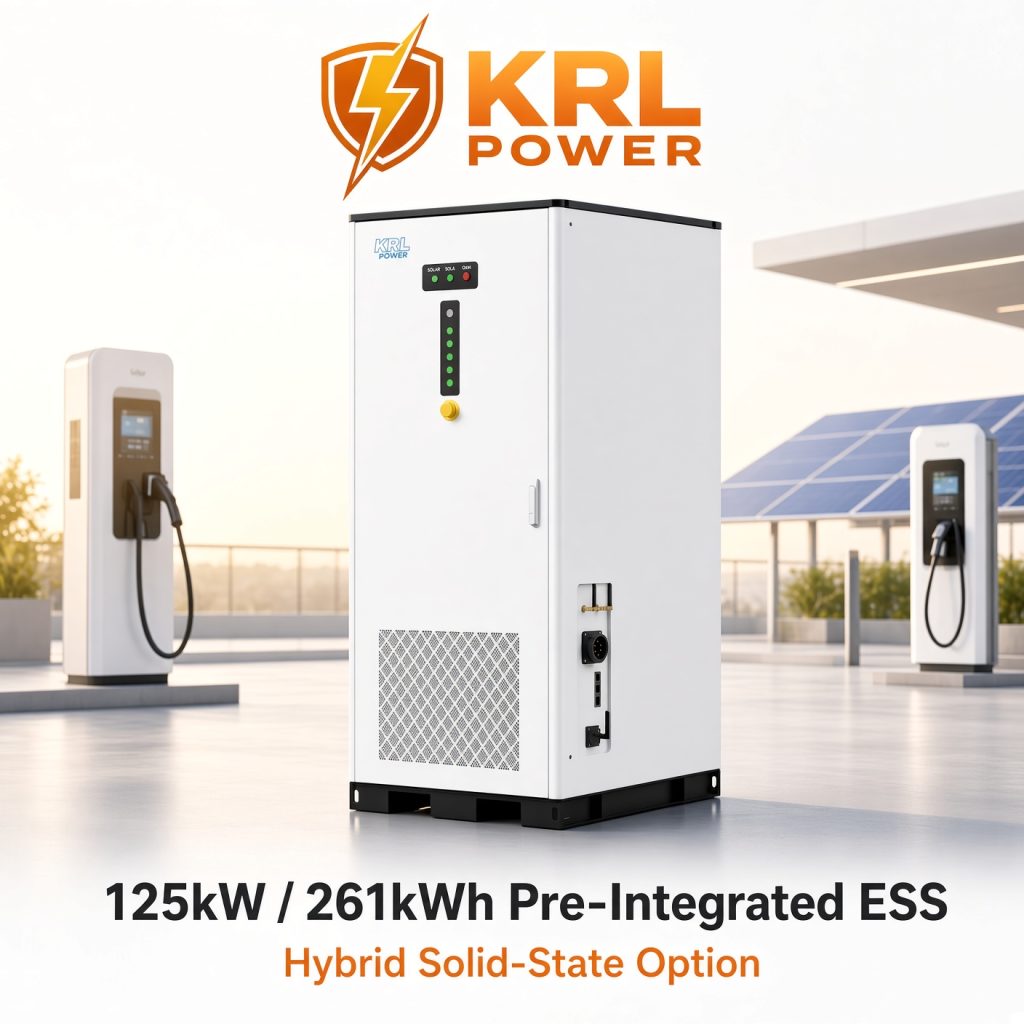
Building a successful commercial EV charging station in Nigeria requires a reliable, safe and cost-effective power system that can support simultaneous high-power charging under unstable grid conditions.
A 125 kW / 261 kWh pre-integrated liquid-cooled ESS, combined with solar PV + optional diesel generator + intelligent EMS, forms a practical starting architecture.
| Item | Key Specification |
|---|---|
| Rated Power | 125 kW AC |
| Rated Energy | 261 kWh |
| Battery Architecture | 832 V nominal (typical 1P260S + 314 Ah cells) |
| Cooling | Liquid cooling |
| System Type | Factory pre-integrated |
| Optional Safety Upgrade | Hybrid solid-state / quasi-solid-state (SHS180-314Ah) |
| Main Functions | Peak shaving, solar self-consumption, backup power, load management |
Grid and Market Reality in Nigeria
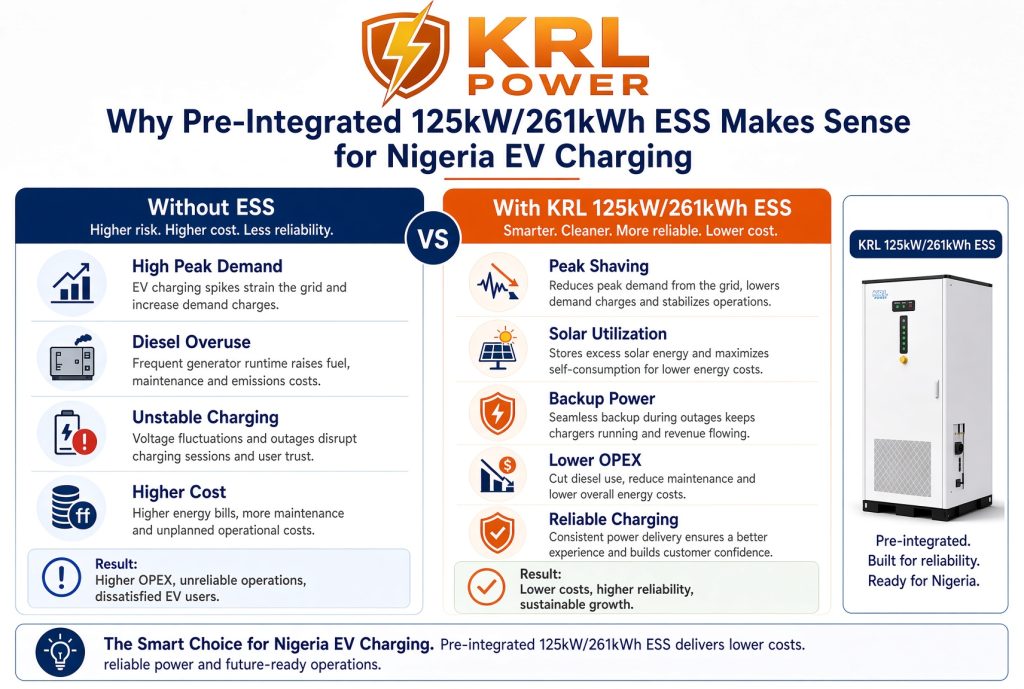
Unstable electricity supply remains common. Simultaneous EV charging creates short-duration high power demand. Grid upgrades are costly and time-consuming. Many sites still rely heavily on diesel generation.
- Chargers cannot operate at full rated power
- Longer customer waiting times
- Higher peak demand charges
- Frequent diesel starts increase fuel and maintenance costs
- Solar generation cannot be fully utilized
A well-designed ESS delivers peak shaving, higher solar self-consumption, backup power during outages, optimized generator operation and real-time multi-charger load balancing.
Understanding 261 kWh Capacity vs 125 kW Power
| Parameter | Value | Meaning |
|---|---|---|
| Rated Energy | 261 kWh | Total energy the battery can store |
| Rated Power | 125 kW | Continuous power the system can deliver |
| Theoretical duration | ≈ 2.61 hours at 100 kW | Ideal calculation only |
| Real usable duration | Shorter | Affected by SOC window, losses, reserve, temperature, auxiliary power |
Always start from the actual charging load curve. Do not size the system based on battery capacity alone. The 125 kW / 261 kWh configuration is part of KRL Power’s C&I energy storage systems designed for these commercial load profiles.
Recommended System Architecture
Grid + Solar PV + Diesel Generator → Intelligent EMS → 125 kW / 261 kWh Pre-integrated ESS → EV Charging Piles.
- High demand → ESS discharges to limit grid peak
- Low demand → ESS charges from grid or solar
- High solar output → Priority to chargers, excess stored in battery
- Grid outage → Automatic transfer to ESS / generator
- Multiple chargers → EMS balances available power in real time
This architecture aligns with the same design principles used in KRL’s 522kWh solar-storage-diesel microgrid cabinets.
Advantages of Factory Pre-Integrated Systems
| Aspect | Multi-supplier Approach | Pre-integrated System |
|---|---|---|
| Communication | Protocol mismatches common | Factory-tested interfaces |
| Thermal management | Difficult to guarantee | Unified liquid-cooling design |
| Commissioning | Multiple parties, longer time | Significantly reduced site work |
| Warranty | Easy to shift responsibility | Single supplier accountability |
| Expansion | Often poorly planned | Designed for modular growth |
These benefits are consistent across KRL’s commercial and industrial ESS solutions.
Why Battery Safety Matters Near Public Areas
Commercial charging stations are often located near residential communities, shopping centers, hotels, mixed-use developments and fleet parking areas. In these environments, battery safety affects property owners, insurance, customer confidence and permitting.
Hybrid Solid-State / Quasi-Solid-State Option
For higher-safety sites, the hybrid solid-state / quasi-solid-state cells (SHS180-314Ah) from KRL’s solid-state battery technology provide an additional safety margin.
- Thermal propagation delay ≈ 1,100 seconds (vs ≈ 759 seconds for conventional cell) → about 40% improvement
- 5 mm nail penetration: no thermal runaway observed
- 1 mΩ external short-circuit: stable operation, maximum temperature ≈ 75.7°C
These results indicate improved safety margin. They do not mean the battery is immune to all thermal events under every condition.
Layered Safety Architecture
Safer cell chemistry alone is not enough. A complete system includes cell monitoring, intelligent BMS, liquid cooling, integrated fire protection, outdoor-rated enclosure and EMS coordinated control.
Safety model = Chemistry + BMS + Thermal management + Fire protection + Electrical protection + EMS
Thermal Management in Nigerian Conditions
High ambient temperature, humidity, dust and repeated high-power charge/discharge cycles are typical challenges. The system is designed for an operating temperature range of –20°C to 55°C (with derating at higher temperatures) and liquid cooling for battery temperature control.
EMS Strategies and Commercial Value
- Peak shaving during high charging demand
- Solar self-consumption priority
- Configurable backup reserve SOC
- Multi-charger load balancing
- Generator optimization (reduce unnecessary starts)
Further engineering examples and project insights can be found in the KRL BESS knowledge center.
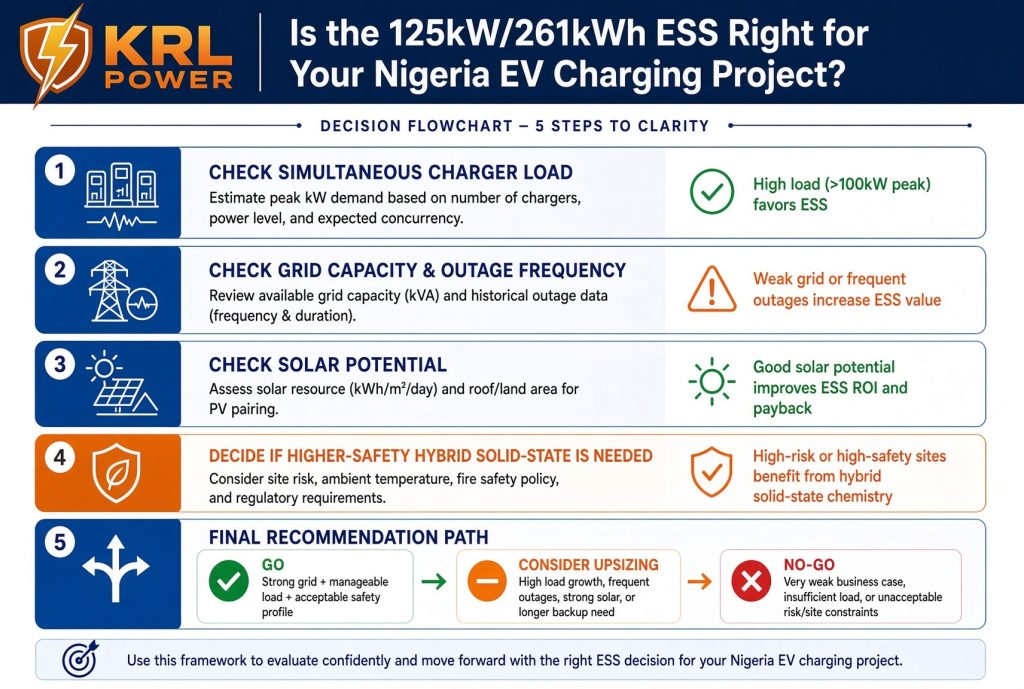
Practical Starting Configuration & Sizing Guidance
| Component | Preliminary Recommendation |
|---|---|
| ESS | 125 kW / 261 kWh liquid-cooled |
| Battery option | Standard LFP or hybrid solid-state (for safety-sensitive sites) |
| Solar PV | 100–200 kWp (site dependent) |
| EV Chargers | Sized by expected simultaneous demand |
| Grid | Existing utility connection |
| Generator | Optional |
| Control | Intelligent multi-source EMS |
| Protection | BMS + PCS + fire system |
| Enclosure | Outdoor-rated, liquid-cooled |
Sizing logic: Charger power → Number of chargers → Simultaneous utilization → Daily energy demand → Grid capacity → Solar capacity → Battery size → PCS size.
Key Procurement Questions
- What is the actual usable battery capacity?
- What is the continuous PCS output power?
- How does the system manage simultaneous high charging demand?
- What happens during a grid outage?
- What is the thermal management method and performance data?
- What battery chemistry is used and what safety test documentation is available?
- Can the system integrate solar and diesel generation?
- Can the system be expanded later?
- Who takes full responsibility for system-level integration?
- What factory testing and site commissioning scope is included?
These questions reflect the engineering approach used by the team at KRL Power.
Final Recommendation & Next Steps
A 125 kW / 261 kWh pre-integrated liquid-cooled ESS provides a practical and scalable foundation for many commercial EV charging projects in Nigeria. For stations near residential or public areas, higher-safety hybrid solid-state cells should be evaluated as part of the overall risk and insurance strategy.
Complete value chain: Reliable power + peak management + solar integration + backup capability + intelligent EMS + layered safety protection.
Provide charger quantity, power ratings, simultaneous utilization, daily energy demand, grid capacity and solar target. The engineering team at KRL Power will return a project-specific architecture.
FAQ
Why is a 125 kW / 261 kWh pre-integrated ESS a practical starting point for commercial EV charging stations in Nigeria?
It supplies continuous 125 kW AC power with 261 kWh of storage in a single factory-tested cabinet, reducing on-site integration risk while supporting peak shaving, solar self-consumption and backup under typical Nigerian grid constraints.
How should usable runtime be calculated from the 261 kWh nameplate rating?
Subtract the effects of the SOC operating window, round-trip losses, auxiliary consumption, temperature derating and the required backup reserve. The resulting delivered AC energy divided by the protected average load gives the realistic runtime.
What microgrid topology does KRL recommend for a commercial EV charging site?
Grid, solar PV and an optional diesel generator feed an intelligent EMS that coordinates a 125 kW / 261 kWh pre-integrated ESS supplying the EV chargers, enabling seamless mode transitions and multi-charger load balancing.
How does factory pre-integration improve project delivery compared with a multi-vendor build?
Communication protocols, thermal design and control logic are validated before shipment, shortening commissioning time, clarifying warranty ownership and allowing modular expansion without redesigning interfaces.
Under what site conditions should the hybrid solid-state cell option be prioritised?
When the station is adjacent to residential buildings, hotels, shopping centres or other public areas where insurance requirements, permitting and public perception place a premium on additional thermal-propagation and mechanical-abuse resistance.
What layers make up the complete safety architecture beyond cell chemistry?
Continuous cell monitoring, intelligent BMS with balancing and fault isolation, liquid cooling for temperature uniformity, integrated fire suppression, outdoor-rated enclosure and EMS-managed reserve and load-shedding logic.
How is thermal performance maintained under Nigerian ambient conditions?
Liquid cooling keeps cell-to-cell temperature difference low across the published –20 °C to 55 °C operating window, with automatic derating at the upper end to protect cycle life during high-temperature, high-duty-cycle operation.
Which EMS functions directly improve the commercial return of an EV charging station?
Peak-demand limiting, preferential use of on-site solar, configurable backup SOC thresholds, real-time allocation of available power among multiple chargers and reduced diesel runtime through intelligent start-stop logic.
What minimum data set is required to receive an accurate project proposal?
Number and power rating of chargers, expected simultaneous utilisation factor, estimated daily energy throughput, available grid capacity and outage statistics, solar resource or target capacity, and any mandatory backup duration.
Which technical questions should be answered in every competitive quotation?
Usable AC energy guarantee, continuous and overload PCS ratings, simultaneous-load management algorithm, outage behaviour and reserve policy, thermal performance data, cell chemistry and test reports, solar and diesel interface details, expansion method, single-party system responsibility and factory-test scope.
Is the 125 kW / 261 kWh platform commonly selected for commercial EV charging projects across Nigeria?
Yes. Its power and energy ratings, outdoor liquid-cooled design and diesel-hybrid capability match the load and grid characteristics of many small-to-medium commercial charging hubs currently being planned in Nigeria.
Which environmental factors unique to Nigerian sites influence ESS specification?
Elevated ambient temperature, high humidity, airborne dust and frequent multi-hour grid outages require liquid cooling, wide temperature tolerance, robust enclosure sealing and seamless diesel-generator integration.
How can a Nigerian project developer obtain a site-specific 125 kW / 261 kWh proposal?
Submit charger configuration, grid data, daily energy demand, solar target and backup requirements via the KRL Power contact channel; the engineering team responds with a tailored single-line architecture and preliminary bill of materials.
What are the nameplate power and energy ratings of the recommended pre-integrated ESS?
125 kW continuous AC output power and 261 kWh rated energy, supplied as a factory-assembled liquid-cooled outdoor cabinet.
Which higher-safety cell chemistry is offered as an optional upgrade?
Hybrid solid-state / quasi-solid-state cells (model series SHS180-314Ah) that demonstrate extended thermal-propagation delay and improved resistance to nail penetration in internal comparative testing.
Which operating modes are natively supported by the recommended microgrid architecture?
Grid-connected peak shaving, solar self-consumption priority, automatic islanded backup, multi-charger power allocation and coordinated diesel-generator support under a single EMS.