
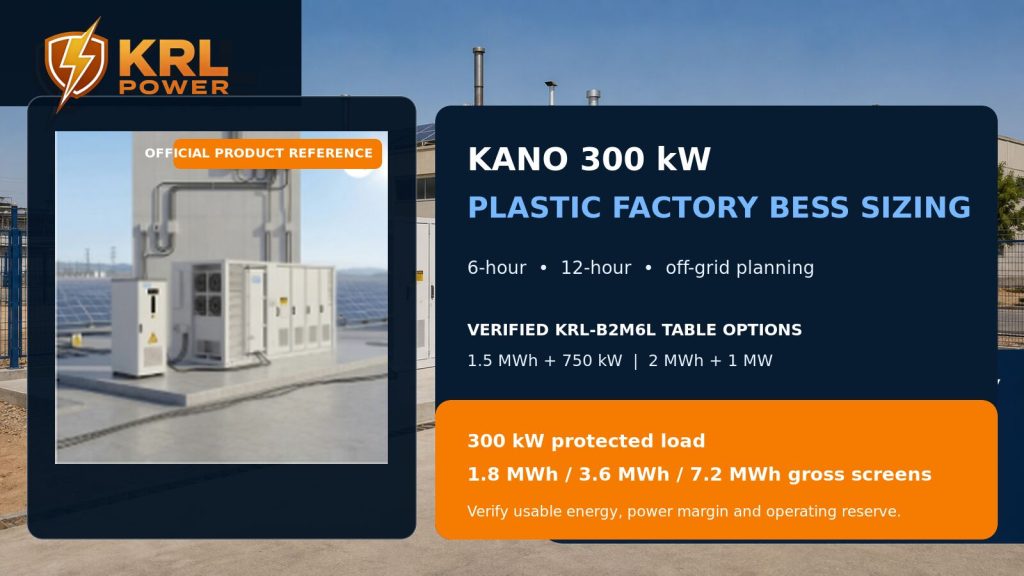
Factory battery storage in Nigeria must protect the production load and the controlled shutdown sequence. A 300 kW plastic plant consumes 1.8 MWh in six hours, 3.6 MWh in twelve hours, ، و 7.2 MWh in twenty-four hours when the protected load remains at 300 kW. The verified KRL-B2M6L container energy storage system has publicly listed 1.5 MWh / 750 kW and 2 MWh / 1 MW configurations.
The result is direct:
- The 1.5 MWh version is excluded from six-hour duty at 300 kW because its ideal nameplate runtime is five hours before losses, auxiliaries and reserve.
- The 2 MWh version is the first published candidate for six hours, but its 200 kWh gross margin cannot support a runtime guarantee without usable AC energy data.
- A twelve-hour target requires 3.6 MWh delivered at the load. A two-unit concept remains a capacity-screening concept until KRL confirms parallel operation.
- A full off-grid target requires 7.2 MWh per day plus system losses and reserve recovery. PV, BESS and diesel generation must close the energy balance for every hour.
KRL provides buyers with a practical starting platform: high PCS power, direct PV inputs, a diesel-generator port, on-grid and off-grid ratings, liquid battery cooling, an IP65 rating for the battery subsystem and a published outdoor operating range. The order decision still depends on measurable runtime, the factory load profile and a signed system architecture.
Convert the 300 kW Requirement Into Delivered AC Energy
Battery power and battery energy answer different procurement questions:
- Power in kW and kVA: can the PCS carry the simultaneous load, motor starts and load steps?
- Delivered energy in kWh: how long can the protected production process continue?
- Reserve energy: can the plant purge material, maintain cooling and start the generator before shutdown?
The nameplate calculation is only the first line:
Load-side energy = protected average load × operating time
The bankable calculation is:
Delivered AC energy = rated battery energy × usable SOC fraction × AC efficiency × retained capacity − auxiliary energy
Runtime = delivered AC energy ÷ protected average load
| Operating target | Load-side requirement at 300 kW | Public KRL capacity reference | Current engineering status |
|---|---|---|---|
| 6-hour backup | 1.8 MWh | One 2 MWh unit | Candidate; usable AC energy guarantee required |
| 12-hour backup | 3.6 MWh | Two-unit nominal-capacity concept | Parallel architecture unverified |
| 24-hour load energy | 7.2 MWh/day | Four-unit nominal-capacity concept | Hourly hybrid simulation required |
No parallel capability, redundancy or control architecture is assumed in the two-unit and four-unit concepts. KRL’s public B2M6L table lists individual configurations and does not publish a multi-container topology.
Measured average load can change the result substantially:
| Average protected load | 6 hours | 12 hours | 24 hours |
|---|---|---|---|
| 150 kW | 0.9 MWh | 1.8 MWh | 3.6 MWh |
| 225 kW | 1.35 MWh | 2.7 MWh | 5.4 MWh |
| 300 kW | 1.8 MWh | 3.6 MWh | 7.2 MWh |
Use one-minute or fifteen-minute meter data to determine the protected average. Record the maximum simultaneous load separately because energy sizing and PCS sizing use different inputs.
Protect the Plastic Process Through Grid Loss and Restart
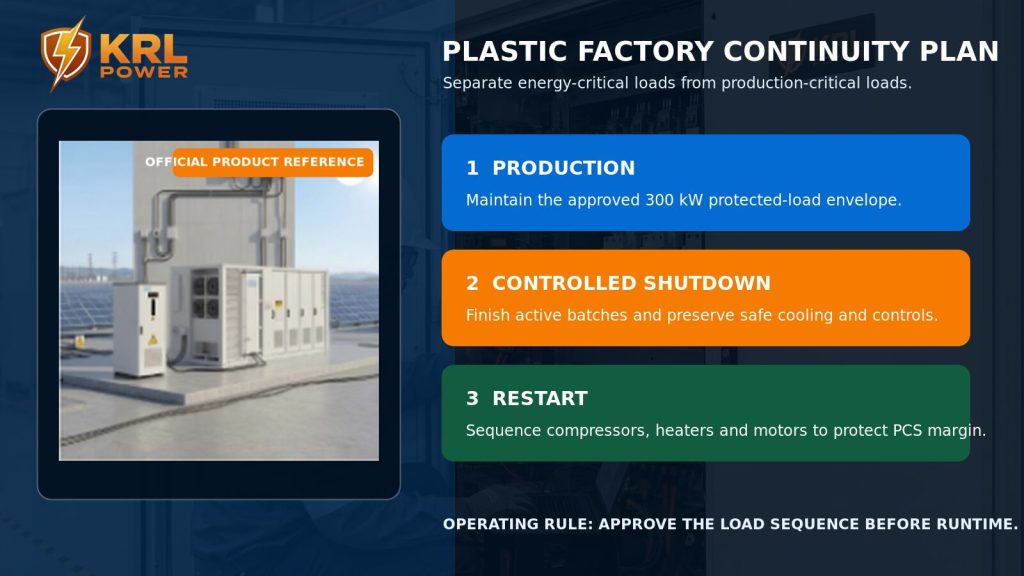
A plastic plant can lose product and production time when power disappears during heating, extrusion, injection or cooling. The load schedule should contain four operating states.
Normal Production
Record the operating kW, kVA, power factor and phase current for:
- Extruders or injection-moulding machines
- Barrel, die and mould heaters
- Hydraulic power units and servo drives
- Chillers, cooling towers and circulation pumps
- Air compressors
- Granulators, conveyors and material-feeding systems
- PLCs, industrial computers, communication equipment and safety systems
Sudden Grid Loss
Measure what happens during the public <10 ms transfer interval:
- PLC power-supply ride-through
- VFD DC-bus ride-through
- Contactors that release during a voltage interruption
- Cooling pumps that must continue without a restart delay
- Safety interlocks that require manual reset
- Maximum load step presented to the PCS
The B2M6L switching figure must be tested against each critical device. Sensitive control circuits may still require a dedicated control UPS.
Controlled Production Shutdown
Reserve energy must cover the plant’s approved shutdown procedure, including any required:
- Material purging or barrel clearing
- Heater control during the purge cycle
- Mould and process cooling
- Ventilation and extraction
- PLC, instrumentation and communication power
- Generator start attempts and stabilization time
The reserve should be expressed in kWh and minutes, with an automatic load-shedding sequence. A percentage SOC value alone does not prove that the shutdown can finish.
Production Restart
Cold or warm restart may create a different peak from normal operation. The study should capture:
- Simultaneous heater recovery
- Compressor and chiller starting
- Hydraulic-pump or extruder-motor acceleration
- Conveyor and material-feeding restart
- Minimum time before saleable production resumes
KRL’s commercial and industrial energy storage systems provide the product-family reference. The selected PCS must be approved using the plant’s operating sequence and measured waveform data.
Verify PCS Current, Motor Starts and Factory-Bus Voltage
KRL publishes 750 kW grid-connected and off-grid rated power for the 1.5 MWh version and 1,000 kW for the 2 MWh version. Both exceed 300 kW on a steady-state power screen.
For a 400 V three-phase system:
I = P ÷ (√3 × V × power factor)
- At PF 1.0, 300 kW is approximately 433 A.
- At PF 0.9, 300 kW is approximately 481 A.
- KRL publishes 1,130 A maximum AC current for the 750 kW version.
- KRL publishes 1,500 A maximum AC current for the 1 MW version.
These values show steady-state current headroom. Approval still requires:
- PCS overload curve and overload duration
- Motor-start current and acceleration time
- Largest simultaneous load step
- Phase imbalance and neutral current
- Harmonic spectrum from VFDs and rectifiers
- Voltage recovery after load application
- Frequency response in off-grid mode
- Transformer energization and auxiliary-start sequence
The product table states 400/230 Vac, L1/L2/L3/N/PE. The EPC must measure the actual factory bus and define:
- Nominal and permitted voltage range
- Required transformer ratio and impedance, when applicable
- Neutral connection and earthing arrangement
- Generator-neutral switching
- Islanded earth-fault detection
- PCS fault-current magnitude and duration
- Breaker and relay selectivity under PCS-limited current
A 1 MW PCS rating does not prove that traditional downstream breakers will clear an islanded fault. The protection study must use the manufacturer’s current-limiting and fault-response data.
Six-Hour Configuration: One 2 MWh Unit Remains a Candidate
The 1.5 MWh / 750 kW version has an ideal runtime of:
1.5 MWh ÷ 300 kW = 5 hours
It cannot meet six hours at 300 kW even before project deductions.
The 2 MWh / 1 MW version has an ideal nameplate runtime of:
2 MWh ÷ 300 kW = 6.67 hours
Its gross 200 kWh margin equals 40 minutes at 300 kW. The technical offer must convert that margin into a delivered-energy guarantee by stating:
- Beginning-of-life usable AC energy
- End-of-warranty usable AC energy
- Minimum and maximum SOC
- Conversion efficiency at the expected load
- Battery, PCS and HVAC auxiliary consumption
- Kano ambient-temperature derating
- Emergency shutdown reserve
- Recharge time from grid, PV and generator
One 2 MWh KRL-B2M6L can be approved for six hours only if KRL guarantees at least 1.8 MWh of delivered AC energy under the agreed load, power factor, ambient conditions and reserve policy.
If the guarantee falls below 1.8 MWh, the buyer can:
- Remove lower-priority loads from the protected bus.
- Start the diesel generator at a higher SOC threshold.
- Review additional capacity after KRL confirms the permitted system architecture.
Twelve-Hour Configuration: Define the Multi-Unit Architecture
Twelve hours at 300 kW requires 3.6 MWh delivered to the load. Two 2 MWh units create a 4 MWh nominal-capacity concept with a 400 kWh gross margin.
The quantity calculation does not establish a working system. KRL must issue:
- Approved single-line diagram
- Number and rating of PCS outputs
- Common AC-bus and transformer arrangement
- EMS master–follower or distributed-control method
- Steady-state and transient power-sharing tolerance
- Grid and generator synchronization sequence
- Communication-loss response
- Protection coordination and fault-current study
- Operation with one unit isolated for maintenance
- Capacity, throughput and warranty measurement across all units
The commercial value of twelve hours comes from avoided production interruption. Compare the incremental CAPEX with:
- Contribution margin protected during the additional six hours
- Scrap avoided during controlled production continuity
- Diesel fuel and maintenance avoided
- Labour and restart hours avoided
- Delivery penalties or order delays avoided
KRL’s C&I energy storage engineering capabilities describe integrated controls, liquid cooling and modular system concepts. The project contract must identify the exact functions included in the quoted multi-unit design.
Full Off-Grid Configuration: Close the Hourly Energy Balance
A continuous 300 kW load uses 7.2 MWh each day. An 8 MWh nameplate concept cannot create energy; the system must replenish the battery while production continues.
The daily calculation is:
Required daily generation = factory load energy + BESS losses + auxiliaries + reserve recovery
Required PV energy = required daily generation − diesel-generated energy
The model needs synchronized hourly data for:
- Factory kW and kVA by operating state
- Kano solar resource and seasonal variation
- PV temperature, dust, availability, clipping and curtailment
- BESS SOC, efficiency, power limits, auxiliaries and aging
- Generator fuel curve, minimum loading, start time and ramp rate
KRL publishes 960 kW maximum PV power, eight MPPT channels, a 250–850 Vdc MPPT range and 950 Vdc maximum PV voltage for the 2 MWh version. The final design must confirm:
- Whether those PV limits apply independently to each supplied unit
- Approved string voltage and current at Kano temperatures
- PV power available to the load while the battery charges
- Maximum combined charging power from PV, grid and generator
- External AC-coupled PV compatibility
- PV curtailment at high SOC
- Low-sun and generator-outage reserve
The public diesel-generator port confirms interface intent. It does not confirm synchronizing, reverse-power protection, generator droop, dispatch logic or simultaneous charging capability.
A practical control sequence should define:
- PV supplies the active factory load.
- Surplus PV charges the battery within approved limits.
- BESS responds to rapid load and solar changes.
- The generator starts at a defined SOC, forecast or production-risk threshold.
- The generator supplies firm energy and approved battery-charging power.
- PV is curtailed when generation exceeds load plus permitted charging power.
- Load shedding protects the controlled-shutdown reserve.
KRL’s Nigeria diesel-hybrid energy storage solution and Nigeria industrial energy storage planning provide related architecture references. The signed proposal must contain the Kano project’s own simulation and control sequence.
Verified KRL-B2M6L Public Parameters
| Parameter | 1.5 MWh + 750 kW | 2 MWh + 1 MW |
|---|---|---|
| Model | KRL-B1M5L-750H3S-720M6-HX1 | KRL-B2ML-1MH3S-960M8-HX1 |
| Battery chemistry | LiFePO4 | LiFePO4 |
| Nominal battery voltage | 832 V | 832 V |
| Rated capacity | 1,884 Ah | 2,512 Ah |
| Maximum PV power | 720 kW | 960 kW |
| Maximum PV voltage | 950 Vdc | 950 Vdc |
| MPPT operating range | 250–850 Vdc | 250–850 Vdc |
| Maximum PV input current | 200 A × 6 | 200 A × 8 |
| MPPT channels | 6 | 8 |
| Grid-connected rated power | 750 kW | 1,000 kW |
| Off-grid rated power | 750 kW | 1,000 kW |
| AC voltage | 400/230 Vac, L1/L2/L3/N/PE | 400/230 Vac, L1/L2/L3/N/PE |
| Rated frequency | 50/60 Hz | 50/60 Hz |
| Maximum AC current | 1,130 A | 1,500 A |
| Switching time | <10 ms | <10 ms |
| Diesel-generator port | Yes | Yes |
| Communication | RS485 / WiFi | RS485 / WiFi |
| Battery protection rating | IP65 | IP65 |
| Fire-protection system | Yes | Yes |
| Battery cooling | Liquid cooling | Liquid cooling |
| PCS cooling | Intelligent cooling | Intelligent cooling |
| Operating temperature | -10°C to 55°C | -10°C to 55°C |
| Humidity | 5% to 95% RH | 5% to 95% RH |
| Altitude | <2,000 m | <2,000 m |
| Dimensions | 6,058 × 2,438 × 2,896 mm | 6,058 × 2,438 × 2,896 mm |
| Approximate weight | 15,000 kg | 19,500 kg |
The product title references a wider range, while the public table lists only these two configurations. The quotation should use one of the exact table models and identify every approved project option.
Convert KRL Capabilities Into Contract Evidence
The buyer’s stated decision factors are warranty, cycle life, cell brand and total system CAPEX. Each factor needs a measurable document.
Product and Control Evidence
Use KRL’s BMS and PCS integration capability to define:
- Signal and protocol list
- Operating modes and transitions
- Alarm severity and response
- Communications-loss fallback
- Remote access and data ownership
- Software and firmware change control
Cell and Supply Evidence
KRL provides OEM and ODM battery engineering and describes battery supply-chain management. The contract should lock:
- Cell manufacturer and model
- Cell production batch traceability
- Module, rack, PCS and BMS models
- Approved-substitute procedure
- Final bill of materials
Test and Certification Evidence
KRL’s battery testing and certification capability describes capacity, resistance, cycling, high-rate, short-circuit, environmental, ingress-protection and transport testing.
Where applicable, request evidence against the latest project-specified editions:
| Evidence reference | Procurement purpose |
|---|---|
| IEC 62619:2022 | Industrial lithium cell and battery safety |
| IEC 62933-5-2:2025 | Electrochemical energy storage system safety |
| IEC 62477-1:2022 | Power electronic converter safety |
| IEC TS 62933-3-3:2022 | Backup and energy-intensive application planning |
| IEC TS 62933-2-2:2022 | Application duty-cycle and performance testing |
The RFQ should request the certificate holder, model, report number, issuing body, edition, scope and matching bill of materials. No compliance claim should be accepted without model-specific evidence.
Warranty Evidence
The signed warranty schedule should define:
- Warranty start date
- Calendar years and warranted throughput
- Allowed daily cycles and depth of discharge
- Beginning-of-life and end-of-warranty usable AC energy
- Capacity-test conditions and meter boundary
- Temperature, C-rate and maintenance limits
- Cell, module, rack, PCS and HVAC coverage
- Labour, travel, freight and customs responsibility
- Response, diagnosis and remedy times
- Claim records and exclusions
- Spare-parts availability
Compare CAPEX With Diesel and Production Losses
Use a common cost boundary for all three options:
| Cost boundary | Include |
|---|---|
| BESS | Battery, PCS, BMS, EMS, HVAC, fire system and auxiliaries |
| Electrical balance | Switchgear, transformer, protection, metering, cabling and earthing |
| PV | Modules, structures, DC equipment, installation and cleaning access |
| Generator integration | Controls, synchronizing, protection and fuel interface |
| Site work | Foundation, drainage, fencing, fire separation and access |
| Delivery | Transport to Kano, lifting, insurance, taxes and duties |
| Services | Studies, FAT, SAT, commissioning and training |
| Lifecycle | Maintenance, spares, software support and capacity testing |
Use customer records for the commercial model:
Annual avoided outage loss = avoided production-stop hours × contribution margin per hour
Annual diesel saving = baseline diesel cost − hybrid-system diesel cost
Incremental payback = additional CAPEX ÷ annual additional benefit
Required inputs include:
- Generator fuel consumption at several load levels
- Delivered diesel price in Kano
- Grid-outage hours by month
- Production contribution margin per hour
- Scrap and restart cost
- Generator maintenance and overhaul cost
- Monthly PV yield
- Battery replacement and service assumptions
KRL’s factory energy storage ROI calculation can support the model. Final values should come from fuel invoices, meter exports and production records.
Select the Configuration by Production Risk
| Option | Engineering position | Commercial fit | Purchase condition |
|---|---|---|---|
| 1.5 MWh / 750 kW | Excluded for six hours at 300 kW | Shorter backup or reduced protected load | Recalculate using measured average load |
| One 2 MWh / 1 MW unit | First six-hour candidate | Defined outage bridge with diesel support | Guarantee ≥1.8 MWh delivered AC energy |
| Two-unit concept | Twelve-hour nominal screen | Long outage crossing production shifts | KRL-approved parallel architecture |
| Full off-grid hybrid | 7.2 MWh/day load basis | Site requiring continuous production without dependable grid energy | Hourly PV–BESS–diesel simulation |
The six-hour option limits initial storage quantity but carries the tightest energy margin. The twelve-hour option can protect an additional production shift and requires a verified multi-unit design. Full off-grid operation adds PV generation, firm diesel energy, advanced controls, protection and a larger maintenance scope.
KRL is a strong candidate for the Kano project because the verified B2M6L platform combines a high-power PCS, multi-MWh LiFePO4 storage, direct PV inputs, a diesel-generator port, on-grid and off-grid ratings, liquid cooling and an outdoor operating range. KRL must convert those public capabilities into a model-specific quotation with guaranteed energy, approved controls, test evidence and a clear commercial boundary.
الأسئلة الشائعة
Can the 1.5 MWh KRL-B2M6L configuration support a 300 kW plastic factory for six hours?
No. The ideal nameplate quotient is five hours at 300 kW, before conversion losses, auxiliaries, reserve and temperature effects. The 1.5 MWh configuration can support a shorter operating window or a reduced protected load after engineering review.
Can one 2 MWh KRL-B2M6L run a 300 kW load for six hours?
It is the first published candidate because six hours requires 1.8 MWh at the load. Approval requires a signed guarantee of at least 1.8 MWh delivered AC energy under the agreed SOC window, losses, auxiliaries, ambient conditions and shutdown reserve.
How much delivered energy does a 300 kW factory need for twelve hours?
The load requires 3.6 MWh before project losses and reserve. Two 2 MWh units create a nominal-capacity screen, but KRL must approve the parallel topology, power sharing, protection, controls, maintenance state and warranty measurement.
How much daily load energy is required for continuous 300 kW off-grid operation?
A constant 300 kW load consumes 7.2 MWh in twenty-four hours. The generation plan must also cover BESS losses, auxiliaries and reserve recovery through an hourly PV, battery and diesel simulation.
Do the published 750 kW and 1 MW PCS ratings provide enough power for the factory?
Both ratings exceed 300 kW on a steady-state screen. Final approval still requires the measured kVA, power factor, motor-start current, phase imbalance, harmonics, transformer inrush and PCS overload curve.
Does the published transfer time below 10 ms make the B2M6L a UPS?
The table publishes a switching time below 10 ms. Each PLC, VFD, contactor and control power supply must pass a ride-through test, and sensitive control circuits may still require a dedicated control UPS.
What factory-bus voltage does the public B2M6L table list?
The public table lists 400/230 Vac with L1, L2, L3, neutral and protective earth. The EPC must verify the actual plant voltage, earthing, neutral switching, transformer requirements and protection coordination.
What PV input limits are published for the two B2M6L configurations?
The 1.5 MWh configuration lists 720 kW maximum PV power, six MPPT channels and 200 A per channel. The 2 MWh configuration lists 960 kW, eight MPPT channels and 200 A per channel. Both list 950 Vdc maximum PV voltage and a 250–850 Vdc MPPT range.
Can the B2M6L operate with an existing diesel generator?
The public table lists a diesel-generator port. The project must still define synchronization, generator controls, reverse-power protection, charging limits, dispatch thresholds, transition logic and communications.
Is the complete B2M6L installation IP65?
The public table states IP65 for the battery. The quotation must identify the ratings of the PCS, auxiliary panels, connectors and completed field interfaces and must also define drainage, access and fire separation.
Does KRL publish the model-specific warranty, cycle life and cell brand on the B2M6L page?
Those model-specific commercial terms are not stated in the public parameter table. The signed quotation should identify the cell manufacturer and model, usable-energy obligation, throughput or cycle terms, test method, exclusions and remedy.
Which factory data should be used before the BESS configuration is approved?
Use interval kW and kVA, power factor, per-phase current, major motor-start recordings, the controlled-shutdown sequence, restart sequence, outage history, diesel records, ambient conditions and the required reserve.
Why is the KRL-B2M6L a practical candidate for this plastic-factory requirement?
Its public table combines multi-MWh LiFePO4 storage, 750 kW or 1 MW on-grid and off-grid power, direct PV inputs, a diesel-generator port, liquid battery cooling, battery IP65 and an outdoor operating range. The purchase decision still requires project-specific guarantees.
Which KRL configuration is the first candidate for six-hour factory battery storage in Nigeria at 300 kW?
The published 2 MWh and 1 MW KRL-B2M6L configuration is the first capacity candidate. It becomes an approved six-hour solution only after KRL guarantees at least 1.8 MWh of delivered AC energy under the agreed project conditions.
How should Kano conditions affect a plastic-factory BESS design?
Keep the equipment inside the published -10°C to 55°C operating range and verify temperature derating, dust management, drainage, solar soiling, ventilation, clearances and maintenance access for the actual site.
Where can a Nigerian plastic factory request a verified KRL-B2M6L proposal?
Use the KRL Power contact page and identify the 300 kW protected-load schedule, six-hour or twelve-hour target, factory bus, motor starts, shutdown reserve, generator, PV scope and site conditions so the quotation can define a model-specific system boundary.