
A Nigerian mining site needs continuous power for air conditioning, water pumps, lighting and kitchen equipment during weak-grid and off-grid periods. KRL Power's KRL-B522L 250 kW/522 kWh liquid-cooled energy storage cabinet is a direct product candidate for this duty because one cabinet combines a 522 kWh LFP battery, 250 kW PCS, 240 kW dual-channel MPPT, diesel-generator interface and intelligent EMS.
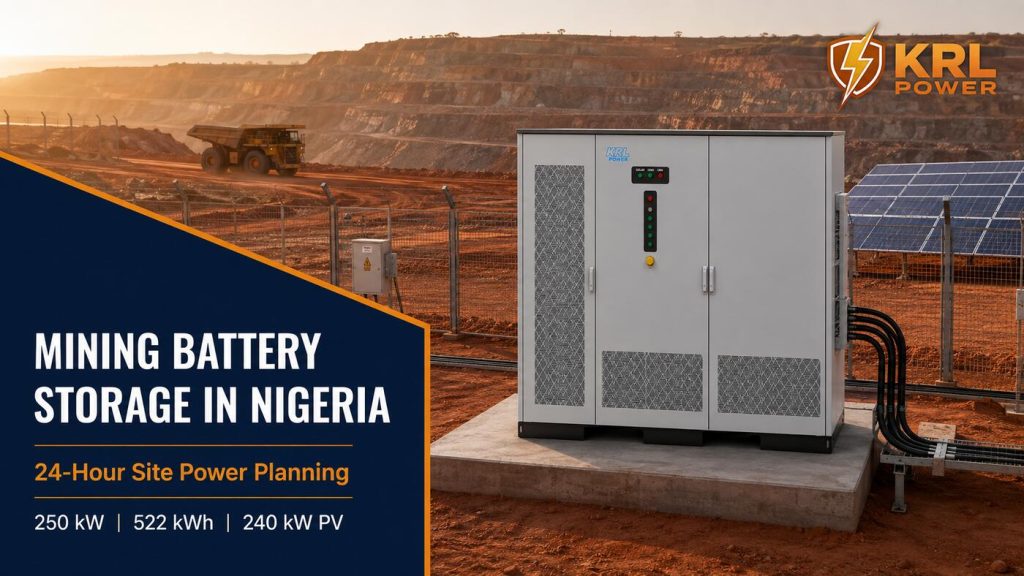
The sizing result is direct: one B522L can be selected only when the mine's simultaneous load, motor-starting demand and off-grid energy requirement remain inside the verified system limits. If any limit is exceeded, KRL Power can scale the design with an approved multi-cabinet configuration or select another C&I platform that matches the measured load.
The purchase screen is equally direct:
- Power: Total running load must remain within the validated PCS limit.
- Starting current: The largest pump or compressor start must remain inside the PCS transient envelope.
- Energy: Usable battery energy must cover the selected load tiers through the required off-grid period while protecting reserve SOC.
- Recharge: PV and the diesel generator must restore SOC without exceeding the published PV, charging and electrical-interface limits.
Once these limits are verified, KRL Power can fix the cabinet quantity, PV allocation, generator operating sequence and load-shedding priorities in one equipment schedule. The resulting mining battery storage system for Nigeria uses a solar-storage-diesel architecture to preserve essential loads, reduce generator runtime and shed discretionary loads in a controlled sequence.
Why Choose KRL Power for This Mining Requirement
The KRL-B522L gives the mine five practical procurement advantages:
- Integrated system responsibility: The battery, PCS, PV interface, generator interface and EMS are defined around one KRL model, reducing the number of cross-supplier control interfaces that the EPC must coordinate.
- Full rated power in both operating modes: The published table lists 250 kW on-grid and 250 kW off-grid, so the first power screen uses the same rated value for either operating state.
- Built-in renewable and generator interfaces: The 240 kW PV input, two MPPT channels and diesel-generator port support a solar-storage-diesel microgrid without treating the battery as an isolated backup device.
- Industrial thermal and safety design: The published configuration combines LFP cells, liquid battery cooling, intelligent PCS cooling and a fire-protection system. The IP65 rating applies specifically to the battery enclosure.
- Defined monitoring and expansion review: RS485 and WiFi are listed for communications, while the published "Parallel Number: 6" entry gives the project team a clear expansion item to confirm in the quotation.
These features make the KRL-B522L a strong engineering and commercial starting point. Final cabinet quantity still follows the mine's measured kW, motor-start data, off-grid kWh and recharge model.
The Purchase Decision in One Table
| Decision | What the stated mining requirement means | Purchase condition |
|---|---|---|
| Continuous power | Pumps, HVAC, lighting and kitchen loads can overlap | Total simultaneous kW must remain within the operating PCS limit |
| Motor starting | Water pumps and HVAC compressors create short-duration current demand | The starting method and measured inrush current must remain within the PCS’s validated transient capability |
| 24-hour energy | Daily kWh determines storage quantity | Battery count follows the usable-energy calculation, including reserve and losses |
| Solar charging | PV must serve daytime loads and restore battery SOC | PV yield must be calculated from site irradiation, array design and the 240 kW cabinet input limit |
| Backup source | Cloudy periods and prolonged operation still need an energy source | Generator dispatch must be defined by SOC, load and available PV |
| Outdoor deployment | Heat, dust, rain, humidity and site access affect reliability | Civil works, clearances, drainage and hazardous-area boundaries must be resolved |
KRL's commercial and industrial energy storage range also allows the project to move to a smaller or larger verified platform when the measured load falls outside the B522L operating envelope.
Convert the Stated Loads into an Operating Model
The customer has identified four load groups. Each group creates a different sizing risk, so combining them into one estimated kW value would hide the information needed for a reliable quotation.
| Load group | Power characteristic | Data that controls sizing | Recommended operating treatment |
|---|---|---|---|
| Water pumps | Motor load with starting current and possible pressure-driven cycling | Motor nameplate, quantity, running kW, starter type, start sequence and duty cycle | Use VFD control where the process permits; prevent simultaneous starts |
| Air conditioning | Compressor and fan load that rises with ambient temperature | Input kW, compressor technology, quantity, thermostat schedule and hottest-hour demand | Divide essential rooms from comfort cooling; stagger compressor starts |
| Lighting | Predictable, mostly continuous auxiliary load | Fixture wattage, quantity and operating schedule | Place safety and security lighting in the highest-priority tier |
| Kitchen equipment | Intermittent resistive and motor loads with meal-time peaks | Appliance kW, diversity and meal schedule | Block non-essential high-power appliances during low SOC |
The load model should produce three outputs:
- Peak running power: the highest credible combination of equipment already operating.
- Starting power condition: the largest motor start plus the background load present at that moment.
- Daily energy: the sum of each load’s input power multiplied by its operating hours.
The third output determines whether the site can operate through the night and during low-solar periods. The first two determine whether the PCS remains online when equipment switches on.
Size Power and Energy as Separate Constraints
Power and energy answer different questions.
- Power in kW determines how much equipment can run at one time.
- Energy in kWh determines how long the selected equipment can run.
- Starting current determines whether motors can accelerate without forcing a protection trip.
- Reactive power and power factor affect PCS current even when the real-power total appears acceptable.
For a KRL-B522L-based design, the preliminary cabinet count is the larger result from the power and energy checks:
Power check
Npower = ceiling(required simultaneous kW / approved kW per cabinet)
Energy check
Nenergy = ceiling(required off-grid kWh / verified usable kWh per cabinet)
Selected quantity
N = max(Npower, Nenergy)
The published 522 kWh value is rated energy. Usable energy for a project must reflect the agreed SOC window, conversion losses, auxiliary consumption, temperature conditions, ageing allowance and emergency reserve. Those factors belong in the signed performance schedule.
At the full published 250 kW rating, the nameplate energy-to-power ratio is approximately 2.09 hours before those project factors are applied. A 24-hour requirement therefore depends on the real average load, solar contribution, generator schedule and cabinet quantity.
The public product table lists "Parallel Number: 6." The project quotation must confirm that this value represents the maximum approved parallel quantity and that every cabinet may deliver its full rated power simultaneously. The following figures are arithmetic totals of rated cabinet values; they are planning references and do not replace a project performance guarantee.
| Cabinet quantity | Combined rated AC power | Combined rated energy |
|---|---|---|
| 1 | 250 kW | 522 kWh |
| 2 | 500 kW | 1,044 kWh |
| 3 | 750 kW | 1,566 kWh |
| 4 | 1,000 kW | 2,088 kWh |
| 5 | 1,250 kW | 2,610 kWh |
| 6 | 1,500 kW | 3,132 kWh |
Each multi-cabinet design still needs an approved AC bus, protection study, communications architecture, auxiliary-power plan and site-level EMS sequence.
Control Pump and Compressor Starting Current
Water pumping creates one of the most immediate trip risks among the stated loads. A motor can require substantially more current while accelerating than it draws after reaching normal speed.
The electrical design should apply four controls:
- Record each motor’s starting method: direct-on-line, star-delta, soft starter or VFD.
- Start the largest pump while other discretionary loads are blocked.
- Use a VFD when the pump and process permit controlled acceleration.
- Test the final start sequence with the BESS operating off-grid and at the lowest allowed SOC.
The acceptance test should capture the complete start and retain time-synchronized records for:
- AC voltage and frequency.
- Current on each phase.
- DC bus voltage.
- PCS current-limit status.
- Motor acceleration time.
- BMS and PCS alarms or protection events.
A successful motor start requires stable acceleration and continued supply to the mine's critical loads.
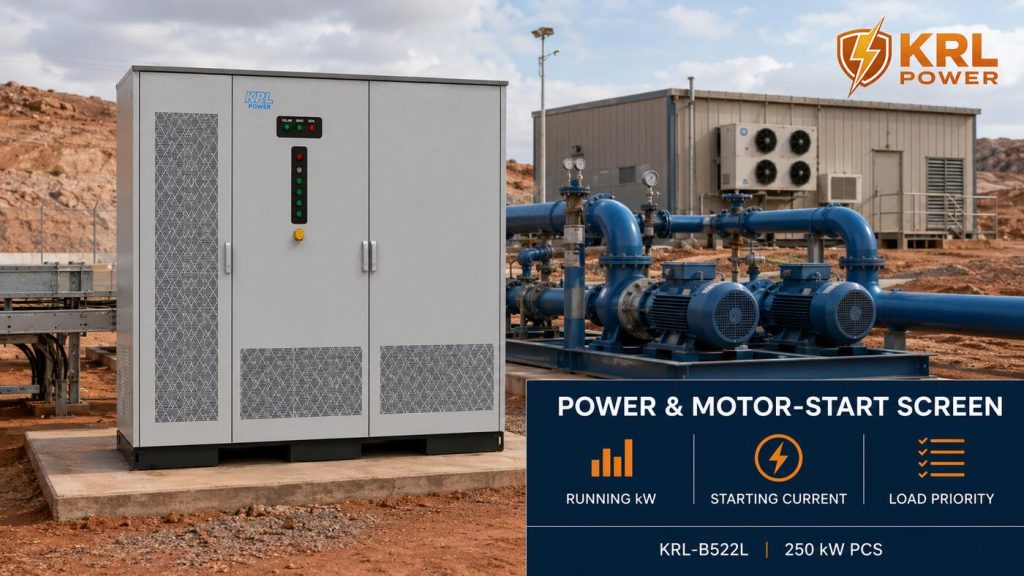
For broader project integration, KRL's commercial and industrial microgrid solutions page covers system applications, while the BMS and protection engineering page explains the battery-control layer.
Build a 24-Hour Energy Budget
The daily calculation should preserve the operating schedule of each load:
Daily load energy = Σ(load input kW × operating hours × quantity)
Then separate the result by time period:
| Energy period | Required calculation | Why it matters |
|---|---|---|
| Solar hours | Load energy served directly by PV plus available battery charging energy | Shows whether PV can recharge the battery while the site is operating |
| Evening peak | Kitchen, lighting, pumping and cooling overlap | Often creates the largest non-production auxiliary demand |
| Overnight | Critical lighting, essential cooling, communications and scheduled pumping | Determines the minimum stored-energy requirement |
| Low-solar reserve | Energy retained for cloud cover, maintenance or delayed generator start | Prevents routine operation from consuming the emergency reserve |
This structure also supports load shedding. When SOC crosses a defined threshold, the EMS can release capacity in a controlled sequence:
- Block discretionary kitchen appliances.
- Adjust non-critical comfort cooling.
- Delay flexible pumping within the water-storage limit.
- Preserve safety lighting, communications and essential process auxiliaries.
The thresholds, restart rules and operator override must be recorded in the control narrative.
Use Solar Energy Within the Verified Input Boundary
The KRL-B522L public product table lists a maximum PV power of 240 kW, two MPPT channels, a 950 Vdc maximum PV voltage and a 250–850 Vdc MPPT range. The array design must also remain within the published 200 A + 200 A input-current boundary.
Daily PV energy should be calculated with site-specific data:
Daily PV energy (kWh) = installed PV capacity (kWp) × peak sun hours (h/day) × verified performance ratio
The verified performance ratio should cover:
- Module-temperature losses.
- Soiling and mismatch.
- DC and AC wiring losses.
- Conversion losses.
- Scheduled downtime and curtailment.
Nigeria-wide solar averages are too broad for a mining procurement decision. The project calculation should use the site coordinates and an agreed meteorological dataset.
The EMS operating sequence should follow the project objective:
- PV first supplies active daytime loads.
- Remaining PV power charges the battery within the SOC and charging limits.
- The generator starts when the forecast energy balance cannot protect the reserve SOC.
- Flexible loads run during the strongest solar window when the process allows.
- PV power is curtailed when the battery cannot accept more energy and the loads cannot consume it.
KRL's KRL-B522L application articles provide additional system context. The mining design should retain its own load hierarchy and site-specific energy budget.
Verified KRL-B522L Reference Configuration
The following values come from the current KRL-B522L product page, checked on 14 August 2026.
| Item | Published value |
|---|---|
| Model | KRL-B522L-250H3S-240M2-HX1 |
| Battery type | LiFePO4 |
| Rated energy | 522 kWh |
| Nominal voltage / capacity | 832 V / 628 Ah |
| PV input | 240 kW maximum |
| MPPT | 2 channels; 250–850 Vdc |
| Maximum PV voltage | 950 Vdc |
| On-grid / off-grid rated power | 250 kW / 250 kW |
| AC interface | 400/230 Vac, L1/L2/L3/N/PE, 50/60 Hz |
| Maximum AC current | 375 A |
| Transfer time | <10 ms |
| Parallel number | 6 |
| Generator interface | Yes |
| Communication | RS485 / WiFi |
| Battery enclosure | IP65 |
| Fire protection | Yes |
| Operating environment | -10°C to 55°C; 5% to 95% RH; altitude below 2,000 m |
| Cooling | Liquid-cooled battery; intelligent PCS cooling |
| Size / approximate weight | 2,480 × 1,400 × 2,050 mm / about 4,900 kg |
Review the source specification on the KRL-B522L 250 kW/522 kWh product page. A smaller load block can also be compared with the verified KRL-B261L 125 kW/261 kWh cabinet.
Resolve the 400 V and Nigerian Site Interface
The B522L product table specifies 400/230 Vac. A Nigerian mine may operate equipment on a 400 V or 415 V three-phase bus, and older equipment may introduce additional voltage requirements.
The final single-line diagram should confirm:
- Site nominal voltage and allowable steady-state range.
- Earthing arrangement and neutral requirements.
- Transformer ratio, vector group, impedance and inrush control when a transformer is required.
- Breaker ratings, selectivity and fault-current contribution in grid-connected and islanded operation.
- Generator voltage, frequency, governor mode and synchronization method.
- Phase loading for single-phase kitchen, lighting and HVAC circuits.
- Maximum permitted negative-sequence current and phase imbalance in islanded operation.
The public specification does not establish project-specific 415 V compatibility. The approved drawing and equipment schedule should resolve that interface before manufacture.
The same design review must define the black-start sequence. The public B522L table does not state a project-level black-start guarantee, so the final control narrative should confirm whether the selected configuration can energize the site from a de-energized condition.
A controlled sequence normally includes:
- Establish battery, controls and protected auxiliary power.
- Form and stabilize the AC bus under the approved PCS mode.
- Pre-magnetize or soft-energize any transformer within the validated inrush limit.
- Energize critical lighting, communications and control feeders.
- Start pumps and HVAC equipment one at a time under the approved priority schedule.
- Connect discretionary loads after voltage, frequency and reserve SOC are stable.
Define the Diesel-Hybrid Operating Sequence
The published B522L specification includes a diesel-generator port. A complete mine-site sequence still requires an agreed controller interface and dispatch logic.
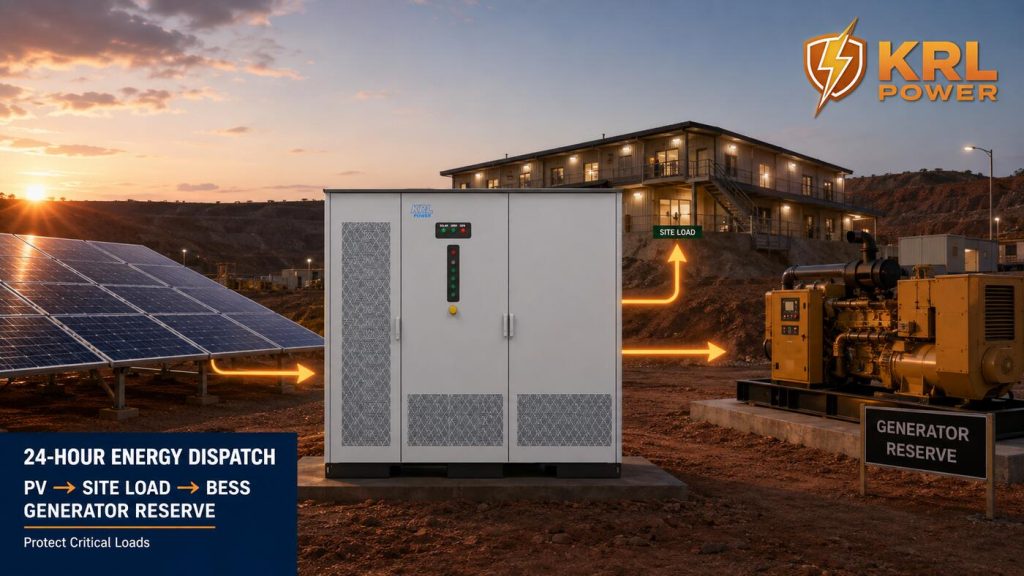
| Operating condition | Required control action |
|---|---|
| Strong PV and normal SOC | PV serves loads and charges the battery |
| Low PV and adequate SOC | Battery carries the selected load tiers |
| SOC approaches reserve | EMS starts the generator and confirms stable voltage and frequency |
| Generator online | The generator operates within its efficient load band while the BESS absorbs rapid load changes and recharges under the approved limit |
| Large motor start | BESS supports the transient within its validated current envelope |
| Sudden load removal | EMS increases battery charging within the approved limit, curtails PV output, or reduces generator power to stabilize the islanded bus |
| Generator fault | BESS preserves critical loads and sheds discretionary tiers according to the control narrative |
The generator fuel curve should drive dispatch settings. Fuel savings can then be calculated from measured baseline litres and the simulated hybrid schedule:
Annual fuel saving = baseline litres − projected hybrid litres
Annual fuel-cost saving = annual fuel saving × delivered diesel cost per litre
This method produces a traceable commercial model. It avoids generic savings percentages that may fail at a specific mine.
Design the Outdoor Installation for Mine Conditions
The public IP65 rating applies to the battery enclosure. The quotation must separately confirm the environmental rating of the PCS, cable-entry areas and complete assembled system. Outdoor reliability also depends on civil, electrical and operational controls.
Include the following items in the site design:
- A level foundation rated for the cabinet’s approximate 4,900 kg mass plus project safety factors.
- Drainage that prevents standing water around cable entries and service areas.
- Required service clearances and a protected maintenance route.
- Solar shading or layout measures that keep the equipment inside its published temperature range.
- Dust management around the PCS cooling path and scheduled inspection intervals.
- Lightning protection, surge protection and site earthing.
- Physical barriers against vehicles and mobile mining equipment.
- Communications backhaul for remote alarms and service access.
IP65 does not certify equipment for a classified explosive atmosphere. Where combustible gas or dust can be present, the site design should:
- Confirm the hazardous-area classification and boundary.
- Place the BESS outside the classified zone when the layout permits.
- Use appropriately certified equipment inside any classified area.
- Match every certificate to the final location, installation method and application.
KRL’s explosion-proof battery engineering page describes the separate battery category.
Make the Quotation Decision-Ready
A useful mining BESS quotation should let engineering, procurement and operations review the same boundaries.
The commercial schedule should identify:
- Exact BESS model and cabinet quantity.
- Rated and guaranteed usable energy at the agreed conditions.
- Continuous power, transient limit and duration.
- PV input power, voltage, current and MPPT channel allocation.
- Generator communication and synchronization scope.
- Transformer, switchgear, protection and metering ownership.
- EMS operating modes, load-shedding logic and remote-access boundary.
- Fire protection, detection and emergency-stop interfaces.
- Factory acceptance tests and site acceptance tests.
- Warranty throughput, operating limits, exclusions and response process.
- Spare parts, commissioning, training and remote-support scope.
- Shipping, foundation, cabling and installation exclusions.
KRL’s testing and certification process can support the evidence schedule, while BESS supply-chain and delivery planning helps define the export and site-handover boundary.
Recommended Configuration Path
For the stated Nigerian mining requirement, the KRL-B522L is a credible reference platform because it combines battery energy, 250 kW AC power in on-grid and off-grid modes, 240 kW PV input, generator connectivity, liquid cooling and outdoor battery-enclosure protection in one published configuration.
The selection path is straightforward:
- Calculate the critical and discretionary load tiers from the four stated load groups.
- Validate the largest pump and HVAC start against the PCS transient capability.
- Calculate overnight and low-solar energy with the reserve SOC protected.
- Select the cabinet quantity from the larger power or energy result.
- Confirm the meaning and engineering limits of the published "Parallel Number: 6" entry.
- Verify the 400/230 Vac interface against the mine bus.
- Simulate PV, battery and generator dispatch across representative days.
- Put every guaranteed value and responsibility into the quotation schedule.
This path gives the customer a product-based answer while preserving the engineering checks that decide whether the system will run for 24 hours.
الأسئلة الشائعة
Can one KRL-B522L run the stated mine loads for 24 hours?
Only the load profile can confirm that result. One cabinet is rated at 522 kWh and 250 kW; the calculation must also apply the usable SOC window, losses, auxiliary consumption, reserve and available PV or generator energy.
What is the first sizing limit to check?
Check peak simultaneous power and the largest motor start first. A system with sufficient kWh can still trip when pump or compressor current exceeds the validated PCS envelope.
How is the required battery quantity calculated?
Calculate cabinet count separately for power and usable energy, then use the larger result. Confirm that the quantity remains within the published parallel limit and the project’s protection design.
Can the 240 kW PV input fully recharge a 522 kWh cabinet every day?
The result depends on site irradiation, module temperature, soiling, daytime load and battery SOC. The energy model must calculate PV production and load consumption over the same time steps.
Can large water pumps operate from the BESS?
They can operate when running power, starting current, acceleration time and power factor remain within the approved system limits. VFD control and sequenced starting often make the duty easier to support.
Can the cabinet connect to an existing diesel generator?
The public B522L table lists a diesel-generator port. The project still has to confirm the controller protocol, synchronization, start/stop signals, protection and charging limit.
Does the B522L support a 415 V mine bus?
The public table specifies 400/230 Vac. Compatibility with a 415 V bus must be confirmed in the approved electrical design, including any transformer or PCS setting required.
Is IP65 sufficient for every mining location?
IP65 applies to the battery enclosure and does not replace hazardous-area classification, drainage, lightning protection, impact protection or cooling-path maintenance.
What should remain powered when SOC is low?
Safety lighting, communications, essential water service and process-critical auxiliaries should receive the highest priority. Comfort cooling and discretionary kitchen loads can follow controlled shedding rules.
How should Nigeria’s heat affect the design?
Keep the cabinet inside the published -10°C to 55°C operating range through layout, clearance, shading and maintenance. Verify the project performance guarantee at the expected ambient conditions.
How many B522L cabinets can be paralleled?
The current public product table lists "Parallel Number: 6." The quotation must confirm whether this represents the maximum approved quantity and whether all units may deliver full rated power simultaneously. The final system also requires busbar, breaker, protection, control and communications engineering.
Can the BESS eliminate the site's diesel generator?
That decision follows the worst-period energy balance and required autonomy. A hybrid design keeps the generator available when PV and stored energy cannot protect critical loads and reserve SOC.
What remote-monitoring interfaces are published?
The B522L page lists RS485 and WiFi. A remote mine may need a separate cellular, satellite or site-network gateway, cybersecurity controls and an agreed service-access method.
Does this mining BESS planning apply to Nigerian mine sites?
Yes. It addresses mining battery storage in Nigeria under weak-grid and off-grid conditions. The final design must apply the actual mine load, Nigerian electrical requirements, site climate, logistics and authority approvals.
Can KRL Power configure mining battery storage for other African markets?
Yes. The same power, motor-start, energy and recharge checks can support mine sites in other African markets. Each project still requires its own grid interface, climate conditions, local approvals, service plan and logistics review.
Which Nigerian site conditions must be confirmed before the BESS is ordered?
Confirm ambient temperature, dust exposure, drainage, altitude, hazardous-area boundaries, mine-bus voltage, generator controls, communications coverage, transport access and the available PV installation area.