

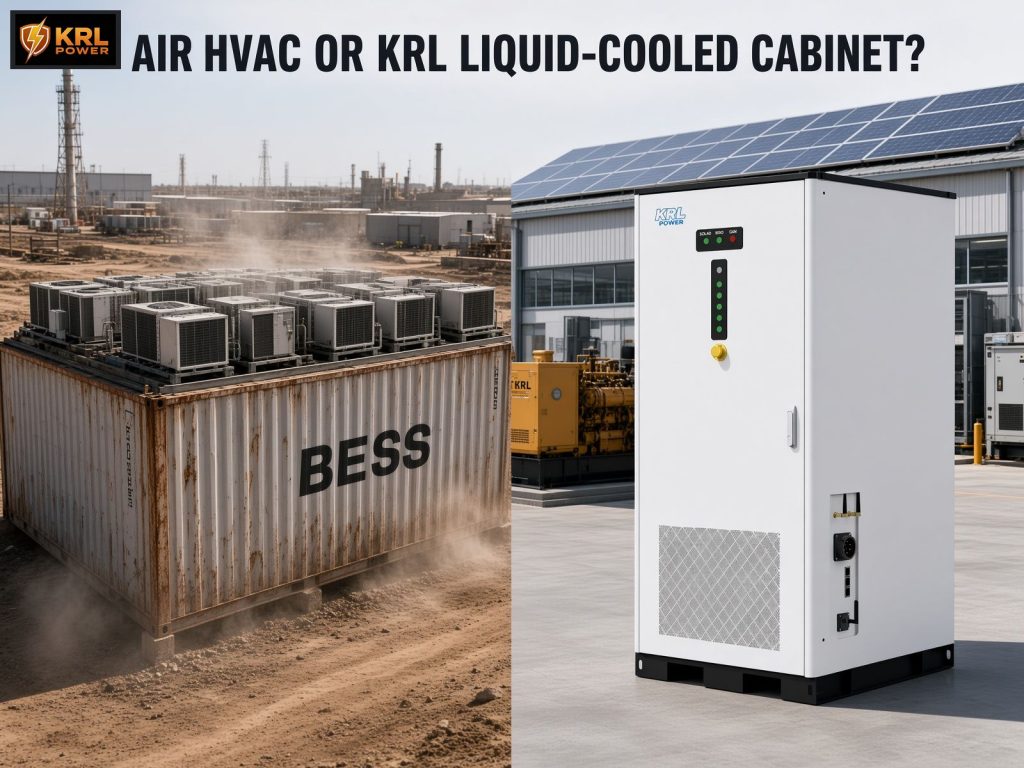
Air-cooled container BESS and liquid-cooled outdoor cabinets get quoted as one item. They are not the same machine. HVAC moves heat with aisle air. A liquid loop moves heat at the pack. Transfer time, PV rating and the diesel port sit on the electrical sheet. Write those lines separately.
KRL Power lists battery liquid cooling on its C&I cabinets. The same sheets also list on/off-grid switching under 10 ms, a PV input and a diesel port. One cabinet. Two checks: thermal, then electrical.
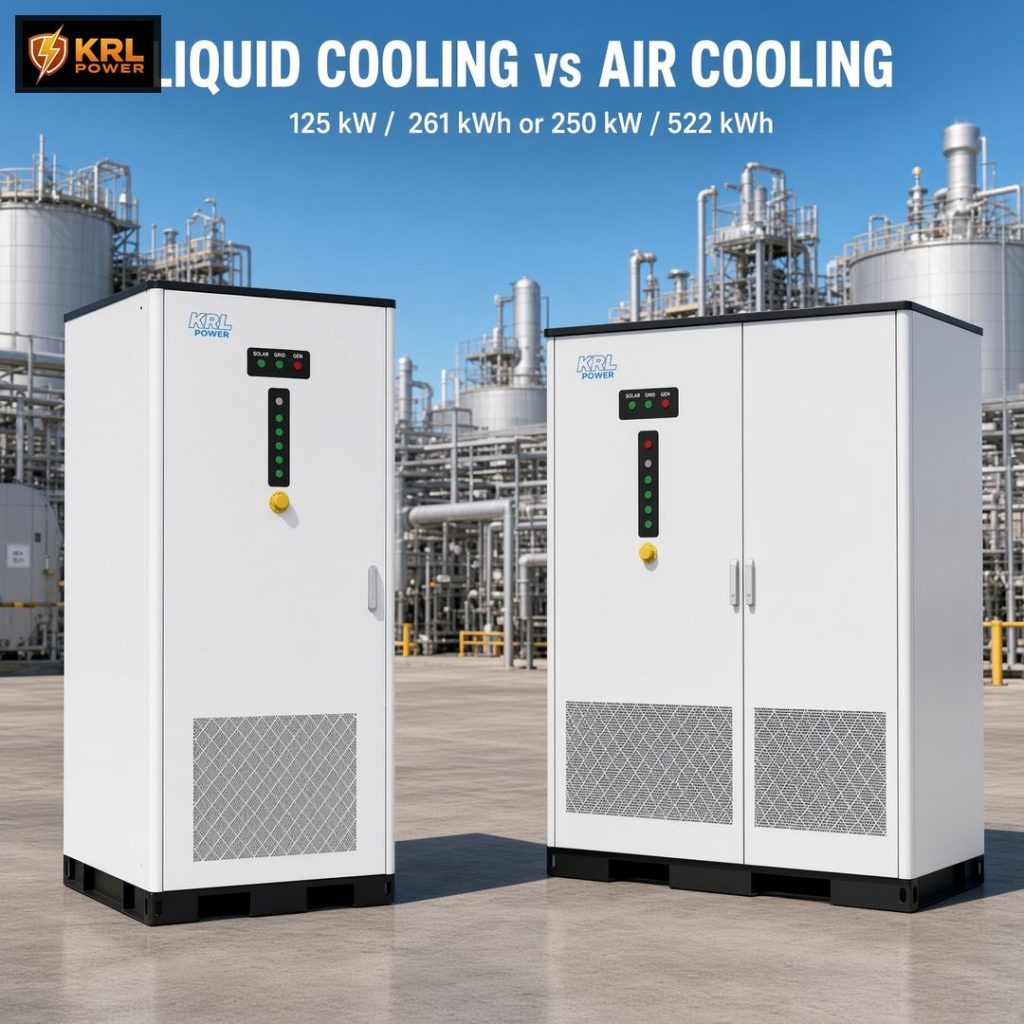
For one factory or charging feeder I open the KRL-B261L 125 kW / 261 kWh. When measured demand leaves that class I open the KRL 522 kWh / 250 kW solar-storage-diesel cabinet. Multi-MWh work waits for the B2M6L class and a measured project sheet.
| Specify | Published rating | Typical duty |
|---|---|---|
| KRL-B261L | 125 kW / 261 kWh, liquid-cooled battery, IP65 battery, switching under 10 ms | One measured feeder |
| KRL-B522L | 250 kW / 522 kWh, liquid cooling, IP65 cabinet, switching under 10 ms | Next power class after 125 kW |
| KRL-B2M6L | 1-2 MW / 2-6 MWh class | Plant scale. Confirm the model on the project sheet |
| Review item | What the sheet must show |
|---|---|
| Cooling method | Battery liquid cooling on B261L and B522L. PCS cooling on B261L is listed as intelligent cooling |
| Cell temperature spread | Within 3 °C on the B261L product page |
| Transfer | On/off-grid switching under 10 ms on both C&I cabinets |
| PV and diesel | B261L: PV up to 120 kW and a diesel port. B522L: PV 240 kW on two MPPT channels and a diesel port |
| Power class | 125 kW or 250 kW after motor-start review, not after nameplate shopping |
Thermal path and electrical path
LiFePO4 cells heat when they work. Uneven heat means the hottest group limits power and ages first. That is cell behaviour. It does not depend on the brand name on the door.
Air cooling uses a coil, fans and aisle air. Intake modules see cooler air. Downstream modules see warmer return air if the duct map fails. Daily cycling makes that gap wider.
Liquid cooling uses a closed coolant loop on the battery. The B261L page states cell temperature differences stay within 3 °C. Holding container air at a set point does not prove the hottest cell sits inside that band.
Switching under 10 ms comes from the PCS and the changeover path. Coolant does not create it. PV input and the diesel port are electrical interfaces too. KRL prints them on one sheet. The RFQ still accepts them as four lines: cooling, transfer, PV, diesel interlock.
Published KRL values that belong on the RFQ
B261L and B522L list battery liquid cooling. B261L also lists intelligent cooling for the PCS. Both cabinets list on/off-grid switching under 10 ms. A diesel start runs in seconds. In that window the signed feeder either stays up or it drops.
B261L accepts up to 120 kW of PV and includes a diesel port. B522L accepts 240 kW of PV on two MPPT channels and includes a diesel port.
B261L lists parallel operation to 10 cabinets. B522L lists up to 6 cabinets, subject to system design. B2M6L is listed at 1-2 MW / 2-6 MWh. Capacity should be added after the next feeder is measured.
The public site also lists 98.5% all-DC coupling efficiency, 6000+ deep cycles, UL / CE / IEC / UN38.3, and FORM E origin documents. 98.5% is DC coupling efficiency. Treat it as that. Cycle life still needs DoD, temperature and end-of-life terms in the contract.
Where air-cooled HVAC remains acceptable
Air cooling works where ambient is moderate, duty is light, land exists for HVAC, and filter access is planned. On a hot yard that cycles every day I treat it as a weak default. Outdoor air shrinks the air-to-cell gap. The pack then limits power to protect the hottest cells.
KRL does not publish an air-cooled derating table on these product pages. I will not invent one. The liquid-cooled sheets give operating windows: B261L from -10 °C to 55 °C, B522L from -30 °C to 55 °C.
Maintenance hours are unpublished too. Air systems need coil and filter work. Liquid loops need coolant checks and leak detection. Write the service plan from the architecture. Do not assume a monthly interval.
Long outages still need diesel. The cabinet covers transfer and events inside usable energy. The generator covers events beyond that window. The same split is described in KRL's industrial battery storage for diesel cost reduction.
Heat rejection inside the cabinet
Air path: coil, fans, module aisle, return. Simple drawing. It needs airflow volume, filter area and HVAC footprint.
Liquid path: coolant through the battery cooling circuit, then rejection at a chiller or liquid-to-air exchanger. Branch flow has to be balanced. A starved branch recreates a hot corner. Flow scheme, leak trip and isolation valves are not on the public B261L table. They belong on the project datasheet.
KRL places that loop in a cabinet that already carries PCS, BMS, EMS, PV input and a diesel port. Thermal design and hybrid control arrive together. Factory tests still prove each function on its own.
Published KRL-B261L ratings
Source: KRL-B261L product page.
| Item | Published value |
|---|---|
| Model | KRL-B261L-125H3S-120M1-HX1 |
| Battery type | LiFePO4 |
| Rated energy | 261 kWh |
| Nominal voltage | 832 V |
| Rated capacity | 314 Ah |
| Rated AC power | 125 kW on-grid and off-grid |
| AC voltage | 400 Vac / 230 Vac |
| Frequency | 50 Hz / 60 Hz |
| Max AC current | 189 A |
| Switching time | under 10 ms |
| Parallel number | 10 |
| Max PV power | 120 kW |
| Max PV voltage | 950 Vdc |
| MPPT range | 250-850 Vdc |
| Max PV input current | 200 A |
| MPPT channels | 1 or 4 |
| Diesel generator port | Yes |
| Communication | RS485 / WiFi |
| IP grade | IP65 (battery) |
| Fire protection system | Yes |
| Operating temperature | -10 °C to 55 °C |
| Humidity | 5% to 95% |
| Altitude | under 2000 m |
| Battery cooling | Liquid cooling |
| PCS cooling | Intelligent cooling |
| Size | 980 x 1300 x 2320 mm |
| Weight | about 2600 kg |
| Cell temperature difference | within 3 °C |
B261L is an outdoor cabinet of about 2600 kg. Price the foundation and the lift for that mass.
Nameplate division of 261 kWh at 125 kW is about 2.1 hours. At 80 kW it is about 3.3 hours. Usable duration is shorter after the contracted SOC window, conversion losses, auxiliary load and reserve.
Published KRL-B522L ratings
Source: KRL 522 kWh / 250 kW cabinet page.
| Item | Published value |
|---|---|
| Model | KRL-B522L-250H3S-240M2-HX1 |
| Battery chemistry | Lithium iron phosphate |
| Rated battery energy | 522 kWh |
| Nominal battery voltage | 832 V |
| Rated battery capacity | 628 Ah |
| PCS rated power | 250 kW |
| Output | 400 Vac / 230 Vac, three-phase |
| Frequency | 50 Hz / 60 Hz |
| Maximum AC current | 375 A |
| PV input power | 240 kW |
| MPPT channels | 2 |
| MPPT voltage range | 250-850 Vdc |
| Maximum PV voltage | 950 Vdc |
| Grid / off-grid switching | under 10 ms |
| Diesel generator port | Included |
| Battery cooling | Liquid cooling |
| Battery cabinet protection | IP65 |
| Operating temperature | -30 °C to 55 °C |
| Parallel capability | Up to 6 cabinets, subject to system design |
| Communications | RS485, WiFi or 4G, subject to configuration |
| Approximate dimensions | 2480 × 1400 × 2050 mm |
| Approximate weight | 4,900 kg |
Nameplate division on the same page: 522 kWh at 250 kW is about 2.09 hours; at 100 kW about 5.22 hours. Contract language should use delivered AC energy at the agreed meter point.
Selecting 125 kW or 250 kW
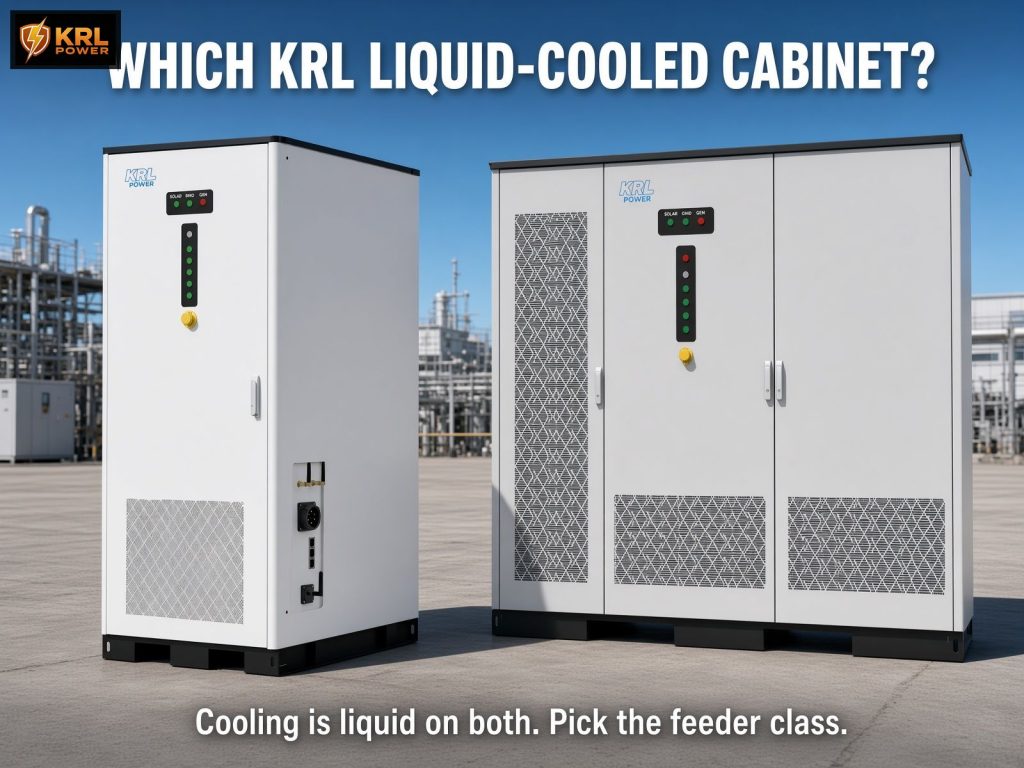
Both cabinets use battery liquid cooling. After that method is fixed, the feeder decides the class.
| Measured condition | Published cabinet |
|---|---|
| Continuous protected load remains inside 125 kW after motor-start review | KRL-B261L |
| Simultaneous demand requires the 250 kW class | KRL-B522L |
| Several feeders, or duration beyond one cabinet | Parallel B261L up to 10, or parallel B522L up to 6, then B2M6L class |
A 90 kW continuous recording does not prove a 125 kW PCS can take three motors starting together. Direct-on-line, soft-start and VFD cases produce different inrush. The same check applies at 250 kW. Confirmation needs start method, which motors start together, kVA and short-duration overload at site temperature.
B261L altitude is published under 2000 m. Sites above that elevation need a written derating statement.
If the safety review requires another cell type, the next reference is KRL solid-state battery technology, followed by the matching model sheet.
EMS architecture on the SLD
The published control path is grid to EMS to the KRL cabinet to the signed feeder. The diesel set remains long-duration backup. PV uses the published input rating when the roof or ground array exists.
| Grid and PV state | Intended EMS action |
|---|---|
| Grid present, PV available | PV supplies process load and charges the battery, up to 120 kW on B261L or 240 kW on B522L |
| Grid present, tariff or quality is poor | The cabinet supports the signed feeder and limits the import spike within PCS rating |
| Grid lost | Switching under 10 ms holds the signed feeder |
| Event longer than usable energy | Diesel starts through the published port |
That layout is consistent with the KRL C&I energy storage systems and KRL industrial energy storage applications. The protected list should be one signed feeder. A whole hall should not be assigned to a single nameplate without a load study.
Contract, SAT and civil works
Battery, liquid cooling, PCS and EMS arrive as one cabinet. Air-cooled container plants often separate HVAC warranty from battery warranty. A temperature excursion then sits between two vendors. KRL lists liquid cooling on the same sheet as the battery.
SAT can use published numbers. Switching under 10 ms is on both C&I sheets. Cell spread within 3 °C is on B261L. Acceptance should include a transfer test to the signed feeder and a cell-temperature map under the agreed power.
B261L mass is about 2600 kg. B522L mass is about 4900 kg. Foundation design follows the cabinet that will be installed.
FORM E is listed on the public site. UL / CE / IEC / UN38.3 are listed on the trust set. Certificates should be tied to the serial number. Import duty remains a customs matter. No flat duty saving is stated here.
Cost context without an invented LCOE figure is in the commercial energy storage cost guide. Cabinet selection after the cooling method is fixed is in the commercial and industrial energy storage system selection guide.
Additional project notes are in the KRL BESS knowledge center. Company record: KRL Power company profile.
RFQ items that still need project data
- Usable AC kWh at the agreed SOC window, power and site temperature.
- SAT method for switching under 10 ms to the signed feeder.
- SAT method for mapping cell temperature against the B261L 3 °C statement.
- C-rate versus ambient curve. This curve is not on the public table.
- Coolant type, leak trip and isolation valves.
- Motor-start sequence on grid loss.
- PV used at 120 kW or 240 kW, or reserved.
- Diesel start command and reverse-power rule.
- Parallel design if a second cabinet is added.
- UL / CE / IEC / UN38.3 files issued against the serial number.
A quotation that only repeats "liquid cooled, 261 kWh" has not closed those items.
Decision
| Site condition | Published KRL class | Risk if the project keeps air HVAC only |
|---|---|---|
| High ambient, daily cycle, one feeder inside 125 kW after start review | B261L | Uneven module temperature and HVAC service load. Transfer time still depends on the PCS specified with that container |
| Feeder requires the 250 kW class | B522L | Same thermal exposure, plus PCS rating below simultaneous demand |
| Several feeders or staged growth | Parallel B261L or B522L | Later redesign of cooling plant and electrical board |
| Multi-MWh plant | B2M6L class plus project sheet | C&I cabinet civil package will not match container mass and footprint |
| Moderate climate, light duty, HVAC access planned | Air-cooled container may remain in review | Liquid cooling is not required by the published sheets for every site |
Selection starts from the measured feeder, then from the published KRL power class that covers that feeder after motor-start review.
Information required before a configuration
- Latest SLD and the feeder to be protected
- Measured kW, kVA and power factor
- Motor-start method
- Design ambient
- PV target against 120 kW or 240 kW
- Diesel retained or removed
- B261L, B522L or B2M6L class
- SAT items: transfer time, temperature map, usable AC kWh
The KRL Power contact channel is the point for a class recommendation, usable energy at the agreed SOC window, and the SAT list.