

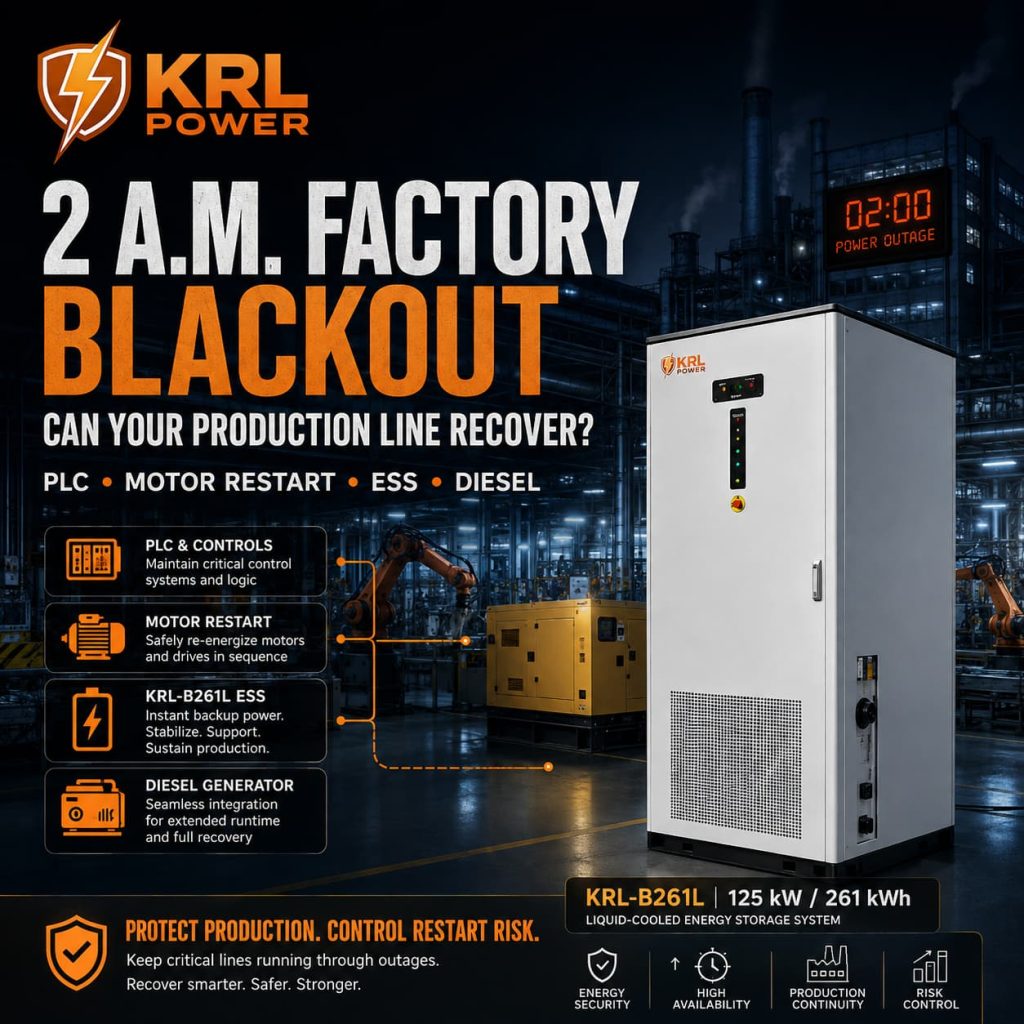
A short factory blackout at 2 a.m. can become a much longer production interruption when PLCs drop out, motors attempt to restart together, or the diesel generator enters too late. KRL Power approaches this problem by engineering the recovery sequence first: which loads must stay powered, which machines should restart in sequence, and when the ESS or diesel generator should take over.
For factories screening a 125 kW power class, the KRL-B261L 125 kW / 261 kWh liquid-cooled ESS provides a practical starting platform. The cabinet rating alone does not determine whether a production line can recover successfully after a blackout.
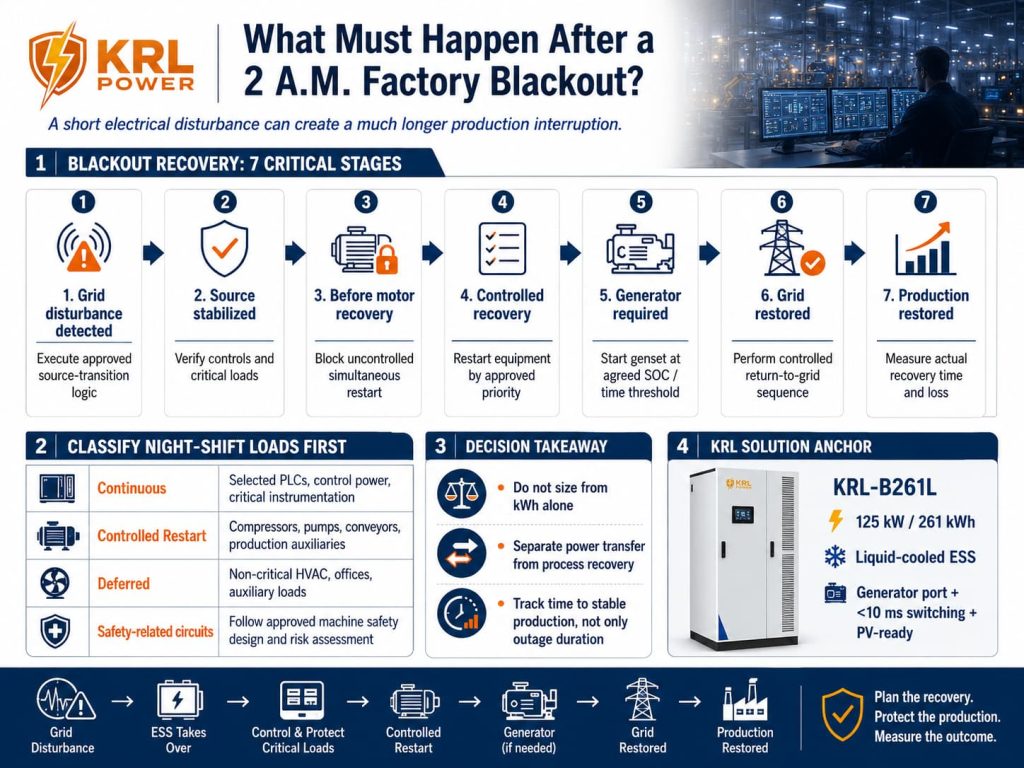
What Must Happen After a 2 A.M. Factory Blackout?
| Recovery Stage | What the Factory Needs | Main Risk |
|---|---|---|
| Grid fails | Execute the approved source-transition logic | PLCs, VFDs or contactors drop out |
| ESS takes over | Maintain the approved critical-load group | Transfer time is mistaken for process continuity |
| Before restart | Block simultaneous motor recovery | PCS or generator overload |
| Controlled recovery | Restart machines by priority | Wrong restart order or interlock failure |
| Longer outage | Start diesel at the agreed SOC/time threshold | Battery reserve is exhausted too early |
| Grid returns | Perform controlled re-transfer | A second production interruption |
| Production restored | Measure actual recovery time and loss | True blackout cost remains hidden |
A five-second power disturbance can create a much longer production interruption. The engineering target is therefore not only fast electrical transfer—it is fast, safe and repeatable production recovery.
Protect the Production State Before You Size Battery Capacity
The design target is not simply “How many kWh should we buy?” It is “What production state must the factory maintain or recover after the grid disappears?” That distinction separates a production-continuity project from ordinary battery backup.
KRL’s industrial production-line backup power guide and furniture factory BESS sizing analysis both reinforce that protected loads, restart sequence and process behavior must be defined before final ESS sizing.
- Identify which loads must remain energized.
- Identify which loads should restart in sequence.
- Identify which loads can remain deferred until grid or generator capacity is available.
- Confirm how controls, safety circuits and diesel coordination behave during the event.
Classify Night-Shift Loads First
| Recovery Class | Typical Examples | Required Behaviour |
|---|---|---|
| Continuous | Selected PLCs, control power, critical instrumentation | Remain energized where the approved process design requires it |
| Controlled Restart | Compressors, pumps, conveyors, production auxiliaries | Restart after the source is stable and previous conditions are satisfied |
| Deferred | Non-critical HVAC, offices, auxiliary loads | Remain disconnected until sufficient capacity is available |
| Safety-related circuits | Machine-specific safety control functions | Follow the approved machine safety design and risk assessment |
Machine recovery should also reflect IEC 60204-1 for machinery electrical equipment and IEC 62061 for safety-related machine control systems.
What Does a Factory Blackout Really Cost?
The grid may return in seconds, while the production line can remain unavailable far longer. For a factory buyer, the relevant cost is the complete recovery event—not only the utility outage duration.
| Recovery Impact | Evidence |
|---|---|
| Lost production time | MES / line runtime records |
| Scrapped work-in-progress | Batch and QC records |
| Restart labour | Shift and maintenance logs |
| Process stabilization | Historian / process records |
| Motor or compressor delays | PLC / event logs |
| Diesel operation | Generator runtime and fuel records |
| Rework | Production / QC records |
| Shipment delay | Production-planning records |
For fuel-economics and ROI, use KRL’s dedicated industrial battery storage for diesel cost reduction article. This page stays focused on production recovery and restart engineering.
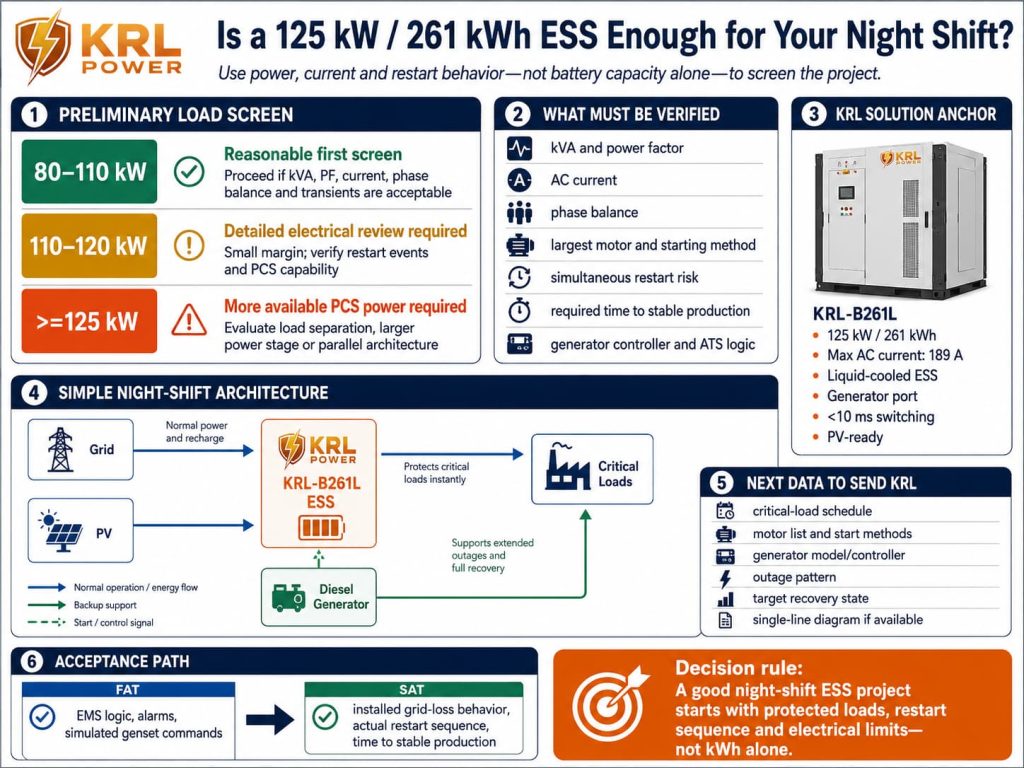
Is a 125 kW / 261 kWh ESS Enough for Your Night Shift?
Once the protected-load strategy is defined, the KRL-B261L 125 kW / 261 kWh ESS can be screened against the project. KRL currently publishes 125 kW rated AC power, 261 kWh rated energy, 189 A maximum AC current, 120 kW PV input and a diesel-generator port for this model.
| Critical Running Load | Preliminary Direction |
|---|---|
| 80–110 kW | Can enter first screening if current, kVA, PF, phase balance and transients are acceptable |
| 110–120 kW | Detailed electrical and restart review required |
| ≥125 kW | Evaluate more available PCS power or load separation |
The important point is that 80–110 kW is not a standalone approval rule. A three-phase load must also be checked against apparent power, power factor, current, phase balance and motor transients.
- Verify kVA and power factor.
- Verify AC current.
- Verify phase balance.
- Verify the largest motor and starting method.
- Verify simultaneous-restart risk.
- Verify generator controller and ATS logic.
- Verify the required time to stable production.
Factories evaluating other sizes can review KRL’s broader commercial and industrial energy-storage range.
A Practical Night-Shift Architecture
A practical night-shift power architecture is typically: Grid and PV support loads and recharge the ESS under normal conditions; the ESS protects approved critical loads when the grid fails; the diesel generator enters only when the agreed threshold is reached; and production loads recover in a controlled sequence.
For deeper hybrid architecture detail, use KRL’s Nigeria industrial diesel-hybrid ESS reference. For broader sizing methodology, use the commercial energy-storage system design guide and the guide to choosing a commercial energy-storage system.
Separate FAT and SAT Requirements
Factory Acceptance Test — FAT
- EMS logic
- SOC thresholds
- Alarm handling
- Generator start-command simulation
- Communication logic
- Control modes and interlocks
Site Acceptance Test — SAT
- Real grid-loss event
- Installed switchgear
- Actual or representative critical loads
- PLC and control-power behavior
- Approved motor restart sequence
- Installed generator response
- Low-SOC behavior
- Return-to-grid sequence
- Event logging
The most important production KPI should be time to stable production in addition to electrical transfer time.
Use Two Safety Layers: ESS Safety and Machinery Safety
ESS safety can be framed using IEC 62933-5-1:2024, IEC 62933-5-2:2025 and IEC 62933-5-4:2026. These standards are procurement references and should not be turned into a product-certification claim unless the supplied project documentation confirms it.
A successful BESS transfer does not automatically mean the production-line restart is safe or complete. The machinery safety layer must still be reviewed.
Final Recommendation
A factory blackout does not have to become a full production restart. The key is to decide in advance which loads stay powered, which machines restart later, how much transient power is required and when the diesel generator should enter.
If your night shift currently depends on operators manually restarting equipment after every blackout, the first step is to map the recovery sequence—not simply buy more battery capacity.
Additional application engineering references are available through the KRL Power BESS knowledge center.
الأسئلة الشائعة
What is the first thing a factory should do before choosing a night-shift BESS?
Classify loads into continuous, controlled restart, deferred and safety-related groups. This determines what actually needs battery support.
Does a fast ESS switching time guarantee that the production line will not stop?
No. Actual process ride-through also depends on PLCs, VFDs, contactors, control supplies, machine logic and safety circuits.
Why can restarting motors be harder than supporting the running load?
Motor starting can create much higher short-duration current or transient demand than normal operation. The restart event may therefore be more difficult than the stable load.
Should every production machine restart automatically?
No. Automatic restart should follow the machine OEM control philosophy, approved interlocks and safety-related control design.
What is a controlled-restart load?
It is equipment that can stop during an outage but should reconnect only after the source is stable and the previous restart conditions are satisfied.
Which loads are usually deferred?
Non-critical HVAC, offices and auxiliary equipment are common deferred loads, but the final decision should follow the process review.
How should blackout cost be measured?
Measure lost production time, scrap, labour, process recovery, generator use, rework and shipment delay—not only grid-outage duration.
Is diesel saving still relevant to this article?
Yes, but it is a secondary benefit. The primary question here is production continuity and restart risk.
Can a 261 kWh battery support a 100 kW load for 2.61 hours?
2.61 hours is the ideal nameplate quotient. Real operating duration is lower after reserve SOC, losses, auxiliaries and operating limits are included.
Is the KRL-B261L suitable for an 80–110 kW night-shift load?
It can enter preliminary screening when kW, kVA, current, PF, phase balance, usable energy and transients are all acceptable.
What if the critical load is 110–120 kW?
A detailed electrical and transient review becomes especially important because continuous power and current margins may be small.
What if the night-shift load exceeds 125 kW?
Evaluate more available PCS power, load separation or a larger or parallel system architecture.
What belongs in FAT?
EMS logic, alarms, SOC logic, control sequences, communication and simulated generator commands are typical FAT subjects.
What belongs in SAT?
Installed grid-loss behaviour, PLC or VFD response, actual restart sequence, generator integration, reserve behaviour and return-to-grid operation should be tested at site.
What should be sent to KRL Power for a night-shift proposal?
Send the critical-load schedule, kW/kVA/PF where available, major motors and starting methods, generator model/controller, outage history and the required recovery state.
Can an ESS and a diesel generator work together on a night shift?
Yes. A practical design often uses the ESS for rapid protected-load support and the generator for longer-duration backup or extended-outage support.
How do I know whether my factory needs a restart-sequence review before buying an ESS?
If your process includes large motors, compressors, conveyors, VFDs, critical PLCs or frequent night-shift outages, a restart-sequence review should be done before final sizing.
What information helps KRL decide whether a 125 kW / 261 kWh ESS is enough?
The most useful inputs are the critical-load schedule, largest motors and their start methods, generator controller details, outage pattern, desired recovery state and available single-line information.
What result should a night-shift continuity project really aim for?
The practical target is not only fast transfer but fast, safe and repeatable time to stable production.