
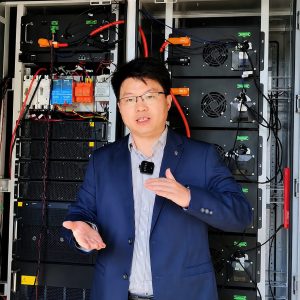
For commercial battery storage in Australia, use interval demand and solar data to size KRL equipment before building the payback model. Check the network tariff, usable AC energy and required approvals for the exact site and cabinet configuration.
- Measure billed kW or kVA and the duration of demand events.
- Compare KRL cabinet ratings and network evidence.
- Test net benefit after dispatch conflicts and costs.
Under a demand tariff, a factory can run efficiently for most of the month and still pay for one badly timed half-hour. A refrigeration plant starts its compressors, a packing line comes back from a break, and pumps ramp together. The meter records a new peak. At noon, the same site may be curtailing rooftop solar because its export limit has already been reached.
Commercial battery storage resolves both timing mismatches. It absorbs energy when the site has surplus generation, releases it before the meter records an expensive peak, and can preserve power for critical loads. On qualifying projects, it can also support a registered market-services pathway.
Commercial battery storage in Australia can reduce demand peaks, store surplus solar energy and support market services. Its value comes from the customer’s actual tariff, interval data, network connection and dispatch strategy. AS/NZS installation requirements, inverter rules and DNSP conditions govern different parts of the project. A bankable proposal connects every claim to the exact equipment, site and approval authority.
Site approval in Australia requires more than a cabinet data sheet. Engineering sign-off depends on a correctly sized battery, a suitable power conversion system, model-specific safety evidence, a compliant installation, an accepted network connection and controls that perform under the local tariff.
Start with Bills and Interval Data
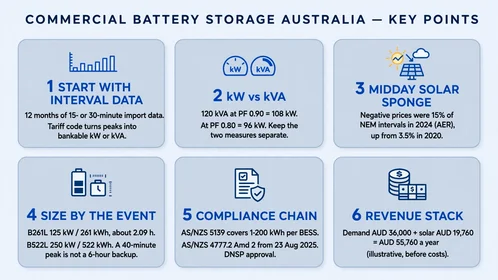
Twelve months of 15- or 30-minute interval data and the verified network tariff code turn peak-demand assumptions into bankable kW or kVA savings before equipment sizing begins.
Battery economics depend on changing what the meter sees. Reconstructing the bill from the site’s interval data is therefore the first engineering task.
For demand-charge analysis, collect at least 12 months of 15-minute or 30-minute import data, the retailer bill, the current network tariff, and any contract schedule that defines demand. Then work through the intervals and tariff rules:
- Find the highest demand interval in each billing cycle.
- Mark the time window in which demand is measured.
- Confirm whether the charge uses kW, kVA or another capacity measure.
- Check whether a historical ratchet keeps an old peak alive.
- Measure how long the load stays above the proposed demand cap.
- Count how often the same event repeats.
- Record power factor during the event.
- Confirm the battery state of charge available before the event begins.
Network tariff structures vary by DNSP, voltage level, customer class and contract.
| Network | Demand example | Model input |
|---|---|---|
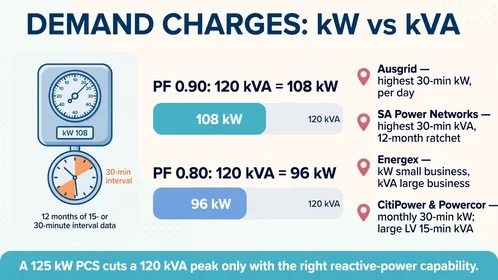
| Ausgrid | 30-min kW in some classes | Peak window and billed days |
| SA Power Networks | 30-min kVA on MBTOUD | 12-month lookback |
| Energex | Small kW / large kVA | Assigned tariff and window |
| CitiPower / Powercor | 30-min kW / 15-min kVA | Class, season and lookback |
These are selected tariff classes. Some Ausgrid classes use kVA, and the 15-minute CitiPower and Powercor example is for large low-voltage customers. Check the current network tariff code and how the retailer bills it.
Sources: Ausgrid demand pricing, SA Power Networks business tariff guidance, Energex 2026–27 network tariff guide, ، و CitiPower and Powercor pricing documents.
These are DNSP network structures, not universal retail prices. A short spike can be expensive without being a universal “penalty.” Under one tariff it may set the month’s peak. Under another, it may affect a 12-month ratchet. A retailer may also translate the network charge into a different customer-facing structure.
Separate kW and kVA Demand
kW measures real power. kVA measures apparent power. Power factor links them.
At a power factor of 0.90, a 120 kVA load represents 108 kW of real power. At 0.80, the same 120 kVA represents 96 kW. Delivering a 120 kVA peak reduction with a 125 kW battery PCS depends on reactive-power capability, site controls, current limits, transformer conditions and the load’s power factor.
For a kVA demand tariff, the EPC should model the battery and any power-factor correction together. For a kW tariff, it should model the real-power peak in the network’s defined interval. Keeping the two measures separate prevents an expensive sizing error.
Capture Surplus Midday Solar
Absorbing curtailed midday PV improves project returns when the dispatch schedule preserves usable SOC headroom and prices round-trip losses, cycling wear and foregone export payments accurately.
Australia’s electricity system routinely runs as two different markets inside a single day. Solar-rich hours can produce low or negative wholesale prices. Evening demand raises system value for dispatchable energy.
The Australian Energy Regulator reported that negative prices made up 15% of NEM price intervals in 2024, up from 3.5% in 2020, and that they occur most often around the middle of the day when rooftop and grid-scale solar output is high. In Q2 2025, AEMO recorded negative prices between 9:00 and 17:00 in 34% of intervals in South Australia, 27% in Victoria, 33% in Queensland and 19% in New South Wales. Those are wholesale-market figures, not a promise that a factory’s retail electricity is free. They do show why flexible load and storage are becoming more valuable.
At site level, the constraint is often an export limit rather than the spot price itself. Three arrangements are common:
- A fixed export limit caps the amount of power the site may send to the network.
- A zero-export system controls the plant so net export stays within the approved limit.
- A dynamic or flexible export arrangement changes the permitted export in response to network conditions.
To act as a solar sponge, the battery needs room to charge throughout the constrained export window. Reaching its upper state-of-charge limit at 11:30 leaves midday solar curtailed at noon. Holding capacity in reserve for backup narrows the usable cycling window and reduces absorbable solar volume. Where the site receives an export payment, storing solar also gives up that revenue.
Use this calculation:
Annual solar-shifting value = delivered AC energy × avoided import price − foregone export value − cycling and incremental operating costs. Apply conversion losses when converting charging energy to delivered AC energy.
The formula exposes what the EPC must measure and which assumptions can break the case. Calling curtailed solar “free energy” hides those costs.
Size for the Load Event
Matching PCS kW rating to peak load and usable AC kWh to event duration avoids undersized tenders, safeguards transformer headroom and defines exact KRL-B261L or KRL-B522L block counts.
The battery’s power rating determines how much of a peak it can cut at one moment. Its usable energy determines how long it can hold that cut. Both matter.
- Peak and duration: Use interval data and time above the demand cap to estimate PCS power and usable energy.
- Connection headroom: Check kW, kVA, power factor, the single-line diagram and transformer rating.
- Solar availability: Check PV output, export and curtailment logs, and the DNSP export limit.
- Dispatch economics: Use the network tariff, retailer contract and plant schedule.
- Backup and FCAS: Document critical loads, reserve SOC, telemetry and the market participation route.
Required discharge power follows the target peak reduction. Required usable energy follows the duration of the peak, the permitted state-of-charge window, conversion losses, reserve margin, temperature conditions and degradation allowance.
Take the KRL-B261L as a screening example. Its published ratings are 125 kW and 261 kWh, giving a nominal energy-to-power ratio of about 2.09 hours. Full-power duration at the point of connection depends on usable AC energy, minimum and maximum SOC limits, auxiliary consumption, temperature derating, beginning-of-life and end-of-life capacity, and any backup reserve.
The same discipline applies to the 250 kW/522 kWh KRL-B522L. Its nominal energy-to-power ratio is also close to 2.09 hours. A 40-minute demand event, a three-hour refrigeration plateau and a six-hour backup requirement are three different projects, even if all three mention 522 kWh.
Set Dispatch Priorities
For many Australian factories, a sensible control hierarchy is:
- Keep enough SOC to protect the demand peak that creates the largest verified bill exposure.
- Charge from solar that would otherwise be exported at low value or curtailed.
- Shift energy into the site’s expensive import window when the spread exceeds losses and cycling cost.
- Reserve capacity for backup only where the cost of interruption justifies it.
- Add FCAS or VPP commitments after the first four duties have a workable schedule.
Sites may rank these duties differently. This sequence protects the value stream the owner can measure before adding market revenue that depends on an external participant.
Map Australian BESS Approvals
Aligning AS/NZS installation design, AS/NZS 4777.2 inverter settings, DNSP connection packs and model-specific fire reports at RFQ stage prevents approval delays and redesign costs.
Australian commercial BESS compliance comes from a documented chain of installation, inverter, network, communications and project approvals.
AS/NZS 5139, inverter standards, DNSP connection rules, communications profiles, product test reports, building requirements and market registration do different jobs. The project team must connect them.
| Layer | Scope | Tender evidence |
|---|---|---|
| AS/NZS 5139 | Battery installation safety | Siting and risk controls |
| AS/NZS 3000 | Electrical wiring | Design and verification |
| AS/NZS 4777.1:2024 | LV inverter installation | SLD and commissioning |
| AS/NZS 4777.2 Amd 2 | PCS and grid settings | Exact model and firmware |
| DNSP | Connection and export | Offer and protection study |
The applicable requirements depend on the installation design and connection pathway. Confirm the reviewer for each item with the project designer, licensed installer and network operator.
Alongside electrical installation and network approvals, commercial tenders also clear cell safety, thermal-propagation, DER telemetry and market registration layers:
- IEC 62619, where specified: Obtain the certificate and test scope for the ordered industrial battery.
- UL 9540A, where requested: Provide the report edition, test level and equipment configuration.
- CSIP-AUS or IEEE 2030.5, where applicable: Document the client, approved equipment, gateway and test results.
- FCAS, where planned: Confirm the market route, metering, telemetry, performance verification and commercial agreement.
Scope of AS/NZS 5139
Standards Australia describes AS/NZS 5139:2019 as covering general installation and safety requirements for BESS connected with power conversion equipment. Its normative capacity scope runs from 1 kWh to 200 kWh for each independent rechargeable BESS within the stated voltage range. The current edition is AS/NZS 5139:2019 Amd 1:2025.
AS/NZS 5139 is an installation standard with a defined scope rather than a universal cabinet certificate. The 261 kWh B261L and 522 kWh B522L exceed the standard’s 200 kWh normative ceiling for one independent BESS. A project engineer may use relevant safety principles as part of the design review, while also defining the applicable connection, fire, building and authority requirements for the larger installation.
Outdoor all-in-one cabinets simplify the layout by keeping battery equipment out of an occupied building, while separation, access, fire, egress and barrier rules still govern placement. Doorways, windows, combustible surfaces, adjoining property, emergency access and the equipment’s hazard evidence continue to shape the design.
AS/NZS 4777.2 Settings
The current inverter product framework is AS/NZS 4777.2:2020 with Amendment 2:2024. The Clean Energy Council states that Amendment 2 took effect on 23 August 2025 for products within its approved-inverter process. The amendment includes updated region settings, generation-limit control parameters, documentation and marking requirements.
Region A, Region B and Region C are grid-setting profiles with network-specific parameters; geographic shorthand alone is insufficient.
Published network guidance places Ausgrid, Endeavour Energy, CitiPower, Powercor, Energex, Ergon Energy, SA Power Networks and several other networks in Australia A. Western Power specifies Australia B. Industry guidance associates Australia C with Horizon Power and TasNetworks. The connection approval for the actual site remains the controlling document.
Sources: CEC inverter standard update, Western Power Region B guidance, ، و Ergon Energy AS/NZS 4777.2 guidance.
In the RFQ, support any “Australia-ready” claim with the exact PCS manufacturer, model, firmware, certificate, rated apparent power and supported regional settings.
Check Dynamic Export Rules
CSIP-AUS is an Australian implementation profile based on IEEE 2030.5. It allows a utility server to communicate with a software client in an inverter, gateway or cloud platform. Its application varies by program and jurisdiction.
South Australia requires dynamic-export capability for prescribed new solar generating systems under its program. SA guidance explains that the CSIP-AUS client can sit in the inverter, a gateway or the cloud. Under Regulation 55E, an AC-coupled BESS using a battery inverter is exempt from the dynamic-export-capable requirement, whereas a hybrid PV-and-battery inverter is treated as a solar inverter and must meet the applicable dynamic-export rule. Site export limits and the connection agreement still apply.
Victoria’s emergency backstop applies to new, upgraded and replacement distributed solar systems over 200 kVA from 25 October 2023 and to new rooftop solar systems of 200 kVA or less from 1 October 2024, with stated exceptions. Victorian guidance uses CSIP-AUS-compatible equipment for relevant installations. For a battery addition that retains the existing solar inverter, check whether any part of the work triggers the current backstop requirements.
These solar and DER-control requirements have defined scopes. Each project needs an architecture that meets the applicable DNSP rule, with the IEEE 2030.5 client located in the PCS, a gateway or an approved third-party platform as the program permits.
Sources: South Australia Technical Regulator DER guideline, SA Power Networks flexible exports, Victoria emergency backstop, ، و Victoria’s distributed-solar guidance.
Request UL 9540A Test Evidence
UL 9540A evaluates thermal-runaway fire propagation at defined test levels. UL Solutions distinguishes it from UL 9540, which is the product safety certification standard for complete energy storage systems in the North American framework.
Australian fire engineers, insurers and commercial clients often request UL 9540A evidence because it provides useful data on heat release, gas generation, propagation and fire behaviour. Because that requirement is project specific, the report must also match the ordered cell, module, unit and installation arrangement closely enough to support the risk assessment.
Request the underlying UL 9540A report and verify the edition, completed test levels, tested configuration, and whether its spacing, ventilation and suppression assumptions match the proposed installation.
Source: UL Solutions UL 9540A test method.
Compare the Two KRL Cabinets
Pre-integrated 125 kW/261 kWh and 250 kW/522 kWh liquid-cooled cabinets with IP65 battery sections reduce on-site electrical assembly and scale up to 10 or 6 parallel units when supported by ambient derating curves and Australian compliance packs.
KRL’s two liquid-cooled cabinets sit in a useful C&I range. The B261L provides a 125 kW power block with 261 kWh of nominal energy. The B522L doubles that to 250 kW and 522 kWh. Their published data make them relevant to cold stores, food plants, warehouses, workshops, retail facilities, mining support sites and factories that need peak control, solar capture or backup.
| Rating | KRL-B261L | KRL-B522L |
|---|---|---|
| القدرة الكهربائية المقننة للتيار المتردد | 125 كيلوواط | 250 كيلوواط |
| Nominal LFP energy | 261 كيلوواط·ساعة | 522 كيلوواط·ساعة |
| أقصى مدخل كهروضوئي | 120 كيلوواط | 240 كيلوواط |
| Published parallel limit | 10 units | 6 units |
| Approximate mass | 2,600 كجم | 4,900 كجم |
Both cabinets list 400/230 Vac three-phase output and transfer times below 10 ms. Confirm the transfer conditions for the ordered configuration.
Thermal, enclosure and physical parameters govern outdoor siting, crane handling and Australian hot-climate sizing:
Both units list liquid battery cooling, intelligent PCS cooling, IP65 for the battery section, fire protection and an ambient range of −10°C to 55°C.
- B261L: 980 × 1,300 × 2,320 mm.
- B522L: 2,480 × 1,400 × 2,050 mm.
Australian connection and fire-engineering reviews depend on project-specific submittals linked to the quoted hardware. Specify the exact Australian PCS variant, AS/NZS 4777.2 conformity certificate, approved firmware, CSIP-AUS or IEEE 2030.5 interoperability file and applicable UL 9540A report in the RFQ and tie every document to the ordered PCS, firmware and battery configuration.
The B261L page also publishes a battery temperature difference within 3°C. The number is useful only with its test condition, sensor locations, charge and discharge rate, ambient temperature and acceptance method.
Check Output in Hot Weather
Western Sydney has recorded 48.9°C at Penrith Lakes, while Onslow in Western Australia reached 50.7°C. Those are ambient-air records, not cabinet internal temperatures. They establish a real design condition: an outdoor BESS may face extreme heat, direct solar load and repeated high-temperature days.
Sources: Bureau of Meteorology NSW 2020 climate summary و Bureau of Meteorology WA 2022 climate summary.
KRL publishes an operating range up to 55°C for both cabinets. Full-power output at 50°C requires a model-specific derating curve; the operating range alone describes the permitted temperature envelope. Before an EPC prices a hot-climate project, it should:
- obtain the PCS and battery power-derating curves
- confirm maximum continuous output at 40°C, 45°C and 50°C
- record auxiliary power at each ambient point
- check the enclosure’s solar-load assumptions
- price coolant and chiller maintenance
- identify high-temperature alarm and shutdown thresholds; and
- review warranty exclusions tied to ambient temperature.
Evidence-led comparisons place every vendor under identical ambient temperature, duty cycle, SOC window and enclosure exposure assumptions.
Plan Parallel Expansion
KRL publishes parallel operation for up to 10 B261L cabinets and six B522L cabinets. On nameplate ratings, those limits correspond to as much as 1.25 MW/2.61 MWh for the B261L family and 1.5 MW/3.132 MWh for the B522L family.
The maximum parallel block still needs a coordinated EMS, protection scheme, communications architecture, switchboard rating, transformer review, fault-level study, harmonic assessment and DNSP approval.
Granularity is useful here. A 125 kW/261 kWh block can follow one feeder or one stage of site growth. A second cabinet can be added after the operating profile is proven, provided the original civil, electrical and connection design allowed for it.
For a defined battery, PCS, thermal-management and control scope, review KRL Power’s commercial battery storage systems for Australian C&I projects, ، أو request a preliminary KRL Power sizing and compliance review. Final project compliance aligns with the ordered configuration, site design and Australian approval pathway.
Model Savings and Revenue
Separating demand savings, solar shifting and market revenue against shared 261 kWh or 522 kWh capacity gives CFOs and lenders an auditable payback test before capital approval.
Commercial C&I battery business cases in Australia often combine several value streams, requiring the dispatch model to allocate the same 261 kWh across competing duties and time windows.
- Demand: Use interval load, tariff and power factor. Check timing, duration, PCS power and SOC.
- Solar and arbitrage: Use PV, export and price data. Account for headroom, foregone export, losses and cycling.
- Backup: Size islanding equipment and reserve SOC against critical loads and outage duration.
- FCAS: Validate availability, telemetry and contract terms with the registered market participant.
- Incentives: Confirm eligibility, commissioning dates and evidence with the scheme administrator.
Work Out Demand Savings
Assume a customer’s actual contract charges AUD 25 per kVA per month. Assume interval analysis shows that the battery can reliably reduce the billed peak by 120 kVA in all 12 eligible billing periods.
Gross annual demand-charge saving = 120 kVA × AUD 25/kVA/month × 12 months = AUD 36,000
The calculation illustrates a method, not an Australian market rate. The result changes when the customer’s tariff uses kW rather than kVA, the battery misses a critical interval, the peak lasts longer than its usable energy, or a ratchet preserves an earlier peak.
Work Out Solar Shifting Value
Assume the site can deliver 200 kWh per operating day from otherwise constrained solar after conversion losses, for 260 days a year. Assume the avoided retail import price during discharge is AUD 0.38/kWh.
Gross annual avoided import = 200 kWh/day × 260 days × AUD 0.38/kWh = AUD 19,760
Now subtract any export revenue that would have been earned, battery cycling cost, additional maintenance and the value of solar that the site could have consumed directly. If 200 kWh is the energy charged into the battery rather than energy delivered to the load, conversion losses must be applied before the multiplication.
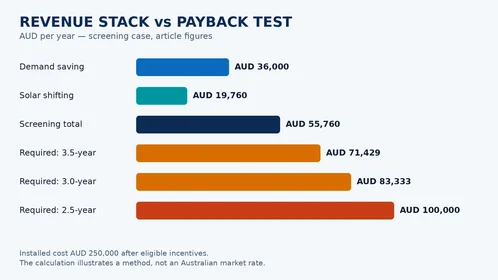
In this screening case, demand reduction and delivered solar shifting total AUD 55,760 before operating costs, degradation and scheduling conflicts. Place FCAS revenue in an upside case until an aggregator confirms the commercial and technical pathway.
Test the Payback Target
Simple paybacks of 2.5 to 3.5 years require annual net benefit equal to about 40% to 28.6% of the installed cash cost.
If the complete installed project costs AUD 250,000 after eligible incentives, the required annual net benefit is:
- AUD 100,000 for a 2.5-year payback
- AUD 83,333 for a 3.0-year payback; or
- AUD 71,429 for a 3.5-year payback.
When the audited model yields AUD 55,760 before operating costs, cash flows fall short of a 2.5-to-3.5-year target. Reaching that payback requires a lower installed cost, more verified demand value, a larger solar opportunity, contracted market revenue, an eligible incentive, or a financially valued resilience benefit.
EPC teams protect margin by proving the inputs needed to reach the attractive payback before putting it in the bid.
Check the FCAS Pathway
Ask the registered participant whether 125 kW and 250 kW cabinets can be aggregated for the target FCAS service. Confirm telemetry, availability and SOC requirements.
Australia’s NEM has 10 FCAS markets: raise and lower contingency services with 1-second, 6-second, 60-second and 5-minute response products, plus raise and lower regulation services. For a 125 kW or 250 kW cabinet, assess participation through aggregation with a registered participant and confirm the offer and verification requirements for the service.
AEMO’s battery registration guidance requires the facility to meet the Market Ancillary Service Specification and participate through the applicable central-dispatch and registration arrangements. Metering, local frequency measurement, telemetry, control, verification and operating availability all matter.
Sources: AEMO battery registration fact sheet, AEMO ancillary services, ، و National Electricity Rules 3.8.7A.
KRL publishes a transfer time below 10 ms for the B261L and B522L. That figure describes on-grid to off-grid switching. FCAS qualification requires separate evidence for frequency-response behaviour, measurement, dispatch control, communications and sustained delivery.
Before placing FCAS income in the financial model:
- ask the aggregator or registered participant to confirm eligibility
- name the exact market services to be offered
- define telemetry and metering requirements
- document the communications and control interface
- agree baseline, availability and performance assumptions
- price revenue sharing and aggregator fees
- set SOC reservation rules
- model expected dispatch and cycling
- test the effect on demand-charge performance; and
- approve a test and commissioning plan.
FCAS can improve project economics. It can also reserve the same SOC needed for the factory’s peak. A dispatch model must resolve that conflict interval by interval.
Check Incentives and Tax Treatment
NSW PDRS business incentives, VEU project pathways and the AUD 20,000 federal write-off threshold each follow strict capacity, accredited-provider and commissioning-date rules that belong in pre-bid financial checks.
New South Wales introduced a business-battery incentive under the Peak Demand Reduction Scheme for eligible batteries commissioned from 1 September 2026. The NSW Government states that eligible business systems must have total battery capacity between 20 kWh and 30 MWh and that the work must run through an Accredited Certificate Provider. Systems from 20 kWh to 200 kWh follow the scheme’s CEC-list and installer pathway, while systems above 200 kWh and up to 30 MWh follow the stated fire-safety and licensed-installer pathway. The provider and current scheme rules determine the available discount for each project.
Source: NSW battery incentive for businesses.
Victoria’s Energy Upgrades program supports defined eligible business upgrades and project-based activities, with measurement and verification for some custom projects. Confirm battery-project eligibility with an accredited provider before treating it as revenue.
The federal instant asset write-off has a narrow threshold in a BESS model. From 1 July 2026, the ATO’s permanent AUD 20,000 threshold applies to eligible depreciating assets costing less than AUD 20,000 for small businesses with aggregated turnover below AUD 10 million. A commercial battery cabinet costing above the threshold follows the applicable depreciation treatment rather than receiving an automatic full write-off under this rule.
Confirm tax depreciation, grants, certificates and network payments with the relevant adviser or scheme administrator before adding them to the target payback.
Prepare the EPC Evidence Pack
Holding every bidder to one standardized safety, performance, DNSP connection and service dossier eliminates unpriced commissioning gaps and speeds up tender comparisons.
EPCs comparing Australian and international C&I BESS manufacturers should place every bidder against the same evidence list.
Product and safety evidence
- Identify the exact battery, module, PCS, EMS and fire-system model numbers.
- Trace the supplied cells and modules to their production records.
- Provide the IEC 62619 certificate and report scope where the specification requires it.
- Submit the UL 9540A report and test level where the project requests it.
- Tie IP test evidence to the supplied enclosure.
- Document the corrosion category and salt-mist evidence for coastal sites.
- Describe fire detection, the suppression agent and release logic.
Performance evidence
- State both rated energy and usable AC energy.
- Define the permitted SOC window.
- Separate AC-to-AC efficiency from DC-coupled efficiency.
- List auxiliary load in standby, charge and discharge.
- Show beginning-of-life and end-of-life capacity.
- Quote throughput, cycle and calendar-life warranty terms.
- Provide power and energy derating curves by ambient temperature.
- Measure noise at a stated distance and operating condition.
Australian connection evidence
- Tie PCS conformity evidence to the applicable AS/NZS 4777.2 pathway.
- Document the region setting and firmware.
- Demonstrate volt-var, volt-watt, generation-limit and protection functions.
- Provide CSIP-AUS client or gateway evidence where required.
- Issue the single-line diagram and protection philosophy.
- Supply harmonic and fault-level data.
- Define where the supplier’s DNSP application support ends.
Delivery and service evidence
- Show cabinet mass, lifting points, foundation loads and transport limits.
- Quote the production schedule, shipping route, Incoterms and customs responsibility.
- Agree the site acceptance and commissioning plan.
- Define the spare-parts package and Australian response arrangement.
- Map the warranty claim workflow.
- Set rules for remote diagnostics, cybersecurity and data ownership.
Quote lead time against the project’s production slot, PCS configuration, test-document package, sea freight, port handling and site commissioning schedule.
Request a Project Review
The strongest commercial battery storage proposal starts with three files: the interval CSV, the electricity tariff and the site single-line diagram. Add the project state, DNSP, transformer rating, PV and export limit, critical loads and proposed equipment location. Those inputs reveal whether the first dollar comes from demand reduction, solar shifting, resilience, a current incentive or an aggregator agreement.
KRL can then screen the 125 kW/261 kWh B261L and 250 kW/522 kWh B522L against the load event, identify the missing PCS and compliance documents, and define the model-specific questions that must be closed before quotation. For model selection and tender documents, compare KRL Power’s 125 kW/261 kWh KRL-B261L و 250 kW/522 kWh KRL-B522L specifications and request the exact data sheet, derating curve, test evidence and interface documents.
Send KRL the following project inputs:
- Name the project state and DNSP.
- Attach 12 months of interval load data.
- Provide the network and retail tariff.
- State the PV capacity and export limit.
- Attach the transformer rating and single-line diagram.
- Define critical-load and backup requirements.
- Mark the cabinet location on the site layout.
- List the intended demand, solar, FCAS or VPP value streams.
- Give the required commissioning date.
The deliverable is a traceable project screen covering proposed power and energy, tariff logic, Australian evidence gaps, thermal conditions, interface responsibilities and the data still needed for an investment-grade model.
Primary References
- Standards Australia: AS/NZS 5139:2019
- Standards Australia: official AS/NZS 5139 preview
- Clean Energy Council: AS/NZS 4777.2 standard update
- Clean Energy Council: approved batteries and guide scope
- Clean Energy Council: CSIP-AUS and approved inverters
- Ausgrid: demand pricing
- SA Power Networks: small and medium business tariffs
- Western Power: Australia Region B settings
- South Australia: dynamic export requirements
- South Australia: Technical Regulator DER guideline
- Victoria: emergency backstop for solar
- AEMO: battery registration in the NEM
- AEMO: ancillary services
- AEMC: National Electricity Rules 3.8.7A
- NSW Government: battery incentive for businesses
- Bureau of Meteorology: NSW 2020 climate summary
- Bureau of Meteorology: WA 2022 climate summary
- UL Solutions: UL 9540A test method
- KRL Power: KRL-B261L 125 kW/261 kWh
- KRL Power: KRL-B522L 250 kW/522 kWh