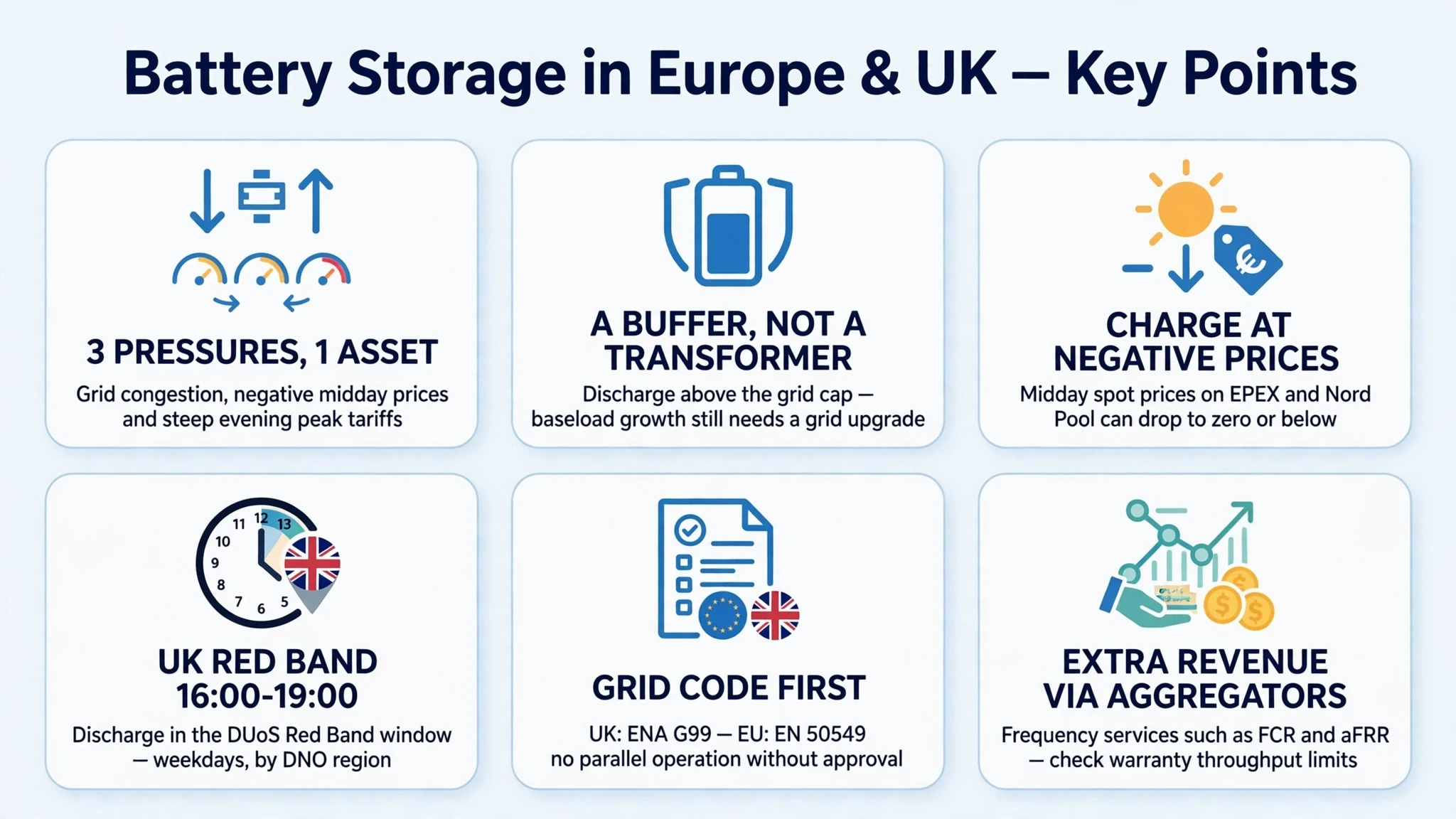
Across the United Kingdom and continental Europe, industrial energy managers and solar EPC contractors face three structural pressures on every project:
- Distribution grid congestion that delays utility transformer upgrades for years
- Midday negative wholesale spot prices and zero-export limits that penalize unstored solar PV
- Steep evening peak tariffs (such as UK DUoS Red Band windows) that inflate manufacturing electricity bills
Deploying commercial battery storage for business solves all three problems behind the meter, provided the cabinet meets regional grid-interconnection codes, property insurer fire-safety requirements and on-grid/off-grid switching demands.
Below, we break down the commercial revenue drivers in the UK, the EU, Australia and the Middle East, map the grid and safety standards required for utility and insurer approval, and explain how hybrid on-grid/off-grid switching supports critical factory loads during blackouts.
1. Why European & UK Businesses Are Deploying Industrial Solar and Battery Storage Solutions
1.1 Mitigating grid congestion and transformer capacity limits
In industrial zones across the Netherlands (where feeder congestion, or Netcongestie, restricts new commercial connections), Germany and parts of the UK Distribution Network Operator (DNO) network, factories expanding production lines or adding heavy EV chargers often face multi-year queues for utility transformer upgrades.
Behind-the-meter industrial solar and battery storage solutions act as a dynamic capacity buffer when the facility's peak load is temporary rather than continuous:
- 1. The plant's Energy Management System (EMS) monitors real-time current draw at the utility point of common coupling (PCC).
- 2. When machinery starts or shift-change EV charging pushes site demand toward the contracted supply capacity (kVA or kW limit), the BESS discharges AC power to supply the load above the grid cap.
- 3. Once plant demand drops during off-peak hours or midday solar generation rises, the battery recharges without breaching the utility import limit.
Engineering boundary:
- Dynamic capacity boosting works when peak spikes fit within the battery's usable AC energy capacity (after deducting depth-of-discharge limits, PCS conversion losses and auxiliary cooling loads).
- It does not replace a physical grid upgrade if a factory increases its continuous 24-hour baseload above the transformer rating.
1.2 Eliminating zero-export curtailment and midday negative spot price losses
Rapid solar PV deployment across Germany, the Netherlands, Spain and Australia has created frequent midday hours where wholesale day-ahead prices on EPEX Spot or Nord Pool drop to zero or turn negative.
Under dynamic wholesale-linked retail contracts, exporting unstored rooftop solar during negative-price intervals costs the site owner money. At the same time, utilities in congested feeder zones increasingly impose zero-export or hard export caps on new commercial PV arrays.
Coupling a liquid-cooled BESS with commercial rooftop PV shifts that curtailed or zero-value midday generation into late-afternoon and evening operating shifts. Actual self-consumption gains depend on the alignment between daytime production loads, PV array sizing and usable battery storage capacity.
1.3 UK DUoS Red Band management and European dynamic spot arbitrage
- United Kingdom: Commercial electricity bills combine wholesale half-hourly energy prices with network charges, including Distribution Use of System (DUoS) time-band rates (Red, Amber and Green periods) and agreed supply capacity (kVA) charges.
- UK peak dispatch: Discharging stored solar or overnight power during the DUoS Red Band window (commonly 16:00 to 19:00 on weekdays, by DNO region) avoids peak wholesale rates and volumetric Red Band charges while keeping kVA demand within contracted capacity.
- Continental Europe: Industrial buyers on dynamic day-ahead or intraday tariffs configure their EMS to pull day-ahead price schedules automatically, charging during overnight troughs or negative-price midday solar hours and discharging during evening price spikes.
1.4 Participating in ancillary grid services via licensed aggregators
In markets such as the UK (Dynamic Containment, Dynamic Moderation and Demand Flexibility) and continental Europe (FCR and aFRR), commercial storage assets can earn secondary revenue by providing fast frequency response or balancing capacity.
Because transmission system operators require minimum bid sizes and pre-qualification testing, behind-the-meter C&I systems typically enroll through a licensed third-party aggregator or Virtual Power Plant (VPP) operator.
Before modeling grid-service revenue, verify that the aggregator's dispatch profile fits within your battery warranty's annual cycle and energy-throughput limits.
Evaluating behind-the-meter storage for peak shaving, solar self-consumption or dynamic tariff management? Review KRL Power's modular commercial and industrial (C&I) energy storage systems to match a cabinet architecture to your site load profile.
2. Regional Grid Codes, Battery Safety Testing & Compliance Requirements
2.1 Why grid-interconnection approval starts with PCS compliance
In the UK, the EU and Australia, a commercial battery cannot operate in parallel with the public distribution network without formal permission from the local network operator (such as a UK DNO, a German Verteilnetzbetreiber, or an Australian DNSP).
Before issuing permission to energize, the network operator reviews the Power Conversion System (PCS) test certificates, fault-ride-through curves, harmonic emission limits and anti-islanding protection settings.
2.2 Table 1: Regional grid codes, safety frameworks and KRL reference tiers
Note: Specific grid-code, product safety and fire-testing requirements depend on installation capacity, voltage level, local authority rules and insurer underwriting criteria. Always confirm exact certification scope and PCS model compliance with KRL Power during project engineering.
| Region & Market | Typical Grid Connection Standards | Safety, Insurer & Transport Frameworks | Primary C&I Use Cases & KRL Reference Tiers |
|---|---|---|---|
| United Kingdom | ENA EREC G99 (applies above the 16A/phase G98 threshold; Type A covers 0.8kW to under 1MW, Type B covers 1MW to under 10MW) | CE or UKCA (Great Britain), CE (Northern Ireland), applicable IEC standards (e.g., IEC 62619), UL 9540A fire test data (often requested by insurers), UN 38.3 transport | DUoS Red Band peak avoidance, kVA capacity management, solar self-consumption (e.g., 100kWh to 522kWh tiers) |
| European Union (Germany, Netherlands, Spain, Italy) | EN 50549-1 (LV) / EN 50549-2 (MV); VDE-AR-N 4105 / 4110 (DE); CEI 0-21 / 0-16 (IT) | CE (LVD / EMC), applicable IEC standards (such as IEC 62619), UL 9540A thermal runaway data, UN 38.3 transport | Grid-congestion buffering (Netcongestie), EPEX Spot arbitrage, zero-export PV storage (e.g., 261kWh to multi-MWh tiers) |
| أستراليا | AS/NZS 4777.2 (LV inverter connections; larger C&I / MV systems must also meet specific DNSP & AEMO technical rules) | AS/NZS 5139 (covers 1–200kWh BESS; systems over 200kWh require project-specific fire/safety engineering beyond AS/NZS 5139 scope), IEC 62619, UL 9540A, UN 38.3 | Midday solar-sponge absorption, peak tariff shaving, off-grid mining/agricultural microgrids (e.g., 100kWh to multi-MWh tiers) |
| Middle East & Weak-Grid Industrial Zones | Local utility rules (such as DEWA / SEC) or islanded off-grid operation | Applicable IEC / UL standards, high-ambient liquid-cooling thermal stability, UN 38.3 transport | Diesel generator hybridization, fuel reduction, 24/7 factory and cold-storage microgrids (e.g., 100kWh to multi-MWh tiers) |
2.3 Understanding CE / UKCA, IEC 62619, UL 9540A and UN 38.3 in commercial procurement
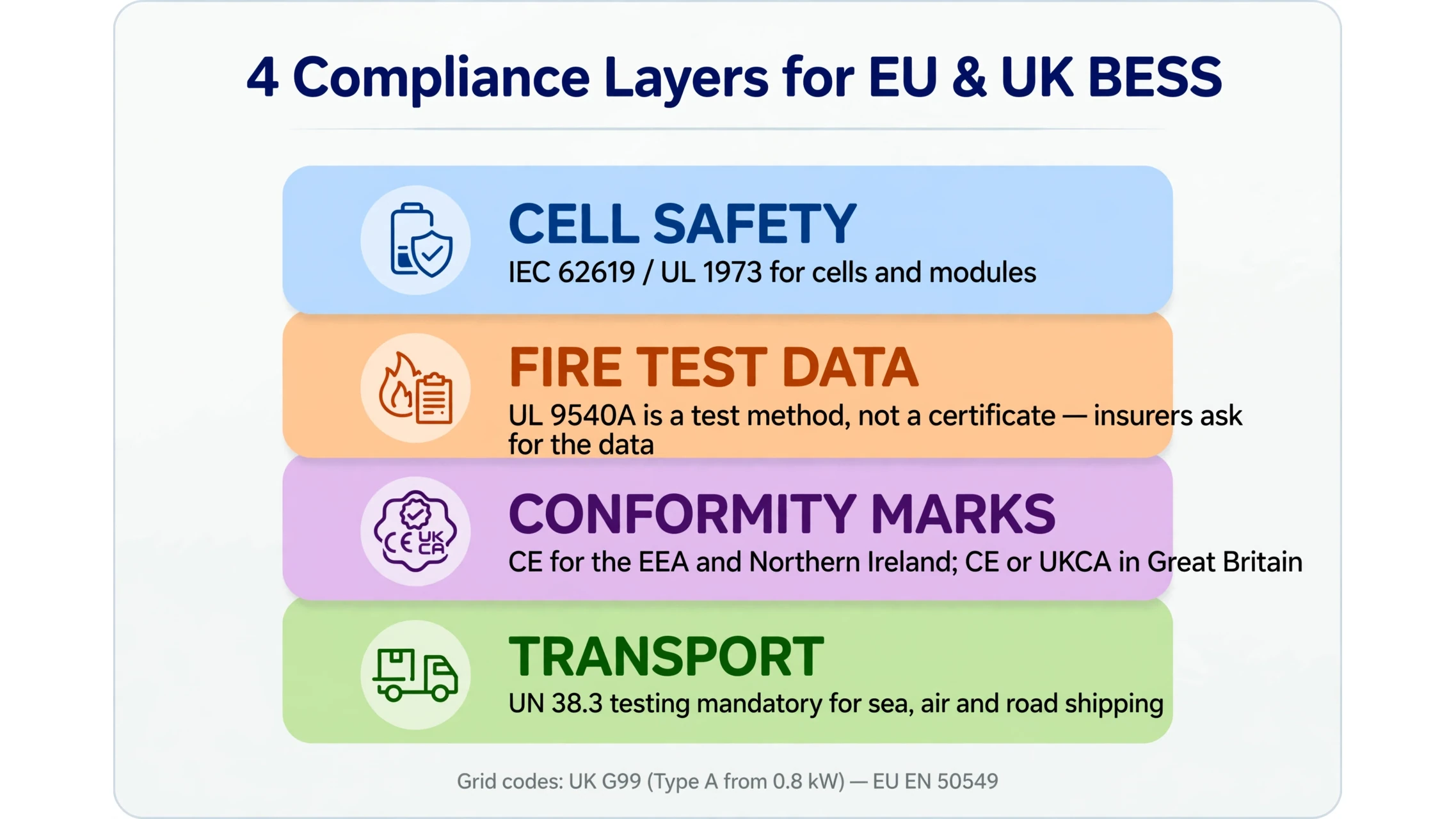
When preparing a technical specification for a commercial BESS tender, procurement teams and EPC engineers should distinguish four separate compliance layers:
- 1. Cell and industrial battery safety (such as IEC 62619 and UL 1973): Evaluates the electrical, mechanical and BMS functional safety of secondary lithium cells and modules in stationary industrial service.
- 2. Thermal runaway fire propagation testing (UL 9540A): UL 9540A is a fire test method (not a pass/fail product certificate) that measures heat release, gas composition and thermal runaway propagation. Commercial insurers (such as Allianz, AXA and FM Global) often request UL 9540A test data alongside cabinet fire-suppression specs during underwriting.
- 3. Electromagnetic and low-voltage conformity (CE / UKCA): CE marking is required across the European Economic Area and Northern Ireland, while Great Britain currently accepts either CE or UKCA marking under applicable electrical equipment regulations.
- 4. International transport compliance (UN 38.3 and SDS/MSDS): UN 38.3 transport testing and supporting Safety Data Sheet (SDS/MSDS) documentation are mandatory for shipping lithium battery systems by sea, air or road, and are separate from stationary installation approvals.
How KRL Power supports project compliance:
- International compliance frameworks: KRL Power's C&I storage systems are engineered on LiFePO4 battery technology and support international CE, IEC, UL and UN 38.3 compliance frameworks.
- Multi-stage cabinet safety: Liquid-cooled enclosures incorporate cabinet-level fire suppression, gas and smoke detection, and active liquid cooling that keeps cell temperature differences within 3°C on flagship models such as the KRL-B261L.
- Project-matched certification review: Submit your target grid code (such as G99, EN 50549 or VDE-AR-N 4110) and insurer fire-safety checklist to KRL Power during the RFQ stage so our engineers can confirm matched PCS configurations and project certification files.
3. On-Grid vs. Off-Grid: Microgrid and Backup Power for Factories
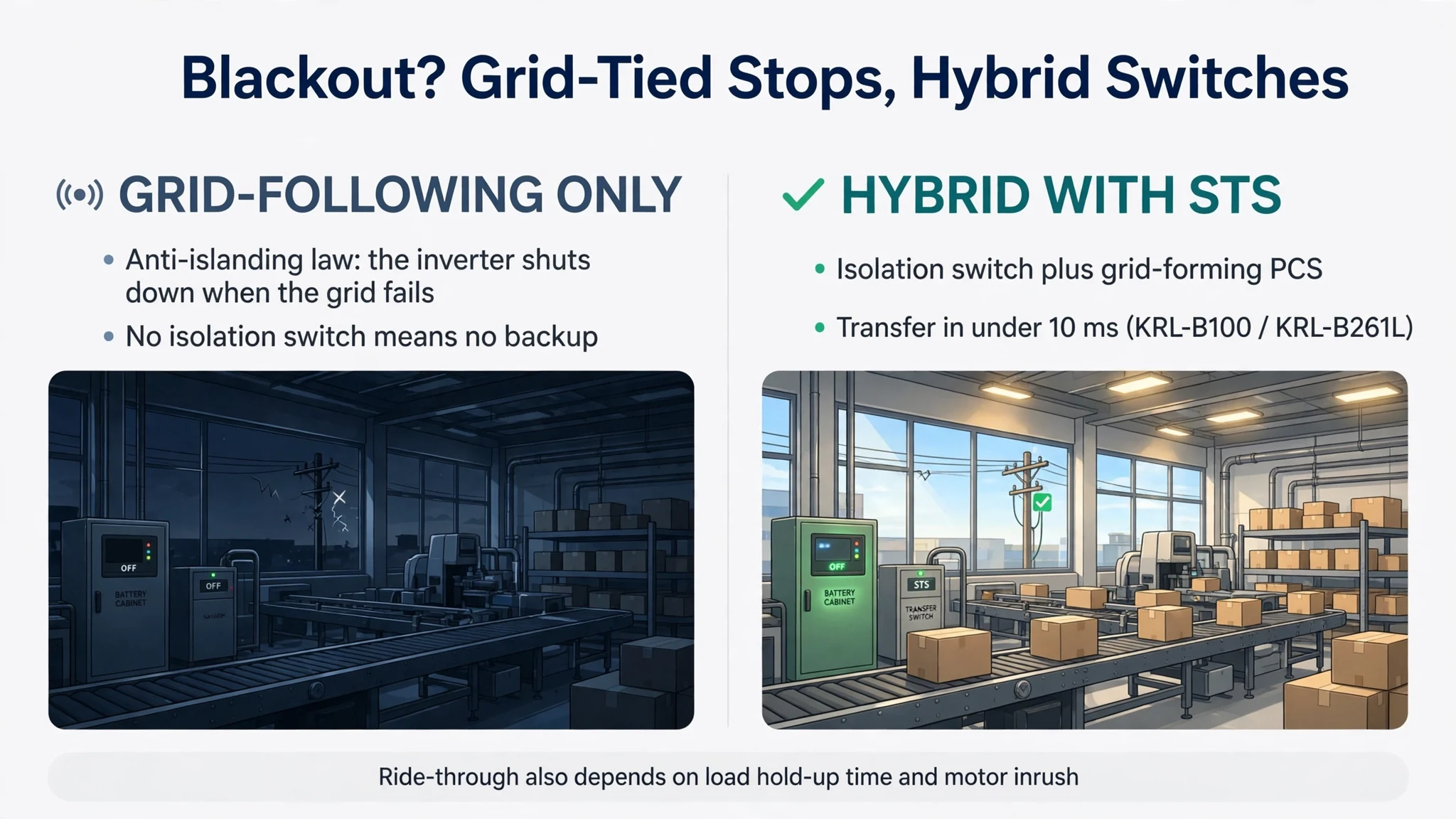
3.1 Why standard grid-tied storage shuts down during a blackout
A common procurement mistake occurs when a factory owner buys a standard grid-tied (grid-following) battery cabinet expecting it to keep machinery running during a utility outage.
Under mandatory anti-islanding regulations (included in ENA G99, EN 50549 and VDE standards), any grid-connected inverter must cease energizing the utility line when the external grid fails, protecting utility workers from back-feed electrocution.
Without a physical isolation switch to disconnect the factory's critical loads from the dead utility street feeder, and without a grid-forming (voltage-source) PCS mode, a grid-tied-only battery locks out and remains idle throughout the blackout.
3.2 Hybrid on-grid / off-grid architecture with sub-10ms switching
Delivering reliable microgrid and backup power for factories requires an integrated transfer and grid-forming architecture:
- Grid-connected mode (normal operation): The BESS operates in parallel with the utility grid, executing TOU arbitrage, peak shaving, solar self-consumption and reactive power control.
- Islanded backup transition (under 10 ms UPS-grade switching): When a grid outage occurs, an integrated Static Transfer Switch (STS) or fast isolation contactor disconnects the protected load bus from the grid while the PCS switches to voltage-source (grid-forming) mode.
- Sub-10ms transfer on KRL cabinets: On the KRL-B100 (50kW / 100kWh) solar-diesel BESS cabinet و KRL-B261L (125kW / 261kWh) liquid-cooled C&I ESS, on-grid-to-off-grid transfer completes in under 10 milliseconds.
- Critical-load ride-through considerations: Whether sensitive CNC controls, PLCs and servers ride through without restarting also depends on each load's power-supply hold-up time, transfer waveform, motor inrush current and critical-load panel separation.
- Solar-storage-diesel coordination: For extended outages or off-grid sites, the system coordinates with rooftop PV via built-in MPPT inputs (such as the 100kW MPPT on the KRL-B100 or the 240kW MPPT on the KRL-B522L (250kW / 522kWh) industrial storage system) and backup diesel generators.
- Low-voltage auxiliary DC backup: For auxiliary 48V DC telecom or control-room backup racks inside substations, refer to our 48V 13S/15S/16S lithium battery voltage chart.
- Multi-megawatt scaling: For industrial parks or mining microgrids, the KRL-B2M6L containerized BESS series offers containerized liquid-cooled configurations (with published standard datasheets for 750kW / 1.5MWh and 1MW / 2MWh alongside 1.2MW / 2.6MWh and multi-MWh project configurations).
الأسئلة الشائعة
How do businesses use battery storage to reduce electricity bills?
Can C&I BESS operate off-grid during power outages?
Can commercial battery storage eliminate the need for a transformer upgrade?
How does a commercial BESS benefit from negative wholesale electricity prices?
What is the UK DUoS Red Band and how can BESS reduce the charge?
What must an EPC verify before connecting a commercial BESS to the public grid?
Is a UL 9540A fire test report the same as a system certification?
Why are CE or UKCA marking and UN 38.3 transport documentation separate requirements?
Can behind-the-meter commercial storage earn revenue from frequency services?
What must be checked before promising uninterrupted factory backup during a blackout?
4. Conclusion & Request a Project Compliance & Sizing Evaluation
Deploying commercial battery storage in Europe, the UK, Australia or the Middle East requires aligning your revenue model (whether dynamic spot arbitrage, DUoS peak shaving or solar-diesel microgrid backup) with verified grid-connection and fire-safety documentation.
- For European, UK and Australian solar-storage EPCs and distributors: Contact KRL Power's engineering team with your target country, grid standard and volume requirements to request technical datasheets, certification files and an EXW, FOB or CIF quotation.
- For industrial facility owners needing custom microgrid or capacity-boosting configurations: Explore our OEM/ODM custom battery solutions and share your 15-minute load profile, solar PV capacity and transformer kVA limit to receive preliminary sizing guidance and a project quotation evaluation.