 تخطي إلى المحتوى
رد شركة KRL Power على مصنع أثاث في لاغوس طلب منه بطارية سعة 50 كيلوواط/ساعة مزودة بمحول تيار بقدرة 100 كيلو فولت أمبير يبدأ الأمر بحقيقة هندسية واحدة: هذان التصنيفان يصفان مهام مختلفة. فطاقة البطارية تحدد نطاق التشغيل، في حين أن قدرة المحول تحدد الأجهزة التي يمكن تشغيلها معًا وما إذا كان من الممكن دعم عمليات بدء تشغيلها.
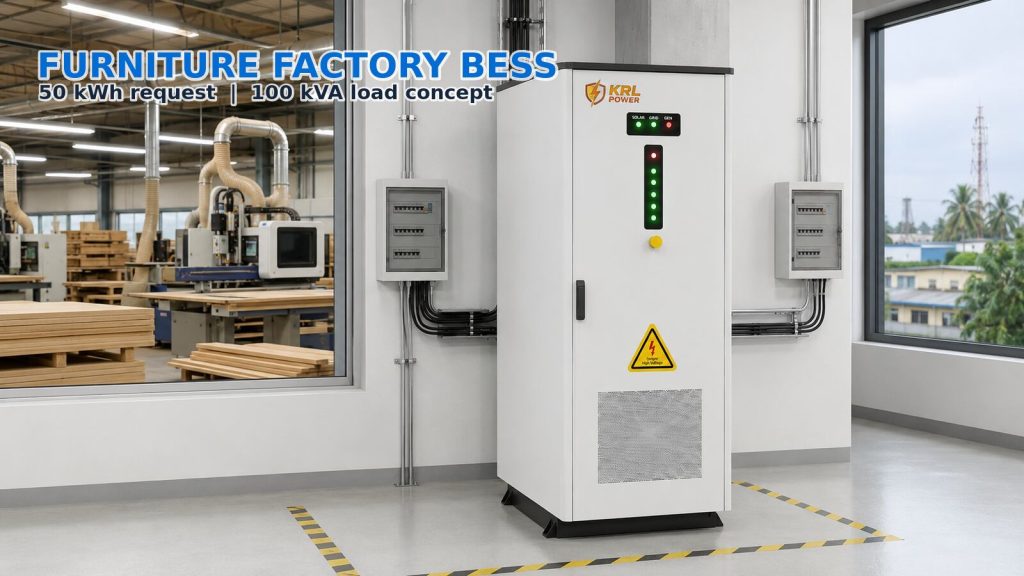
بالنسبة لهذا المصنع، يعتمد اتخاذ قرار شراء موثوق على أربع قيم:
- القدرة الحقيقية القصوى المتزامنة بالكيلوواط
- القدرة الظاهرية ومعامل القدرة بوحدة kVA وPF
- تسلسل تشغيل المحرك وإعادة تشغيله
- وقت التشغيل المطلوب لأحمال الإنتاج المحددة
ويمكن بعد ذلك مقارنة الطلب مع ما نشرته شركة KRL KRL-B100 50 كيلوواط / 100 كيلوواط ساعة خزانة مدمجة. يُعد الطراز B100 تكوينًا محددًا للمنتج. يجب على قسم المشتريات رفض شراء محول بقدرة 100 كيلو فولت أمبير مقترنًا ببطاريات بسعة 50 كيلوواط ساعة كأساس للشراء في إطار التشغيل المستمر، إلى أن يثبت المورد أن البطارية، وناقل التيار المستمر، وأنظمة الحماية والتبريد قادرة على توفير الطاقة المطلوبة.
تحويل 100 كيلو فولت أمبير إلى طاقة الحمل في المصنع
A 100 كيلو فولت أمبير القيمة الاسمية هي القدرة الظاهرية. ويعتمد الطلب الفعلي للمصنع على الطاقة بالكيلوواط على معامل القدرة الإجمالي للمعدات التي تعمل في تلك اللحظة:
القدرة الحقيقية (kW) = القدرة الظاهرية (kVA) × معامل القدرة
يرجى اعتبار القيم التالية أمثلة حسابية أولية، ولا علاقة لها بتصنيفات منتجات KRL وفترات تشغيل البطاريات المنصوص عليها في العقود.
| معامل القدرة التوضيحي | قدرة تيار متردد فعلية تبلغ 100 كيلو فولت أمبير | الحد الأدنى لمعدل P/E من بطارية سعة 50 كيلوواط/ساعة | الفترة المثالية قبل تسجيل الخسائر وتكوين المخصصات |
|---|---|---|---|
| 0.80 | 80 كيلوواط | 1.6 ساعة⁻¹، أي ما يعادل 1.6C تقريبًا | 0.63 ساعة، أي حوالي 38 دقيقة |
| 0.90 | 90 كيلوواط | 1.8 ساعة⁻¹, ما يعادل 1.8C تقريبًا | 0.56 ساعة، أي حوالي 33 دقيقة |
| 0.95 | 95 كيلوواط | 1.9 ساعة⁻¹, ما يعادل 1.9C تقريبًا | 0.53 ساعة، أي حوالي 32 دقيقة |
| 1.00 | 100 كيلوواط | 2,0 ساعة⁻¹, حوالي 2,0 درجة مئوية | 0.50 ساعة و30 دقيقة |
الـ 2.0C تُظهر النتيجة عند 100 كيلوواط العيب الرئيسي في الطلب. فهي عبارة عن نسبة طاقة؛ ويتطلب تحديد معدل التفريغ المستمر الآمن أدلة مستقلة من المعدات. وتؤدي خسائر التحويل والمكونات المساعدة في الخزانة إلى رفع الطاقة من جانب البطارية إلى ما يزيد عن الحمل المتردد، في حين أن انخفاض مستوى الشحن وارتفاع درجة الحرارة والمقاومة الداخلية يمكن أن تزيد من انخفاض الجهد وتوليد الحرارة.
قد تقوم وحدة إدارة البطارية (BMS) بتخفيض الطاقة أو قطع التيار عند بلوغ حد معين ومؤكد للتيار أو الجهد أو درجة الحرارة. ويتطلب التنبؤ بالاندفاع الحراري ووقت القطع الثابت البالغ 15 دقيقة بيانات اختبار خاصة بالنموذج، وهي غير متوفرة حاليًا للبطارية المقترحة.
الأدلة المطلوبة لتقديم اقتراح بشأن فترة 1.6 درجة مئوية – 2.0 درجة مئوية
رفض نقطة التشغيل المقترحة إلى أن يقدم المورد ما يلي:
- طاقة تفريغ تيار مستمر مستمرة ومحدودة زمنياً عبر نطاق حالة الشحن المسموح به
- حدود معدل تفريغ الخلايا والوحدات عند درجة حرارة المشروع
- الحد الأدنى لجهد ناقل التيار المستمر (DC-bus) وانخفاض الجهد المتوقع عند التيار المطلوب
- عتبات التيار والجهد المنخفض ودرجة الحرارة في نظام إدارة البطارية (BMS) مع إعدادات التأخير
- القيم الاسمية للتيار المستمر في القضبان الموصلة، والكابلات، والصمامات، والموصلات الكهربائية، والموصلات
- الأدلة المتعلقة بتوليد الحرارة وقدرة التبريد عند معدل الضريبة المقترح
- اختبار التفريغ الذي أُجري بحضور شهود عند جهد التيار المتردد المتعاقد عليه ولفترة زمنية محددة
التوليفة B100 التي نشرتها شركة KRL والمكونة من 50 كيلوواط مع 100 كيلوواط ساعة يتوافق مع قيمة اسمية 0.5 ساعة⁻¹ معدل تحويل الطاقة إلى طاقة. يُشكل التقييم العام معيارًا موثوقًا لفرز المصانع التي تسعى إلى الحصول على خزانة متكاملة؛ ولا يزال الاقتراح الموقع بحاجة إلى بيانات حول الطاقة القابلة للاستخدام وتخفيض السعة الحرارية.
لذلك، ينبغي أن تطلب إدارة المشتريات قيم المحولات هذه كمجموعة واحدة:
- الإخراج المستمر في كيلوواط وكيلوفولت أمبير
- معامل القدرة المقنن ونطاق معامل القدرة المدعوم للحمل
- قدرة التحمل الزائد مع المدة المسموح بها
- أداء بدء تشغيل المحرك وحدود التيار
- ترتيب الجهد والتردد والخط المحايد في الدائرة ثلاثية الأطوار
- تنظيم الجهد والتردد في الأنظمة غير المرتبطة بالشبكة
- جهد البطارية ونطاق الاتصال المعتمدان
يمكن الاطلاع على توضيح شركة KRL لدور نظام PCS في نظرة عامة على محول تخزين الطاقة بقدرة 100 كيلوواط. يجب أن يحدد العرض النهائي طراز جهاز الكمبيوتر الشخصي (PCS) بدقة والحدود الخاصة بالمشروع.
فصل أحمال إنتاج الأثاث حسب النتائج المترتبة عليها
تجمع مصانع الأثاث بين أحمال المحركات وأحمال العمليات وأحمال الدعم منخفضة الطاقة. ويخفي المبلغ الإجمالي لفاتورة الكهرباء تسلسل التشغيل والمعدات التي يجب أن تظل قيد التشغيل أثناء انقطاع التيار الكهربائي.
| مجموعة التحميل | مشكلة كهربائية شائعة | قرار النسخ الاحتياطي | الأدلة المطلوبة لتحديد الحجم |
|---|---|---|---|
| آلة التوجيه باستخدام الحاسب الآلي (CNC) ومعدات التصنيع | دورة الإنتاج المتغيرة؛ أنظمة التشغيل والتحكم | إكمال المهمة الجارية أو متابعة العمل المحدد | بيانات اللوحة التعريفية، والقيم المقاسة بالكيلوواط (kW) والكيلو فولت أمبير (kVA)، ومعامل القدرة (PF)، ومدة الدورة |
| منشار لوحي ومعدات القطع | بدء تشغيل المحرك والذروة المتقطعة | تأجيل إعادة التشغيل ومنع عمليات التشغيل المتزامنة | طريقة التشغيل، وقياس الذروة، وتسلسل إعادة التشغيل |
| مروحة مركزية طرد مركزي لإزالة الغبار | عزم دوران عالٍ؛ فترة تسارع طويلة؛ تشغيل مستمر أثناء عملية القطع | التعامل مع كل قفل أمان لآلة القطع باعتباره عملية ذات أولوية وتنسيقها | القدرة المقدرة للمحرك، وطريقة التشغيل المباشر (DOL)/المشغل الناعم/محرك التردد المتغير (VFD)، ومنحنى التيار مقابل الزمن، ووقت التسارع، ومنطق الترابط الخاص بتدفق الهواء |
| ضاغط الهواء | حدث الانطلاق السريع وركوب الدراجات القائم على الضغط | إعادة التشغيل بعد استقرار الآلات ذات الأولوية | بيانات محرك الضاغط، والتيار المُحمَّل ودورة الضغط |
| آلة لصق الحواف وخط التشطيب | تأثير الحرارة والمحركات وجودة المنتج | إنهاء المواد التي هي قيد المعالجة بالفعل | القدرة التشغيلية بالكيلوواط والحد الأدنى لوقت الإنجاز |
| الإضاءة، والمكاتب، والشبكات | طاقة أقل مع قيمة الاستمرارية | الحفاظ على تزويد الدوائر الأساسية بالتيار الكهربائي | جدول الدورات والطلب المقدر |
| دوائر الحريق والأمن والطوارئ | المسؤولية عن سلامة الموقع | تخصيص الإمدادات المحمية وفقًا لتصميم الموقع المعتمد | الرسومات الكهربائية ومتطلبات السلامة المعمول بها |
يمكن للمالك تصنيف كل دائرة ضمن إحدى المجموعات التشغيلية الثلاث التالية:
- مستمر: يظل مزودًا بالطاقة طوال فترة انقطاع التيار.
- إعادة التشغيل الخاضعة للرقابة: يتم إعادة التوصيل بعد استقرار الجهد والتردد.
- Deferred: stays disconnected until grid or generator power returns.
This load hierarchy protects available battery energy for production steps with the highest cost of interruption. It also gives the EMS and switchgear designer a defined load-shedding sequence.
KRL’s industrial production-line backup reference provides broader manufacturing context. The furniture-factory design still requires measurements from its own machines.
Control Motor Starts and Factory Restart Order
The highest steady operating demand may occur after production is fully running. The most difficult inverter event may occur several seconds after an outage when multiple motors attempt to restart.
An approved restart sequence should state:
- Which contactors open when the incoming source fails
- Which essential circuits remain connected
- Which motor receives the first restart command
- The delay between each subsequent motor start
- The current or power threshold that pauses the sequence
- The action following an unsuccessful start
- The conditions for transferring back to the grid or generator
The electrical study should also record the PCS fault-current contribution, breaker and fuse settings, protective-device selectivity, neutral arrangement and earthing method. These values determine whether a machine fault disconnects the affected feeder while the remaining approved loads stay energized.
Make the Central Dust-Extraction Fan the First Motor Study
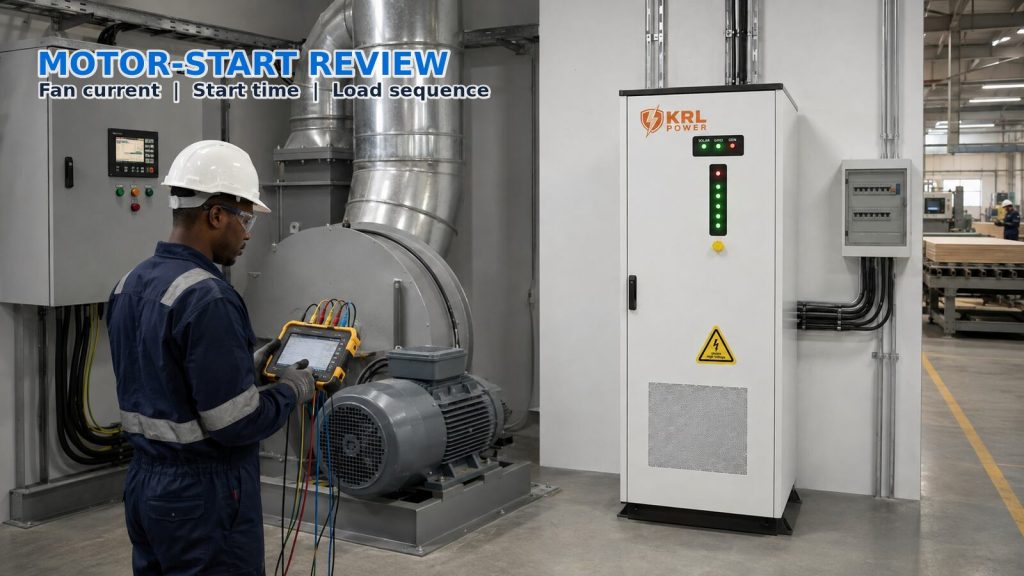
The central centrifugal dust-extraction fan can dominate the furniture factory’s inverter decision. Its impeller carries high rotational inertia, and the fan must remain available whenever connected saws, routers or sanders require extraction.
The EPC should capture one complete fan start with a power-quality recorder and document:
- RMS current and kVA throughout acceleration
- Peak current and the duration above rated current
- Voltage depression at the motor and main bus
- DOL, star-delta, soft-starter or VFD settings
- Loaded and unloaded start conditions, including dampers
- Running kW, kVA and power factor at the required airflow
- Restart delay and interlocks with every dust-producing machine
ABB identifies centrifugal fans as high-inertia, heavy-duty soft-starter applications. A 15–25 second start may be credible for a specific installed fan, yet the procurement model must use its recorded current-time curve. The PCS overload envelope must remain above that curve with the other continuous loads energized.
If the fan start exceeds the confirmed B100 overload capability, the design team can evaluate a VFD or soft starter, unload the fan for starting, sequence the motor under generator power, or move to a higher-power storage class. Each option requires a protection and process review.
Variable-frequency drives and soft starters can change the starting profile. PCS compatibility still requires review of harmonics, regenerative behavior, DC-bus interaction and control settings for the exact drive and inverter combination.
The site acceptance test should reproduce the agreed sequence with production representatives present. A full-duty demonstration validates the cabinet against the factory’s most demanding approved operating mode.
Compare the 50 kWh Request with the KRL-B100
KRL publicly lists the KRL-B100 50 kW / 100 kWh all-in-one BESS for medium-sized commercial and industrial applications. Its published configuration gives the buyer a defined basis for technical comparison.
| KRL-B100 item | القيمة المنشورة |
|---|---|
| Battery chemistry and rated energy | LiFePO4; 100 kWh |
| القدرة الكهربائية المقننة للتيار المتردد | 50 kW on-grid; 50 kW off-grid |
| واجهة التيار المتردد | 400/230 Vac; 50/60 Hz; maximum AC current 75 A |
| مدخلات الطاقة الكهروضوئية | 100 kW maximum; 1,000 Vdc maximum voltage |
| MPPT | 200–900 Vdc; four trackers; 4 × 40 A input |
| Transfer time | Below 10 ms |
| Source and communication interfaces | Generator interface; RS485/WiFi |
| Enclosure and thermal management | IP54; industrial air conditioner; PCS intelligent cooling |
| الحماية من الحرائق | Listed as included on the public product record |
| Operating environment | −10°C to 50°C; 5–95% RH; altitude below 3,000 m |
| Dimensions and approximate weight | 740 × 1,348 × 2,350 mm; approximately 1,150 kg |
The published ratio of 100 kWh / 50 kW equals two hours at rated AC power before applying losses, operating reserve and site conditions. A contracted backup duration needs an AC-delivered energy definition and an agreed end-of-discharge condition.
The published transfer time below 10 ms describes the B100 switching function. Production continuity also depends on PLC ride-through, VFD undervoltage settings, contactor hold-in behavior, control-power supplies and the restart logic of each selected machine. The acceptance procedure should test those devices with the agreed critical-load group energized.
B100 Fit Conditions for the Furniture Factory
The B100 can enter the technical shortlist when all of these conditions are satisfied:
- The approved simultaneous backup load stays within the cabinet’s 50 kW rated AC power.
- The measured starting and restart events fit the confirmed PCS overload envelope.
- The calculated usable-energy requirement fits the final operating reserve and runtime target.
- The factory AC system matches the published 400/230 Vac, 50/60 Hz interface after engineering review.
- The installation environment fits the published IP rating, temperature, humidity and altitude limits.
- The final single-line diagram defines grid, PV, generator and load connections.
The complete KRL cabinet range is listed on the KRL C&I energy-storage system catalogue.
Calculate the B100 Operating Window
The preliminary energy calculation uses average critical-load power. A simple first-pass formula is:
Nominal operating time = nominal battery energy ÷ average load power
| Illustrative average critical load | Ideal time from 100 kWh nominal energy | Procurement interpretation |
|---|---|---|
| 20 kW | 5.00 hours | Longer coverage for a limited essential-load group |
| 30 kW | 3.33 hours | Supports a broader group with controlled machinery use |
| 40 كيلوواط | 2.50 hours | Leaves less power margin for overlapping loads |
| 50 kW | 2.00 hours | Reaches the published AC rated-power level |
These ideal values are calculation references. The engineering model should deduct:
- Minimum state-of-charge reserve
- PCS and transformer losses within the contracted boundary
- Cabinet auxiliaries, cooling and controls
- Battery power and energy limits at the design temperature
- Capacity allowance for the agreed service period
- Uncertainty in machine duty cycles
The proposal should show nominal DC energy, expected usable DC energy and guaranteed AC-delivered energy as separate entries. This prevents two suppliers from using the same “100 kWh” label while pricing different delivery obligations.
KRL’s commercial energy-storage design process gives additional system-level context for power, energy and operating objectives.
Select a Higher Power Class When the Load Requires It
Use the B100 within its published 50 kW AC rating. KRL’s public range includes higher-power cabinet classes for approved factory demand above that boundary.
| Measured requirement | Product-screening response |
|---|---|
| Essential demand within 30 kW and modest energy requirement | Review the KRL-B65 30 kW / 65 kWh class and the full duty profile |
| Essential demand within 50 kW with a longer energy target | Review the KRL-B100 50 kW / 100 kWh class |
| Essential demand above 50 kW and within a 125 kW planning class | Review KRL-B241 125 kW / 241 kWh and KRL-B261L 125 kW / 261 kWh after model-specific checks |
| Demand above published cabinet power or with complex expansion | Develop a coordinated multi-unit or larger-system design using approved parallel and protection data |
The selection decision should use measured demand and operating duty. Motor-start capability, short-circuit contribution, protection settings and load compatibility require separate model-specific evidence.
Buyers comparing product classes can use KRL’s commercial energy-storage selection criteria and request model-specific data for the final shortlist.
Define Grid, Solar and Generator Operating Modes
Grid conditions, onsite PV and standby-generator status remain unconfirmed in the customer demand record. The offer should price the interfaces included in its signed scope and identify the available future interfaces.
| Power source | Required decision | B100 public information | Project document needed |
|---|---|---|---|
| Utility grid | Charge limit, outage detection, reconnection and export rule | On-grid operation is listed | Approved single-line diagram and utility requirements |
| الطاقة الشمسية الكهروضوئية | DC-coupled or AC-coupled architecture; curtailment and charge priority | Maximum 100 kW PV; 1,000 Vdc; 200–900 Vdc MPPT | String design, inverter/MPPT allocation and control schedule |
| مولد ديزل | Start command, minimum loading, charge limit and transfer sequence | Generator interface is listed | Generator model, voltage, frequency, controller and operating sequence |
| BESS | Grid-forming responsibility, black-start need and load-shed sequence | Not stated publicly for the quoted project | Project control narrative and acceptance procedure |
The B100 public PV maximum is 100 كيلوواط, while its rated AC output is 50 kW. The final design must define DC oversizing, charging allocation, curtailment behavior and operating conditions. Treat the 100 kW PV input value and the 50 kW AC load rating as separate design limits.
For sites with generator operation, KRL’s Nigeria industrial diesel-hybrid energy-storage reference can help identify interface questions. Project guarantees must come from the signed furniture-factory design.
Use Diesel-Hybrid Dispatch to Reduce Generator Run Hours
For a Lagos factory exposed to long or repeated outages, diesel displacement can carry greater commercial value than tariff arbitrage. The EMS should operate the generator and BESS as one controlled system:
- Start the generator at the approved low-SOC threshold or when forecast energy becomes insufficient.
- Supply the active factory loads and charge the BESS within the verified generator, PCS and battery limits.
- Modulate BESS charging to hold the generator inside the validated efficient-load band.
- Complete the required minimum run time and cooldown, then stop the generator at the approved target SOC.
- Supply the selected factory loads from the BESS until the next restart condition.
و 80%–85% generator loading target can be tested during commissioning when it agrees with the selected engine’s fuel-consumption curve, prime rating, ambient derating and minimum-load requirements. Caterpillar publishes fuel data at several load points and defines prime applications through model-specific ratings; the final setpoint should therefore come from the quoted generator data.
The commercial model should compare measured litres of diesel per delivered AC kWh for the existing operating pattern against the proposed generator-plus-BESS sequence. Include start fuel, cooldown, charging loss, BESS auxiliary power, maintenance intervals and battery degradation. This produces an auditable diesel-saving estimate without promising a fixed ROI.
Build the CFO Diesel-Hybrid Business Case
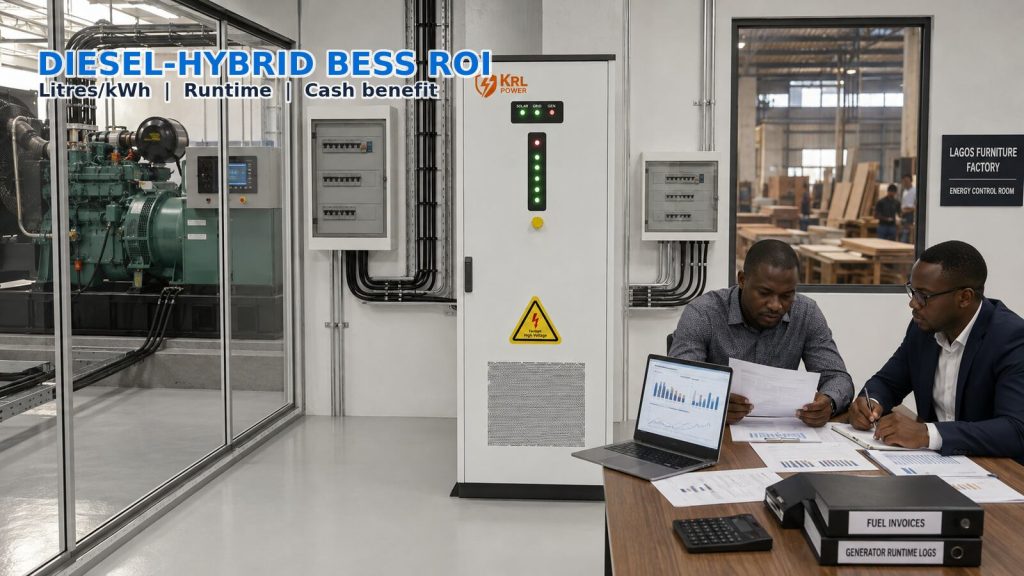
The CFO decision rests on annual cash flow, production continuity and the installed project cost. Four commercial levers should be measured separately so that one optimistic assumption cannot conceal a weak proposal.
| Evaluation area | Existing diesel-only baseline | KRL diesel-hybrid operating plan | CFO measure and evidence |
|---|---|---|---|
| Generator loading and fuel efficiency | Record generator load, runtime, litres consumed and delivered AC kWh across production and low-load periods. Flag prolonged light-load operation against the engine maker’s limits. | Use the EMS charge command to place additional controlled load on the generator within its validated operating band, then stop it after the approved SOC, minimum-runtime and cooldown conditions are met. | Litres per delivered kWh, litres per production day, generator runtime and the exact engine fuel curve |
| Central extraction fan and motor starts | Record voltage, frequency, current and restart time when the fan and major machines start. Connect each event to lost production and rejected material. | Apply the approved start sequence, load shedding and BESS support within the PCS’s verified short-duration overload curve. | Successful starts, voltage and frequency minimums, interruption minutes, scrap quantity and contribution margin lost |
| Maintenance and overhaul exposure | Use service invoices and hour-meter records for oil, filters, callouts, planned service and overhaul accrual. | Recalculate service events from the simulated hybrid generator hours and the engine maker’s calendar- and hour-based schedule. | Annual generator service cost, overhaul reserve and productive hours lost during service |
| Future solar contribution | Establish the present roof, interconnection and daytime load constraints. | The B100 lists a 100 kW maximum PV input. The string design, MPPT allocation, charging limit and 50 kW AC power boundary still govern the usable solar contribution. | PV kWh absorbed, diesel-generated kWh displaced, curtailment and additional installed solar cost |
الـ 80%–85% loading range is a commissioning candidate when the selected generator’s fuel curve and rating data support it. Fuel efficiency should be calculated from the exact generator model at the expected ambient condition. A universal percentage would be unsuitable for contract guarantees.
Use a Measured Baseline
Build the baseline from the factory’s operating records:
- Delivered diesel price in NGN per litre, supported by recent supplier invoices
- Litres consumed per day and per generator operating hour
- Generator output in kWh from a revenue-grade or verified temporary meter
- Generator model, rating basis and manufacturer fuel-consumption curve
- Fifteen-minute factory demand, power factor and outage-duration records
- Motor-start current and start duration for the central extraction fan
- Production interruption minutes, rejected material and verified contribution margin per productive hour
- Generator service invoices, hour-meter readings and overhaul history
- Complete installed BESS cost, including switchgear, cables, controls, logistics, commissioning and room works
Use at least one representative production cycle and cover both high-output and light-load shifts. A 30-day record is useful when production mix and grid outages vary through the month. Longer records improve seasonal confidence.
Calculate Cash Benefit with Traceable Formulas
| CFO output | Calculation basis |
|---|---|
| Baseline annual fuel cost | Delivered diesel price × baseline litres consumed per year |
| Hybrid annual fuel cost | Delivered diesel price × simulated hybrid litres per year, using the selected engine’s fuel curve |
| التكلفة السنوية للوقود التي تم تجنبها | Baseline annual fuel cost − hybrid annual fuel cost |
| Annual maintenance benefit | Baseline generator maintenance and overhaul accrual − hybrid generator maintenance and overhaul accrual |
| Recovered production contribution | Productive hours recovered × verified contribution margin per hour × realization factor |
| Annual net cash benefit | Avoided fuel cost + maintenance benefit + recovered production contribution − BESS service cost − BESS auxiliary-energy cost |
| فترة الاسترداد البسيطة | Incremental installed diesel-hybrid project cost ÷ annual net cash benefit |
| Net present value | Negative initial installed cost + the sum of each year’s discounted net cash benefit |
الاستخدام contribution margin per productive hour for the interruption calculation. Gross sales value overstates the benefit because material, labor and other variable costs remain attached to recovered production. The realization factor should reflect whether the factory has sufficient confirmed orders to use the recovered hours.
Set Commercial Approval Gates
The proposal is ready for CFO approval when the commercial schedule shows:
- The baseline meter period and diesel invoices used in the calculation.
- The generator fuel curve, selected loading band and assumed daily dispatch sequence.
- The critical-load kW, average runtime load and motor-start sequence supported by the BESS.
- The B100’s 50 kW / 100 kWh product boundary and every external component required for the final topology.
- Charging losses, cabinet auxiliary energy, battery degradation and service costs.
- Installed CAPEX with taxes, logistics, civil works, electrical works and commissioning boundaries.
- Base, conservative and high-outage scenarios using the same documented formulas.
- Acceptance tests that connect the commercial model to measured litres, kWh, start performance and productive uptime after commissioning.
Fixed claims such as 40%–60% fuel savings, three to four hours of generator operation per day or a three- to four-fold maintenance extension belong in the offer only when the measured baseline and model-specific simulation produce those results. The signed guarantee should state its measurement period, meter locations, operating assumptions and exclusions.
Check the Installation Environment in Lagos
The B100 public enclosure rating is IP54, and its battery section uses an industrial air conditioner. The equipment location should support the published environmental range and provide service access.
The layout review should confirm:
- Indoor or sheltered outdoor location and exposure to wind-driven rain
- Sawdust migration from cutting and sanding areas
- Air intake and discharge clearances
- Ambient temperature and humidity at the proposed cabinet position
- Foundation capacity for an approximately 1,150 kg cabinet
- Delivery path for a 740 × 1,348 × 2,350 mm enclosure
- Fire detection, separation, emergency access and local approval requirements
- Cable entry, drainage, earthing and maintenance isolation
Lagos combines a coastal location with high-humidity exposure. Fine sawdust entering an electrical cooling path can retain moisture and mix with airborne salt contamination. Deposits can promote corrosion, reduce insulation performance and interfere with contactors, control boards and cooling surfaces.
Schneider Electric classifies relative humidity above 80%, high dust and coastal salt exposure as severe conditions for switchgear. Its maintenance guidance records condensation, rust, mechanism problems and conductive salt deposits on electronic boards as credible failure mechanisms.
The EPC should compare three installation architectures:
| Architecture | Required engineering controls | Acceptance evidence |
|---|---|---|
| Separate BESS room | Filtered and dehumidified air, controlled access, sealed penetrations and dust housekeeping | Room RH trend, filter differential pressure, dust inspection and insulation test |
| Positive-pressure electrical room | Filtered dry supply air, verified pressure differential, relief path and door-management procedure | Pressure alarm test, airflow balance, filter maintenance plan and condensation check |
| Segregated cooling-air design | Cooling intake positioned outside the woodworking dust zone; sealed internal electrical path where supported by the product design | Manufacturer-approved airflow drawing, ingress inspection and thermal test |
Positive pressure only works when its supply air is cleaner and drier than the surrounding factory air. Drawing untreated coastal air into the room can increase salt and moisture exposure. The design must also respect the B100 cooling arrangement and KRL’s approved installation instructions.
The BESS location should be coordinated with the factory’s extraction system and cleaning procedure. The IP54 rating remains one part of the design; humidity control, salt exposure, filtration, pressure management and maintenance complete the environmental protection strategy.
KRL’s discussion of energy storage for unreliable-grid industrial sites provides application context, while the final layout remains a project engineering deliverable.
Price the Complete Procurement Boundary
A useful quotation assigns every component and service to a responsible party. Total installed cost requires stated electrical and site boundaries alongside the battery cabinet price.
| Scope item | Supplier quotation should state | EPC or owner decision |
|---|---|---|
| BESS cabinet | Model, quantity, rated power, rated energy and included controls | Approved duty and installation location |
| Grid and load switchgear | Included equipment, ratings and protection functions | Existing system data and coordination study |
| PV equipment | Included MPPT/PCS boundary and DC protections | PV module/string design and installation scope |
| دمج المولدات | Included interface and control signals | Generator data and operational responsibility |
| External cables | Included length, termination and exclusions | Route, sizing, installation and testing |
| اللوجستيات | Shipping term, packing, destination and unloading boundary | Import, inland transport, crane or forklift plan |
| التشغيل | Remote or onsite activities and test coverage | Site readiness, witnesses and acceptance authority |
| Warranty and service | Covered equipment, start date, exclusions and response path | Maintenance duties and evidence retention |
الـ commercial energy-storage cost breakdown can help procurement teams compare quotation boundaries. The furniture-factory award matrix should use the exact commercial schedule issued for this project.
Turn the Request into an Award Decision
The customer’s original combination becomes actionable after the engineering and finance teams complete six decisions:
- Convert the 100 كيلو فولت أمبير concept into measured continuous kW, PF and motor-start duty.
- Select the production circuits that require battery support.
- Calculate the operating window from usable energy and average critical load.
- Compare the result with the B100’s published 50 kW / 100 kWh boundary and higher KRL classes where required.
- Issue one quotation matrix covering equipment, external works, controls, commissioning and service.
- Calculate diesel, maintenance and recovered-production cash benefits from a measured baseline.
A 50 kWh battery can provide a short operating window for a high-power inverter. The KRL-B100 provides twice that nominal energy with a published 50 kW AC rating. The correct furniture-factory solution depends on the measured load group, restart sequence and required operating time.
KRL Power can use those values to return a model-specific proposal with a defined equipment boundary, preliminary operating window and documented diesel-hybrid dispatch. Procurement can compare the installed project cost with auditable fuel, maintenance and production cash flows before approving the investment.
الأسئلة الشائعة
ما هي العوامل التي يجب على مصنع الأثاث أخذها في الاعتبار قبل اختيار نظام BESS؟
قم بقياس الحد الأقصى للقوة المتزامنة بالكيلوواط (kW) والكيلو فولت أمبير (kVA)، ومعامل القدرة، ومنحنى التيار مقابل الزمن عند تشغيل المحركات الرئيسية، ومتوسط الطلب على الحمل الحرج، ومدة التشغيل المطلوبة. استخدم جدول الأحمال نفسه في كل عرض أسعار من الموردين.
Can a 50 kWh battery supply a 100 kW factory load for 30 minutes?
The ideal energy quotient equals 30 minutes at 100 kW, before losses and reserve. The battery would operate near 2.0C, so the supplier must prove continuous discharge power, voltage sag, thermal control, BMS limits and a witnessed test.
Is a 100 kVA inverter the same as 100 kW?
Real power equals kVA multiplied by power factor. A 100 kVA load equals 80 kW at 0.80 PF, 90 kW at 0.90 PF and 100 kW at unity PF.
ما هي القيم المعلنة للقدرة والطاقة في طراز KRL-B100؟
تطرح شركة KRL Power طراز B100 في شكل خزانة متكاملة تعمل ببطارية LiFePO4 بسعة 50 كيلوواط و100 كيلوواط/ساعة. وتبلغ مواصفات واجهة التيار المتردد العامة 400/230 فولت تيار متردد عند 50/60 هرتز، مع تيار تيار متردد أقصى مدرج يبلغ 75 أمبير.
Can the KRL-B100 start a central dust-extraction fan?
The public 50 kW rating does not establish the required motor-start capability. Compare the measured fan current-time curve and simultaneous running load with the confirmed PCS overload curve, voltage limits and protection settings.
Which furniture-factory loads should remain on the BESS?
Keep the loads required for a controlled production stop, essential controls, lighting, communications and selected machines that fit the verified power and energy boundary. Assign high-inertia motors through an approved start sequence.
How should a dust-extraction fan start be tested?
Use a power-quality recorder to capture RMS current, kVA, voltage depression, start duration, running power factor and the effects of the DOL, star-delta, soft-starter or VFD settings.
How should a diesel generator and BESS operate together?
Use an approved EMS sequence to start the generator at a defined SOC threshold, serve active loads, charge the BESS within verified limits, complete the minimum run and cooldown, then stop at the approved target SOC.
Is 80% to 85% generator loading a universal efficiency target?
It is a commissioning candidate. Set the final loading band from the selected generator model, fuel-consumption curve, rating basis, ambient derating and minimum-load requirements.
Which records are needed for a diesel-hybrid CFO model?
Use delivered diesel invoices, litres consumed, generator kWh and runtime, the engine fuel curve, interval factory demand, motor-start data, outage duration, production contribution margin, service history and complete installed BESS cost.
How should a furniture factory calculate BESS payback?
Add annual avoided fuel cost, maintenance benefit and recovered production contribution. Deduct BESS service and auxiliary-energy costs, then divide the incremental installed project cost by the resulting annual net cash benefit.
Can the KRL-B100 connect future solar PV?
KRL publishes a 100 kW maximum PV input, 1,000 Vdc maximum PV voltage and a 200–900 Vdc MPPT range for the B100. The final string design, four MPPT allocation, protection and charging schedule require project engineering.
Which environmental controls should a Lagos furniture factory use?
Evaluate a filtered and dehumidified BESS room, a controlled positive-pressure electrical room or manufacturer-approved segregated cooling air. Track humidity, dust, salt exposure, filter condition and condensation during operation.
هل جهاز KRL-B100 مناسب لمصنع أثاث في لاغوس، نيجيريا؟
يُعتبر هذا الخيار مناسبًا عندما تظل الأحمال المختارة ضمن حدود الطاقة المثبتة البالغة 50 كيلوواط، وتناسب نطاق التشغيل الطاقة المقدرة البالغة 100 كيلوواط/ساعة، وتكون عمليات تشغيل المحرك قد تم إثبات فعاليتها، كما يتحكم التركيب في الرطوبة والغبار والتلوث الساحلي.
How does an unreliable Nigerian grid change furniture-factory BESS sizing?
Longer and repeated outages increase the required usable energy and make generator coordination central to the design. Size the operating window from the measured critical load, expected outage profile, reserve and charging opportunities.
Where can a Nigerian furniture factory request a KRL-B100 proposal?
Send KRL Power the factory load schedule, motor-start record, generator information, outage profile, installation conditions and commercial baseline through the KRL contact page for a model-specific review.
