 Slaan oor na inhoud

Ingenieursbeoordeling deur Liu, KRL Power R&D-direkteur—20 jaar ingenieurservaring in C&I-energieberging, voorheen by Huawei R&D.
A commercial farm in South Africa is planning a fully off-grid power system around an existing 175 kWp solar array. The customer reports a 175 kW peak load and wants up to 18 hours of continuity for irrigation, water systems and other farm operations. The central purchasing question is whether one 1 MWh battery can meet that target without oversizing the project or creating an unreliable daily energy cycle.
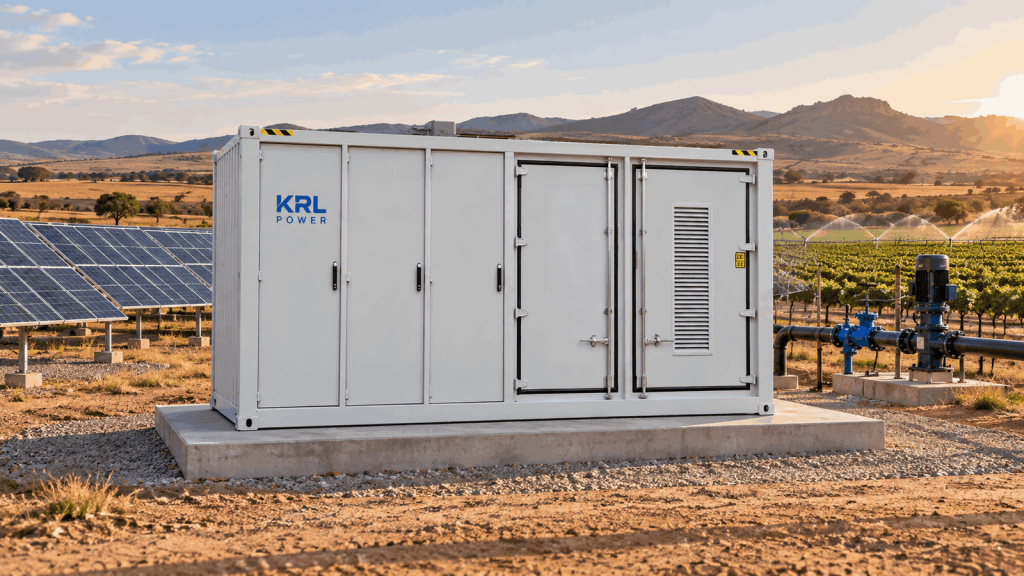
KRL Power recommends one KRL-B1ML-500H3S-480M4-HX1R6 as the preliminary phase-one solution. It integrates a 1 MWh battery, 500 kW bidirectional PCS, 480 kW MPPT with four routes, BMS and EMS in one liquid-cooled 20-foot container. The 500 kW PCS has ample nominal steady-state power relative to the reported 175 kW peak, but the 18-hour result depends on average critical load—not peak kW.
Executive Recommendation
Proceed with one KRL 500 kW / 1 MWh all-in-one unit as the preliminary storage selection, subject to four acceptance conditions:
- The measured 18-hour average of the approved critical loads is approximately 40 kW or lower.
- The 175 kW figure is a short-duration peak rather than the continuous demand throughout the autonomy period.
- The largest irrigation pump and motor-start sequence pass the PCS transient, kVA and voltage-dip study.
- The customer accepts PV expansion, controlled load scheduling or an optional generator if the existing 175 kWp array cannot close the daily energy balance.
Confirmed Project Basis and Open Engineering Inputs
| Design item | Current project basis | Waarom dit saak maak |
|---|---|---|
| Toepassing | Commercial farm in South Africa | Irrigation and agricultural loads require controlled continuity |
| Grid condition | Fully off-grid | PV, battery and load control must maintain the complete energy balance |
| Existing solar array | 175 kWp | Must be checked for daily yield, string compatibility and seasonal recovery |
| Reported peak load | 175 kW | Used for PCS power and motor-start checks, not for 18-hour energy sizing |
| Required continuity | Up to 18 hours | Requires a verified average kW profile and usable-energy calculation |
| Recommended storage | One KRL 1 MWh unit | No multi-unit storage combiner is required |
| Average critical load | Not yet measured | Must be approximately 40 kW or lower for the stated battery-only target |
| Largest motor and start method | Not yet confirmed | Determines inrush current, kVA and voltage-dip performance |
| Dieselgenerator | Optional and not yet confirmed | Can protect continuity during low-solar periods or unexpected load growth |
What the 18-Hour Requirement Means in Usable Energy
Battery capacity is measured in kWh, while load power is measured in kW. A 1 MWh nameplate does not mean that 1,000 kWh can be delivered to the farm bus. Operating depth of discharge, conversion efficiency and container auxiliary consumption must be included.
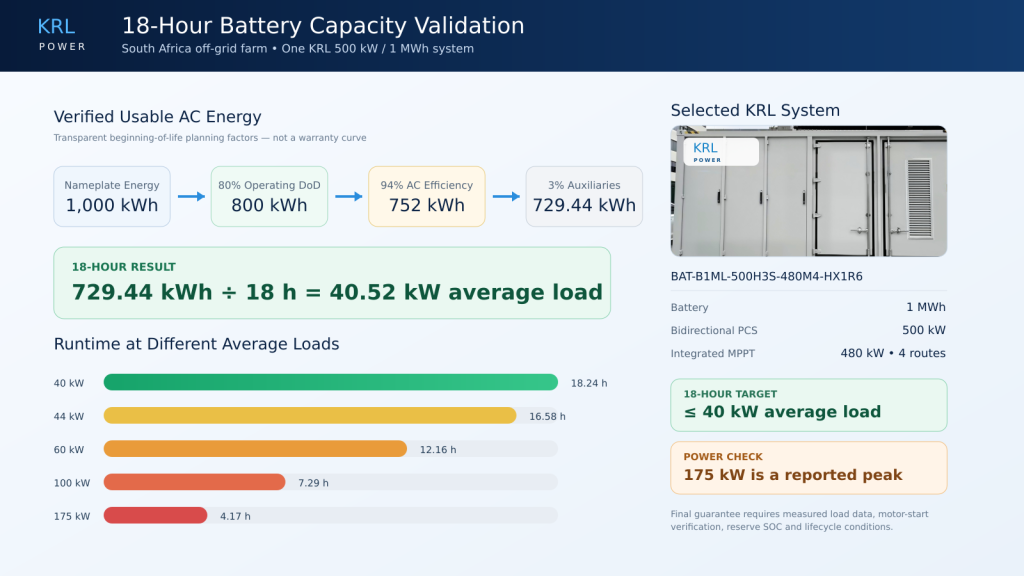
For preliminary beginning-of-life screening, this article uses an 80% operating depth of discharge, 94% battery-to-AC discharge-chain efficiency and a 3% allowance for cooling, controls and auxiliary consumption. These are transparent planning factors, not a warranty curve.
Estimated usable AC energy is 1,000 kWh × 0.80 × 0.94 × 0.97 = 729.44 kWh AC. The maximum average load for 18 hours is therefore 729.44 kWh ÷ 18 hours = 40.52 kW.
| Gemiddelde ondersteunde las | Estimated battery-only runtime | 18-hour result |
|---|---|---|
| 40 kW | 18.24 hours | Meets the preliminary target |
| 44 kW | 16.58 hours | Below target |
| 60 kW | 12.16 hours | Below target |
| 100 kW | 7.29 hours | Below target |
| 175 kW | 4.17 hours | Peak cannot be treated as an 18-hour continuous load |
Can the Existing 175 kWp PV Array Sustain Daily Off-Grid Operation?
The battery can bridge a long non-solar period, but it does not create energy. A fully off-grid design must generate enough energy to serve daytime loads and restore battery SOC before the next night. Using an illustrative performance ratio of 0.78, the existing array produces the following planning-level daily energy:
| Peak-sun-hours | Illustrative 175 kWp PV yield | Engineering interpretation |
|---|---|---|
| 4.5 hours | 614.2 kWh/day | Low-solar-day screening case |
| 5.0 hours | 682.5 kWh/day | Neutral comparison case |
| 5.5 hours | 750.8 kWh/day | Better-solar-day comparison |
A continuous 40 kW average farm load consumes 960 kWh per day. At the neutral 5.0-hour case, the existing PV produces about 682.5 kWh, leaving a 277.5 kWh daily deficit before battery charging losses and reserve margin. Therefore, 175 kWp should not automatically be described as sufficient for indefinite daily off-grid operation at a 40 kW average load.
The theoretical PV size required to generate 960 kWh/day at 5.0 peak-sun-hours and a 0.78 performance ratio is approximately 960 ÷ (5.0 × 0.78) = 246 kWp. A bankable design normally needs additional margin for the lowest-solar month, battery charging losses, soiling, module ageing and operating reserve. The actual answer may be a larger PV array, lower night load, flexible pump scheduling, an optional generator or a combination of these measures.
The KRL system’s integrated 480 kW MPPT provides substantial headroom above the existing 175 kWp array. However, the final PV extension must verify MPPT voltage and current limits, module open-circuit voltage at minimum temperature, string allocation, cable loss, shading and land availability.
Why the 500 kW PCS Fits the 175 kW Peak—but Still Needs a Motor Study
The integrated PCS is rated at 500 kW, so the reported 175 kW peak uses 35% of nominal active-power capacity. This is strong preliminary headroom for normal operating variations. It does not by itself prove that every irrigation pump can start successfully.
A pump motor may demand several times its running current during startup. The design must check motor kW and kVA, locked-rotor or starting current, start duration, power factor, simultaneous starts and the maximum permitted voltage dip. Large pumps should normally be sequenced, and VFDs or soft starters should be evaluated where practical. Protection coordination must also cover short-circuit levels, breaker selectivity, phase imbalance and emergency shutdown.
Recommended KRL 1 MWh All-in-One System
| Product parameter | Recommended specification |
|---|---|
| Model | KRL-B1ML-500H3S-480M4-HX1R6 |
| Battery-energie | 1 MWh |
| Tweerigting-PCS | 500 kW |
| Geïntegreerde MPPT | 480 kW, four routes |
| Operating capability | Roostergekoppel, buite-rooster en naatlose skakeling |
| Integrated controls | BMS, PCS en EMS |
| Termiese bestuur | Vloeistofkoeling |
| Enclosure | 20-foot container |
| Battery-compartment protection | IP65 |
| Kommunikasies | RS485, WiFi of 4G |
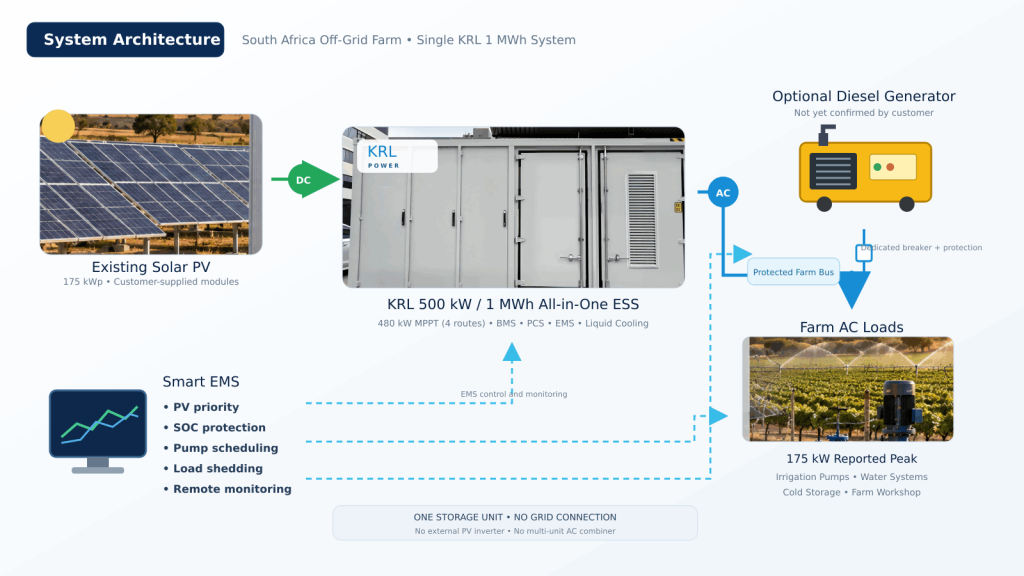
Because the MPPT, PCS, BMS and EMS are already integrated, the farm does not need an external PV inverter, external MPPT cabinet or multi-unit storage combiner. Project-level equipment is still required: correctly rated AC and DC isolation, breakers, protection relays, metering, earthing, surge protection, cabling, emergency stops and any required transformer interface.
Correct Single-Unit Off-Grid Architecture
Compatible PV strings connect to the KRL unit’s four integrated MPPT routes on the DC side. Battery and PV energy are coordinated on the internal DC link, and the 500 kW bidirectional PCS forms and supplies the protected farm AC bus. Critical and flexible loads should be separated so the EMS can preserve irrigation, water, safety and cold-storage functions before disconnecting lower-priority workshop loads.
Only one storage container is proposed, so no storage-unit AC combiner is added. If the customer later installs a diesel generator, it remains separate equipment and connects to the protected bus through its own breaker, synchronization logic, reverse-power protection and EMS start/stop interface. Generator rating has not been assumed in this preliminary design.
How the EMS Should Operate the Farm
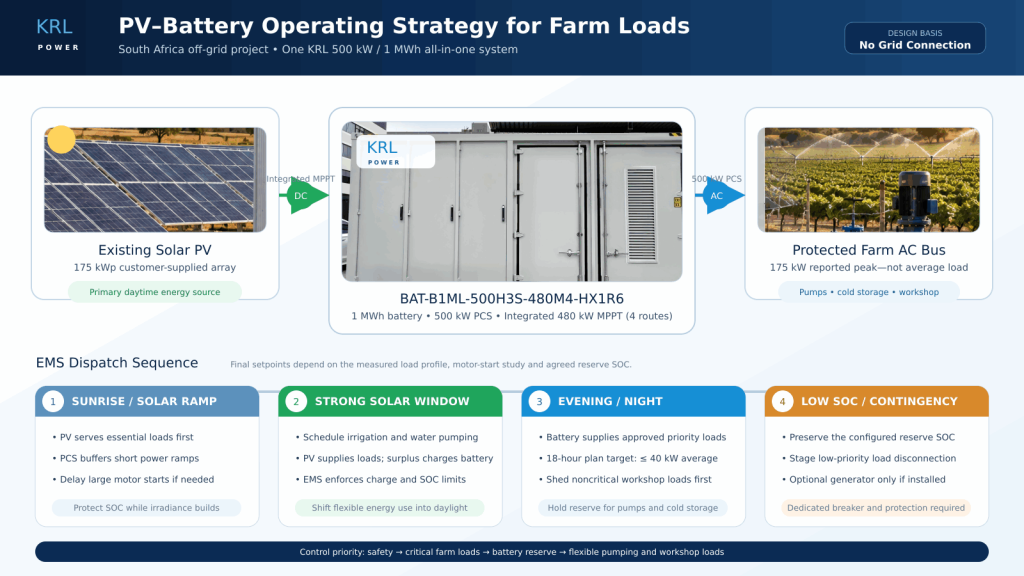
Sunrise and Solar Ramp
PV first supports essential loads while the PCS buffers short power variations. The EMS should delay discretionary high-power starts until irradiance is stable when reserve SOC is limited.
Strong Solar Window
Schedule irrigation and water pumping during the strongest solar period. PV serves the active farm load first, and surplus energy restores battery SOC. Moving flexible work into daylight reduces night-time battery demand and can avoid unnecessary PV expansion.
Evening and Night
The battery supplies the approved priority-load group. To preserve the preliminary 18-hour target, average demand should remain at or below approximately 40 kW, with staged disconnection of noncritical workshop and discretionary pumping loads.
Low SOC or Prolonged Low Solar
The EMS preserves the configured reserve SOC and sheds low-priority loads. If a generator is installed, it can be started at an agreed SOC threshold to support the AC bus and controlled battery recovery. Without a generator, the lowest-solar-month PV design and load-shedding plan become essential reliability measures.
Installation, Safety and Commissioning Boundaries
The liquid-cooled 20-foot system requires an engineered foundation, drainage, cable routes, earthing, service clearances, fire access and unobstructed airflow. IP65 protection of the battery compartment does not remove the need for flood, dust, corrosion, lightning and ambient-temperature assessment.
- Confirm the finished platform level against recorded flood and storm-water conditions.
- Verify ambient temperature, altitude, dust, corrosion and direct-solar exposure.
- Provide vehicle-impact protection, safe maintenance clearance and separated, labelled cable routes.
- Coordinate earthing, surge protection and lightning protection with the PV field.
- Verify emergency isolation, alarm routing and fire-service access.
- Complete breaker coordination and protection settings from the approved single-line diagram.
- Test off-grid formation, load steps, motor starts, MPPT operation, SOC thresholds, load shedding, communications and optional generator controls during commissioning.
Information KRL Needs Before a Firm Quotation
- Sewe dae se 15-minuutdata oor kW, kVA, kragfaktor en fase-stroom.
- A list of critical, flexible and shed-able farm loads with operating schedules.
- Largest motors, start methods, starting currents and simultaneous-start requirements.
- Existing electrical single-line diagram, voltage, frequency and earthing arrangement.
- PV module datasheet, string layout, array orientation, shading survey and site coordinates.
- Required autonomy definition, reserve SOC and beginning-of-life or end-of-life guarantee basis.
- Generator datasheet and control interface if diesel backup is selected.
- Site temperature, altitude, dust, corrosion, flood and lightning conditions.
- Delivery location, installation responsibility, project schedule and commercial scope boundary.
Ingenieursafsluiting
The decisive limit is energy. Under the stated screening assumptions, the system provides approximately 729.44 kWh AC, supporting about 18.24 hours at a 40 kW average load but only 12.16 hours at 60 kW. The customer should approve one unit for an 18-hour target only after the critical-load average is measured and controlled.
Gee 'n oorsig van die KRL kommersiële en industriële ESS-portefeulje, die KRL C&I energy-storage solutions, KRL’s guide to battery storage for South African businesses and the guide to kommersiële batterypak vir kragonderbrekings. For a project-specific design, Kontak KRL Power with the farm load profile, PV records, motor list and single-line diagram.
