Developing an autonomous inspection robot for underground coal mines or petrochemical refineries presents a strict electrical and mechanical trade-off.
When an inspection crawler or quadruped robot enters an atmosphere containing methane, propane, or ethylene, standard industrial lithium battery packs cannot be deployed. Traditional compliance approaches place standard cells inside a thick-walled flameproof metal housing (Ex d).
On compact mobile platforms, heavy metallic flameproof enclosures consume substantial payload capacity and increase drive motor power draw.
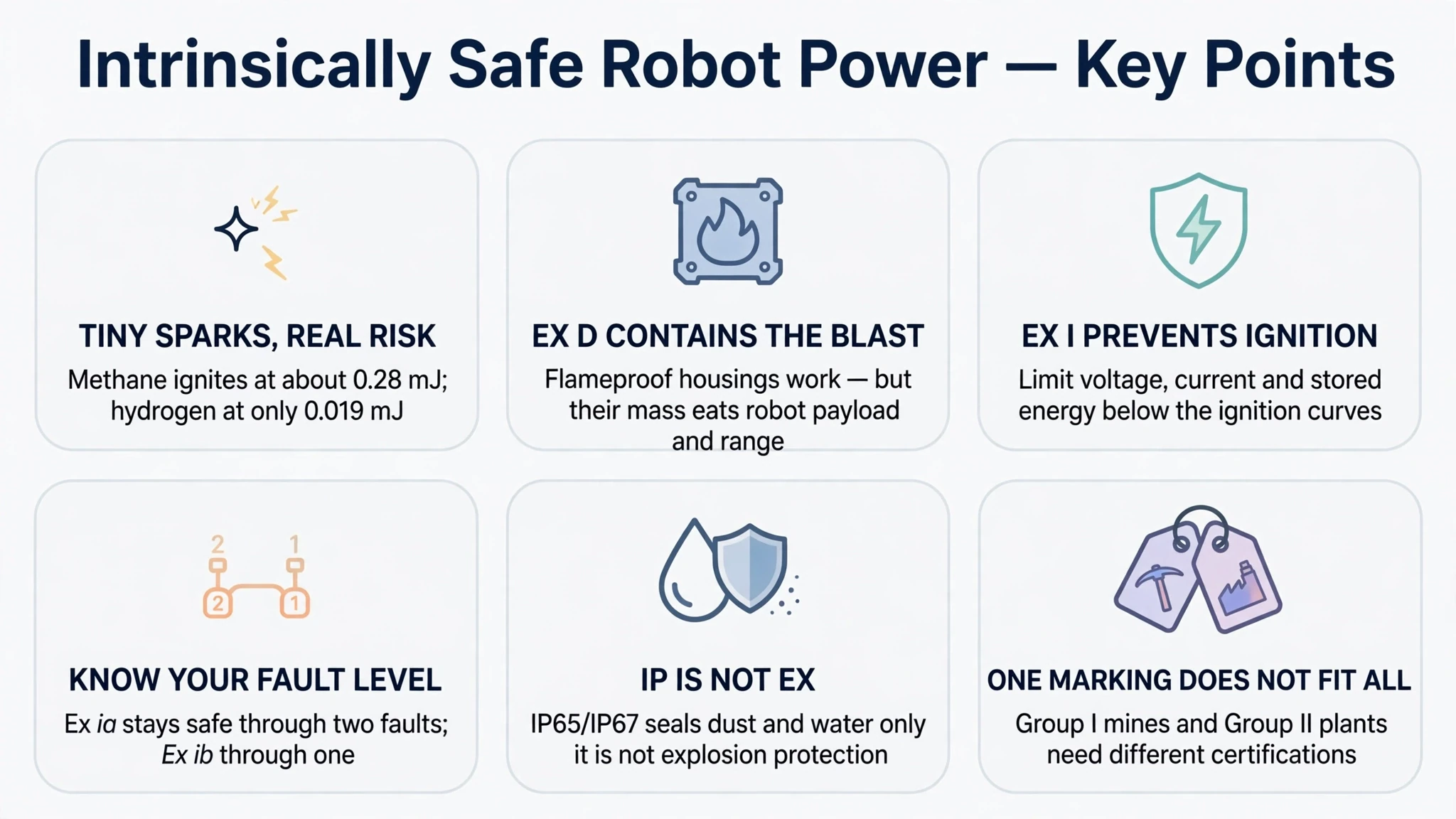
At the same time, explosive gas environments demand strict ignition control. Methane requires a minimum ignition energy (MIE) of approximately 0.28 millijoules, while hydrogen environments drop to 0.019 millijoules.
Standard commercial battery management systems (BMS) designed for warehouse logistics lack the fault-energy limitation and thermal protections required by hazardous-area standards.
Specifying a dedicated mining inspection robot power unit engineered around intrinsic safety (Ex ia/ib) and certified hazardous-area protection resolves these constraints.
By matching electrical energy limitation, thermal management, and IP65/IP67 ingress sealing to the target operating zone, robotics OEMs can reduce structural enclosure weight while meeting ATEX and IECEx safety frameworks.
1. The Enclosure Mass Dilemma: Flameproof (Ex d) versus Intrinsically Safe (Ex ia/ib) Power Architectures
1.1 The mechanical penalties of traditional flameproof housings
Flameproof protection (Ex d, governed by IEC 60079-1) relies on mechanical containment.
The standard assumes that flammable gas can enter the housing and ignite internally:
- The enclosure structure must withstand an internal explosion without rupturing, verified through reference pressure testing.
- Precision-machined metal flanges (flamepaths) with controlled gap widths and path lengths cool escaping gases below the ignition temperature of the surrounding atmosphere.
- Meeting these structural strength requirements typically requires heavy cast-iron, thick steel, or machined aluminum housings.
For multi-ton underground mining loaders, housing weight is minor. For a compact inspection crawler, rail-mounted camera unit, or quadruped robot, heavy flameproof housings create operational problems:
- Elevated motor current draw reduces mission range and accelerates drivetrain wear.
- Higher center of gravity limits incline climbing stability over coal mine rubble or refinery grates.
- Corrosive mine water or chemical washdowns can pit precision flamepath surfaces if maintenance protocols lapse.
1.2 Controlling ignition energy through intrinsic safety and hybrid protection
Instead of containing an internal blast, an intrinsically safe power system prevents electrical sparks and excessive surface temperatures from igniting the atmosphere.
Under IEC 60079-11, intrinsic safety limits circuit voltage, current, and stored capacitive or inductive energy:
- Ex ia protection: Evaluated to maintain safety during normal operation, one countable fault, and two countable faults (plus applicable non-countable faults), corresponding to Equipment Protection Level (EPL) Ga or Ma.
- Ex ib protection: Evaluated to maintain safety during normal operation and one countable fault (plus applicable non-countable faults), corresponding to EPL Gb or Mb.
When mobile robots require higher propulsion power than a single intrinsically safe circuit can supply, engineers evaluate hybrid protection strategies.
Depending on the certification scope, battery cells and high-current circuits may combine encapsulation (Ex mb under IEC 60079-18) or increased safety (Ex eb under IEC 60079-7) with Ex ia/ib current-limited outputs. The complete assembly and all interconnected circuits must be formally assessed as an integrated system before Zone 1 or mining deployment.
Evaluating certified battery architectures for hazardous industrial environments? Review the technical scope of KRL explosion-proof battery solutions for mining, chemical, and oil and gas equipment.
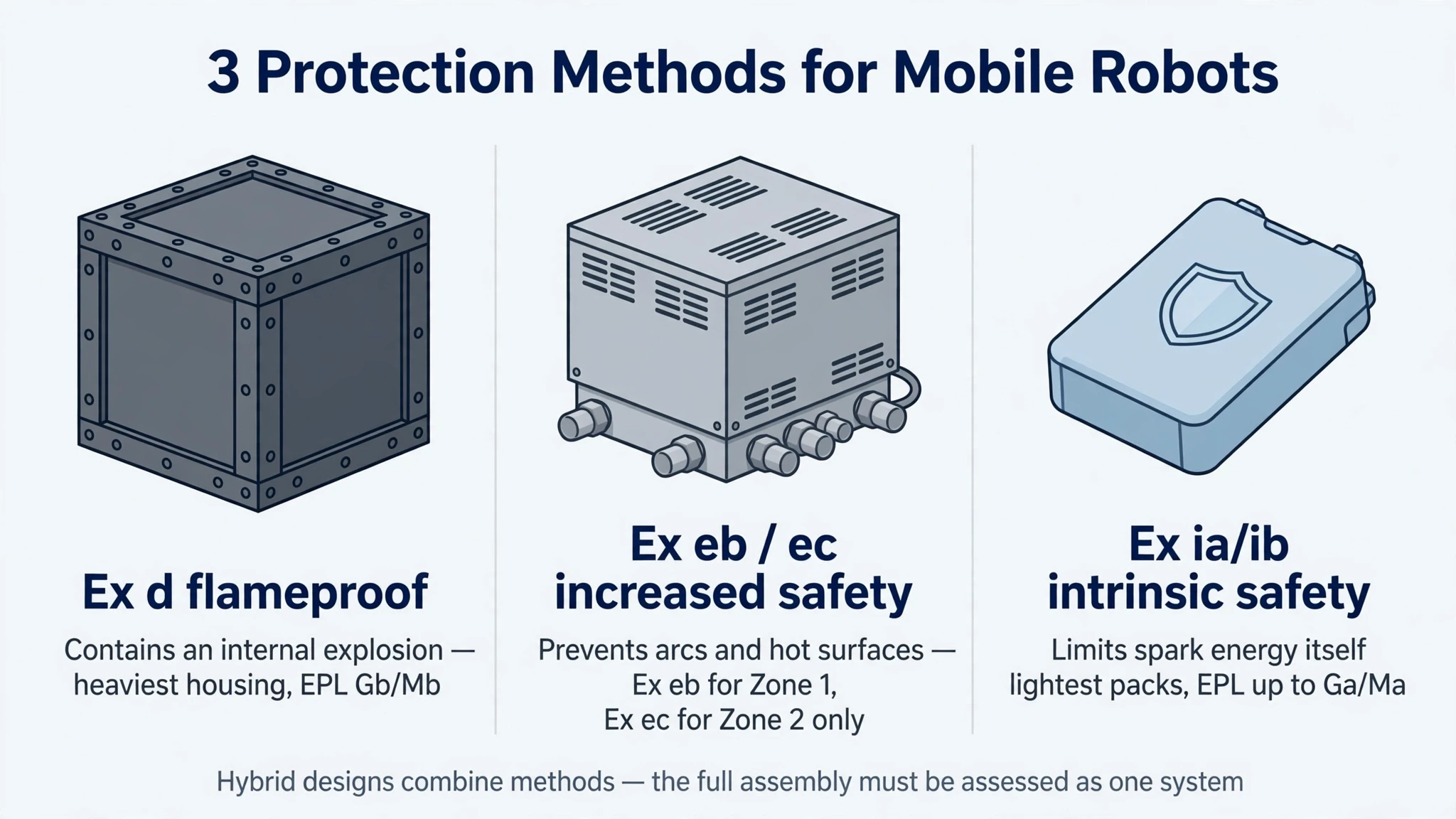
1.3 Comparison of hazardous-area mobile power protection methods
The table below compares major explosion-protection types used in industrial mobile equipment and instrumentation under the IEC 60079 series.
| Engineering Parameter | Flameproof Enclosure (Ex db) | Increased Safety (Ex eb / Ex ec) | Intrinsic Safety & Hybrid (Ex ia/ib, Ex mb) |
|---|---|---|---|
| Protection Principle | Contains internal explosion and cools flame | Prevents arcs and excessive temperatures | Limits circuit spark energy and isolates components |
| Target EPL & Zone Scope | Ex db: EPL Gb or Mb (Zone 1, Group I) | Ex eb: EPL Gb/Mb (Zone 1/Mining); Ex ec: EPL Gc (Zone 2) | Ex ia: EPL Ga/Ma; Ex ib/mb: EPL Gb/Mb (Zone 1/Mining) |
| Structural Mass Impact | High mass penalty (heavy pressure housing) | Moderate mass (impact-resistant housing) | Lower enclosure mass (eliminates blast-pressure walls) |
| Typical Robotics Role | Heavy traction drives on large vehicles | Terminal boxes and approved motor housings | Inspection sensors, control units, compact robot packs |
Engineering boundary note:
- Under IEC 60079-7, Ex eb (EPL Gb/Mb) and Ex ec (EPL Gc) carry different construction and fault evaluation requirements and must not be treated as identical Zone 2 classifications.
- IEC 60529 ingress ratings (such as IP65 or IP67) measure dust and water protection only; an IP rating does not constitute hermetic gas-tight explosion protection.
2. Core Engineering Elements of a Hazardous-Area Robot Power Assembly
Designing a compliant explosion proof mobile equipment power solution requires coordinating BMS fault protection, thermal dissipation, and communication interfaces.
Hazardous-Area Mobile Robot Battery Engineering Architecture
- Industrial Enclosure (IP65 / IP67 Dust & Water Protection): Anti-static housing design per IEC 60079-0.
- Lithium Cell Module & Thermal Management: Matched cells with multi-point temperature sensing; surface temperature regulation within T4 (≤135°C) or Group I limits.
- Intrinsic Safety & Fault Protection Stage (IEC 60079-11): Redundant current, voltage, and stored-energy limitation; creepage, clearance, and infallible component spacing.
- Primary Equipment Output (configured to zone rating) and Custom Auxiliary & Sensor Outputs (project-engineered regulated rails).
- Custom Communication Interface: CAN / RS485 telemetry configured with the required safety barriers.
2.1 Energy limitation and fault assessment under IEC 60079-11
In hazardous atmospheres, fast switch opening time alone is not sufficient to prove intrinsic safety.
While solid-state protection switches react faster than mechanical contactors, IEC 60079-11 certification requires evaluating the entire circuit energy profile:
- Releasable electrical energy: Total voltage, current, internal capacitance, and cable inductance must stay below ignition threshold curves for the specified gas group (such as Group I methane or Group IIA/IIB gases).
- Countable and non-countable faults: Protection circuits use redundant current-limiting resistors, solid-state switches, and clamping diodes rated with appropriate safety factors.
- Creepage and clearance distances: Printed circuit board layouts maintain strict physical separation between intrinsically safe and non-intrinsically safe traces to prevent fault bridging.
2.2 Thermal management and surface temperature classification
During steep incline climbing or high-load operation, internal Joule heating raises battery cell and BMS component temperatures.
Hazardous-area standards enforce strict maximum surface temperatures to prevent hot surfaces from igniting surrounding gas or dust:
- Group II petrochemical environments: A T4 rating requires maximum relevant surface temperatures to stay at or below 135°C, even under specified overload or fault conditions.
- Group I coal mining environments: Under IEC 60079-0, maximum surface temperature is limited to 150°C on surfaces where coal dust can form a layer (and up to 450°C only on protected internal surfaces where coal dust cannot deposit).
- Encapsulation considerations: When potting compounds (Ex mb under IEC 60079-18) are incorporated in custom designs, manufacturing processes must control void formation and verify thermal transfer. Material flammability ratings such as UL 94 V-0 indicate small-scale burning behavior but do not replace IEC 60079 explosion-protection testing.
2.3 Custom power rails and CAN / RS485 communication interfaces
Inspection robots typically power locomotion actuators alongside gas detectors, thermal cameras, and wireless transceivers.
KRL Power supports OEM engineering teams by customizing the battery assembly electrical interface to match vehicle system architectures:
- 1. Application-matched voltage and capacity: Packs are configured to match the robot voltage platform and duty cycle within verified safety boundaries.
- 2. Custom CAN and RS485 telemetry: The BMS provides real-time cell voltage, temperature, and state-of-charge (SOC) data over CAN or RS485 buses, incorporating isolation barriers where required by the certification scheme.
- 3. IP65 and IP67 environmental protection: Enclosures are sealed to IP65 or IP67 ratings to protect internal electronics against coal dust, high humidity, and industrial washdowns.
Developing specialized automated guided vehicles or industrial inspection platforms? Explore our custom AGV and robotics battery packs and broader industrial battery solutions for demanding field deployments.
3. Navigating Compliance: Group I Coal Mining versus Group II Chemical Plants
3.1 Distinguishing Group I and Group II certification markings
A frequent procurement mistake in mobile robotics is assuming that a single explosion-proof battery marking covers both underground coal mines and surface chemical plants.
International IECEx and ATEX frameworks separate these environments into distinct equipment groups with different gas ignition properties:
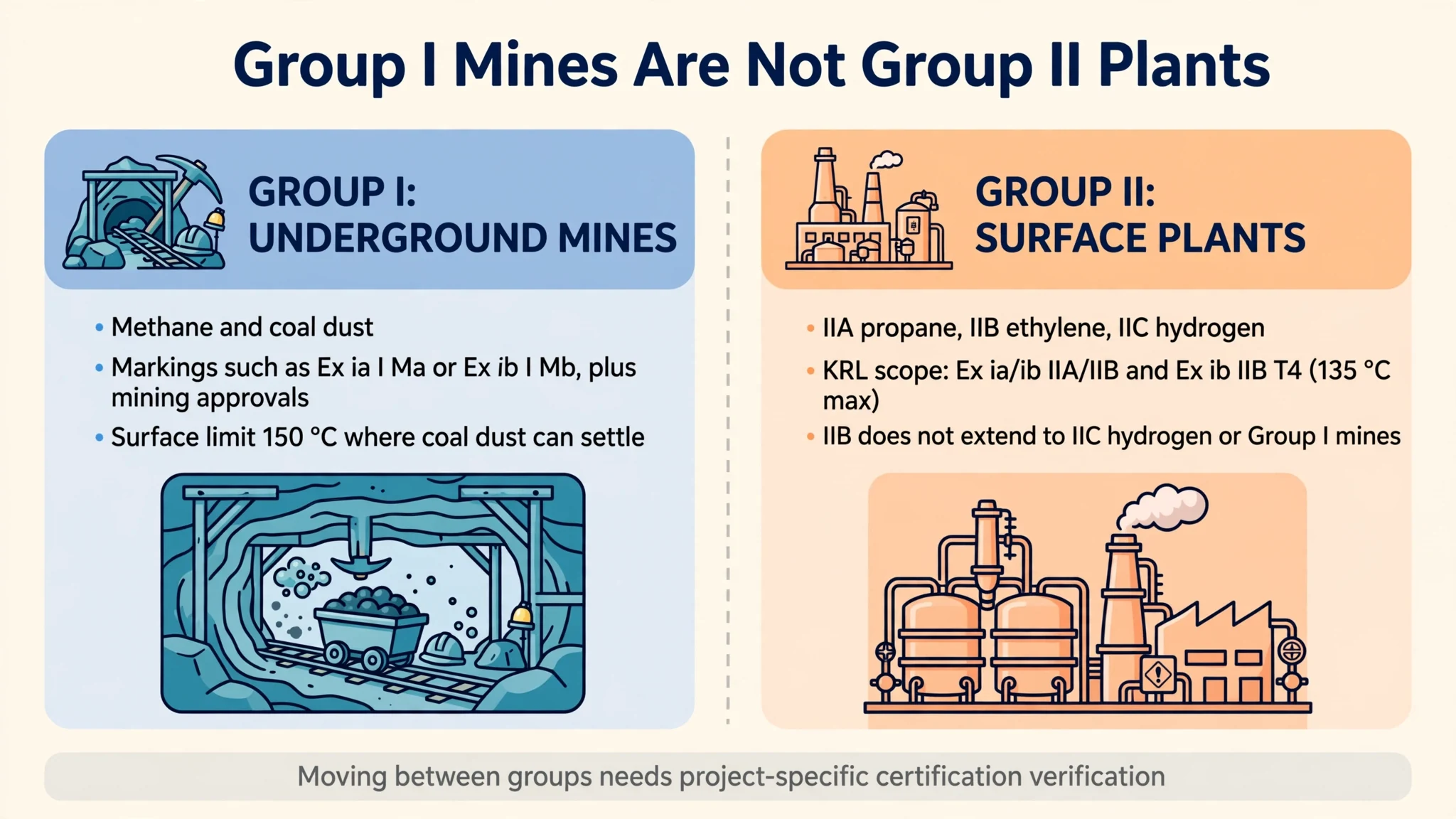
- 1. Group I (Underground Mines Susceptible to Firedamp and Coal Dust):
- Target hazard: Methane gas and combustible coal dust.
- Protection levels: EPL Ma (remains energized in explosive atmosphere) and EPL Mb (de-energized when gas concentration exceeds limits).
- Procurement rule: Underground coal mine robots require specific Group I certification markings (such as Ex ia I Ma or Ex ib I Mb) alongside local mining authority approvals.
- 2. Group II (Surface Explosive Gas Atmospheres):
- Gas subdivisions: Group IIA (propane, butane, hexane), Group IIB (ethylene), and Group IIC (hydrogen, acetylene).
- KRL verified scope: KRL Power publicly supports Ex ia/ib IIA/IIB and Exib IIB T4 battery configurations for mining inspection and chemical applications.
- Procurement rule: A Group II marking (such as Ex ib IIB T4) covers surface IIA and IIB gas environments up to 135°C.
- Boundary verification: A Group IIB marking cannot be automatically extended to Group IIC (hydrogen), Group III (surface combustible dust), or substituted for a Group I underground coal mine certificate without project-specific certification verification.
3.2 Electrostatic control and mechanical impact under IEC 60079-0
Robot enclosures operating in hazardous zones must prevent electrostatic charge buildup caused by friction or airborne dust impinging on the housing.
Under IEC 60079-0 (including the 2026 edition updates), electrostatic hazards on non-metallic enclosures or painted metal surfaces are controlled through several compliance paths:
- Surface resistance limits: Designing non-metallic materials to meet specified surface resistance thresholds under defined temperature and humidity test conditions.
- Surface area restrictions: Limiting the exposed area of non-conductive external parts based on the equipment group (Group I, IIA, IIB, or IIC).
- Conductive coatings and bonding: Using conductive alloys or grounded antistatic surface treatments alongside mechanical impact testing to ensure housing integrity after rock or tool strikes.
4. Selecting Battery Chemistry for Hazardous-Area Robotics
Selecting the right cell chemistry helps engineering teams balance thermal margin, cycle life, and energy density.
In material-level battery safety comparisons, commercial lithium chemistries show distinct thermal characteristics:
- Nickel Manganese Cobalt (NMC): Provides higher gravimetric energy density, though literature reports lower thermal runaway onset temperatures (often cited around 200°C to 220°C depending on cell formulation) and higher gas generation during cell failure.
- LiFePO4 battery technology: Widely preferred in industrial and hazardous-area designs due to stronger phosphorus-oxygen covalent bonds, higher thermal runaway onset thresholds (commonly cited above 250°C to 270°C at the material level), and stable discharge voltage.
- Lithium Titanate (LTO): Offers wide low-temperature operating capability and high cycle life, though at lower cell voltage and energy density.
Note: Material-level thermal onset figures serve as general chemistry references; actual hazardous-area compliance depends on specific cell model testing, BMS protection thresholds, and enclosure thermal design.
To evaluate cell chemistries across mobile platforms, consult our AGV and AMR battery selection guide and review supplier criteria in 10 AGV battery manufacturers to compare in 2026.
When matching pack nominal voltages to motor controllers, reference our 48V lithium battery voltage chart.
FAQ
How do explosion-proof robot batteries balance intrinsic safety with motor power demands?
Can an Exib IIB T4 battery be used in both chemical plants and hydrogen or coal mine zones?
Does an IP65 or IP67 rating make a robot battery explosion-proof?
How are explosion-proof inspection robots safely recharged?
How do Ex ia and Ex ib differ when selecting a robot power system?
Can Ex eb and Ex ec be used interchangeably for Zone 1 mobile equipment?
Why can traction motors require a different protection method from inspection sensors?
Which maximum surface temperature limits should mining and refinery robot designers check?
What CAN or RS485 interfaces can be considered in a hazardous-area robot battery?
What project details should an OEM supply before requesting a custom explosion-proof robot battery?
5. Conclusion & Custom Explosion-Proof Battery Engineering Consultation
Selecting a power system for underground mining or chemical plant inspection robots requires aligning electrical energy limits, thermal class ratings, and enclosure durability with the exact gas group at your site.
By replacing oversized housings with application-engineered Ex ia/ib IIA/IIB battery packs and IP65/IP67 environmental protection, robotics manufacturers can improve vehicle agility and streamline compliance testing.
- For inspection robotics OEMs and hazardous-area equipment integrators: Share your target certification marking (Group I or Group II, Zone 1 or Zone 2, T-class), voltage and current profile, and mechanical dimensions with KRL Power.
- To request a technical feasibility review and custom pack specification, contact our engineering team through our OEM/ODM custom battery solutions portal.