1. Global Energy Storage Is Entering a Structural Inflection Point
Over the next decade, global user-side energy storage will no longer be defined by residential systems alone. While household storage (HESS) pioneered early adoption, the real structural growth driver is now shifting decisively toward Commercial & Industrial Energy Storage (C&I ESS).
The fundamental reason is simple:
The fundamental reason is simple:
Global industrial and commercial electricity consumption far exceeds residential demand—and continues to grow faster due to AI data centers, electrified industry, and distributed manufacturing.
Recent global modeling shows:
- Long-term installed C&I ESS potential: 4,592 GWh
- Residential storage potential: 2,842 GWh
- Current penetration remains extremely low:Residential: ~3%;C&I: <1%.
This imbalance clearly indicates that C&I ESS is still in the early exponential phase of adoption.
As a manufacturer with over two decades of energy storage engineering experience, we at KRL Power believe this transition represents the most important investment cycle in the global energy transition.
2. Why C&I Energy Storage Will Outperform Residential Storage
Although residential storage expanded earlier, C&I storage will dominate future incremental demand due to four structural drivers:
2.1 Electricity Price Volatility in Commercial Markets
Industrial users face:
- Peak tariff volatility
- Vraaggelde
- Grid imbalance penalties
C&I ESS enables:
- Piekvlakvermindering
- Ladingverskuiwing
- Verlaag die vraagheffing
2.2 Rapid Growth of Energy-Intensive Industries
Key demand drivers:
- AI data centers
- Mynboubedrywighede
- Manufacturing clusters
- Cold chain logistics
These industries require:
- High power continuity
- Grid stability
- Backup redundancy
2.3 Transition from Diesel to Clean Microgrids
In regions such as Africa, Southeast Asia, and Latin America:
- Diesel generation cost: $0.34–0.49/kWh
- Solar + storage cost: ~$0.10/kWh
This creates a strong economic case for C&I ESS adoption.
2.4 Electricity Market Liberalizations
Countries are increasingly adopting:
- Time-of-use pricing
- Spot market electricity trading
- Ancillary service participation
C&I ESS becomes a revenue-generating asset, not just a cost-saving device.
3. Why C&I Storage Adoption Lagged Behind Residential
Despite stronger economics, C&I ESS historically lagged due to:
3.1 Longer Decision Cycles
- Residential: 1–2 weeks decision
- C&I: 6–12 months project cycle
3.2 Complex Engineering Requirements
C&I systems require:
- Multi-unit parallel operation
- High-voltage architecture
- Fire safety certification
- Grid interconnection compliance
3.3 Lack of Standardization
Only recently has the industry converged toward:
- Modular 50–261 kWh cabinet systems
- Integrated liquid-cooled architectures
- Plug-and-play deployment models
4. KRL Power C&I Energy Storage System Solution
As global demand accelerates, KRL Krag has developed a next-generation fully integrated C&I ESS platform designed for global industrial applications.
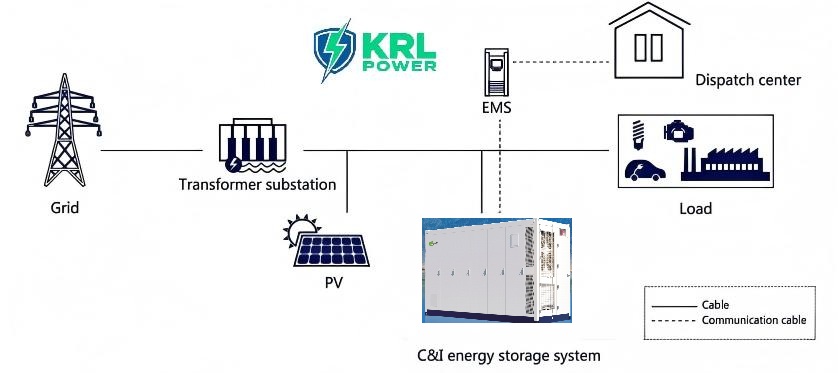
Core System Architecture:
- Liquid-cooled battery system
- Intelligente BMS (Battery Bestuurstelsel)
- Self-developed EMS (Energy Management System)
- Multi-layer fire safety protection
- Wolkgebaseerde afstandmonitering
5. Key Competitive Advantages of KRL C&I ESS
5.1 Extreme Safety Architecture
- High-stability long-cycle battery cells
- Vloeistofkoeling termiese beheer
- Multi-layer active fire suppression system
- Real-time thermal runaway prevention
5.2 High ROI Energy Optimization (EMS Core)
KRL EMS maak moontlik:
- Piekvlakoptimalisering
- Valley filling strategies
- Dinamiese kapasiteitsuitbreiding
- Energy trading readiness (future market integration)
5.3 Modular Plug-and-Play Design
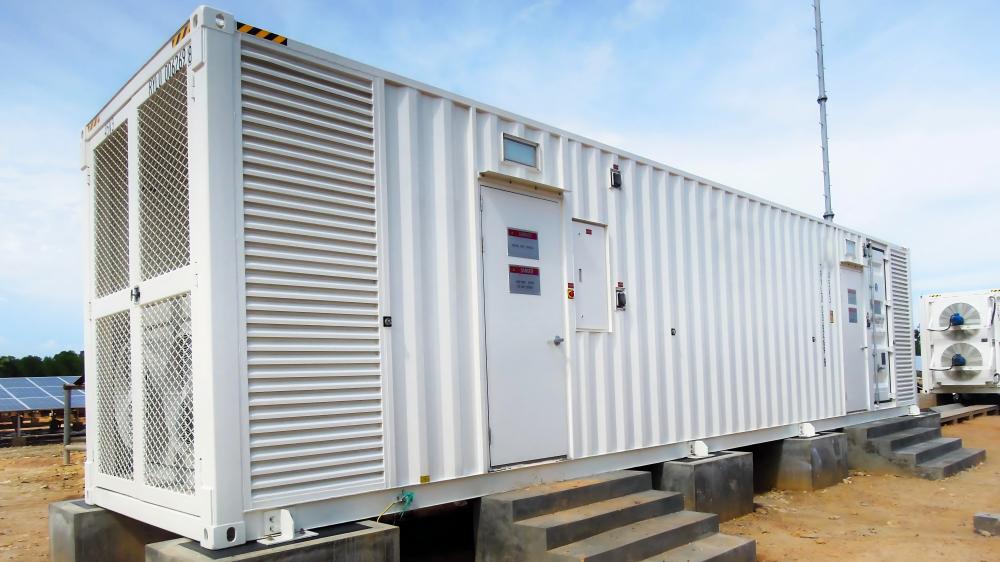
- 50 kW to multi-MW scalable architecture
- Containerized deployment
- Fast installation (days, not months)
5.4 AI Cloud Monitoring
- Voorspellende instandhouding
- Fault detection
- Afstandsdiagnostiek
- Performance optimization
6. Application Scenarios of C&I Energy Storage
Scenario 1: Industrial Manufacturing Plants
- Reduce peak demand charges
- Stabilize voltage fluctuations
- Ensure production continuity
Scenario 2: Mining & Remote Operations
KRL EMS maak moontlik:
- Replace diesel generators
- Provide 24/7 off-grid power
- Reduce fuel logistics cost
Scenario 3: Data Centers
- Backup power stabilization
- Load balancing
- Grid interaction optimization
Scenario 4: Commercial Parks & EV Charging Hubs
- Peak shaving during charging peaks
- Energiearbitrasie
- Grid congestion relief
7. ROI Logic: Why C&I ESS Becomes a Financial Asset
A standard C&I ESS system can achieve:
- Payback period: 3–5 years (typical markets)
- Electricity cost reduction: 20–60%
- Diesel replacement savings: up to 70%
Example system comparison:
- 100 kW / 200 kWh system
- Investment: $10,000–$15,000 per kWh equivalent value range
- Revenue sources:
- Spitsbesparings
- Verlaag die vraagheffing
- Backup power value
8. From Optional to Essential: The Market Transition
C&I energy storage is shifting from “optional optimization” to mandatory infrastructure investment, driven by:
- Roosterstabiliteit
- Renewable penetration
- Electricity market reform
- Energy security concerns
This mirrors early-stage adoption curves seen in:
- Solar PV (2008–2015)
- IEV batteries (2015–2025)
C&I ESS is now entering its hypergrowth phase (2026–2030).
9. Why KRL Power Is Positioned for This Cycle
KRL Power is uniquely positioned due to:
- Strong manufacturing scalability
- Integrated ESS + EMS capability
- Global deployment experience
- High-quality supply chain integration
- Rapidly expanding C&I product portfolio
With increasing global supply constraints in premium battery systems, KRL is accelerating shipments across:
- Europe
- Suidoos-Asië
- Afrika
- Latyns-Amerika
Conclusion: C&I ESS Defines the Next Energy Storage Winners
The global energy storage industry is entering a decisive phase.
Residential storage created the foundation—but C&I energy storage will define the next decade of market leadership.
Companies that succeed in:
Residential storage created the foundation—but C&I energy storage will define the next decade of market leadership.
Companies that succeed in:
- Stelselintegrasie
- Industrial deployment capability
- Energy optimization software
- Global project execution
will dominate the next wave of energy infrastructure transformation.
V&A
Q1: What is C&I energy storage?
C&I energy storage refers to battery systems designed for commercial and industrial users to reduce electricity costs, stabilize power supply, and integrate renewable energy.
Q2: Why is C&I ESS growing faster now?
Due to electricity market reform, AI-driven power demand, and rising industrial energy costs, C&I ESS has become economically necessary.
Q3: What is the typical size of a C&I ESS system?
Most systems range from 50 kW / 100 kWh to multi-MW / MWh scale depending on application.
Q4: How long is the ROI period?
Typically 3–5 years depending on electricity tariffs and usage patterns.
Q5: What makes KRL Power different?
KRL integrates battery systems, EMS software, liquid cooling, and safety architecture into a unified C&I ESS platform designed for global deployment
Industrial energy costs are rising globally. The transition to smart C&I energy storage is no longer optional—it is strategic.
If you are planning:
If you are planning:
- Industrial energy cost reduction
- Microgrid deployment
- Diesel replacement projects
- EV charging infrastructure optimization
KRL Power can provide a complete engineering and ROI assessment.