 Slaan oor na inhoud

Comprehensive Guide to 100kW C&I Energy Storage Inverters: Principles, Features, and Applications
The energy storage inverter is a critical component in Commercial and Industrial (C&I) Battery energiebergingstelsel (BESS). It not only converts DC power from energy storage devices into AC power but also enables bidirectional power flow to meet the electricity demands of various scenarios.
Below, our engineering team at KRL Power explores the working principles, technical features, application scenarios, and the overall importance of the 100kW energy storage inverter in smart energy management.
What is an Energy Storage Inverter?
An energy storage inverter (often referred to as a Power Conversion System, or PCS) is a highly responsive device that converts direct current (DC) from energy storage equipment (such as vastetoestandbattery, lithium-ion, or supercapacitors) into alternating current (AC), while also being able to convert alternating current (AC) back into direct current (DC) for storage in the energy storage devices.
It plays a crucial role in solar photovoltaic (PV) systems, wind energy systems, and smart grids. It is widely used across various energy storage devices by KRL Krag, such as the KRL-B2M6L-1-2MW-2-6MWh, KRL-B522L-250kW-522kWh, and so on.
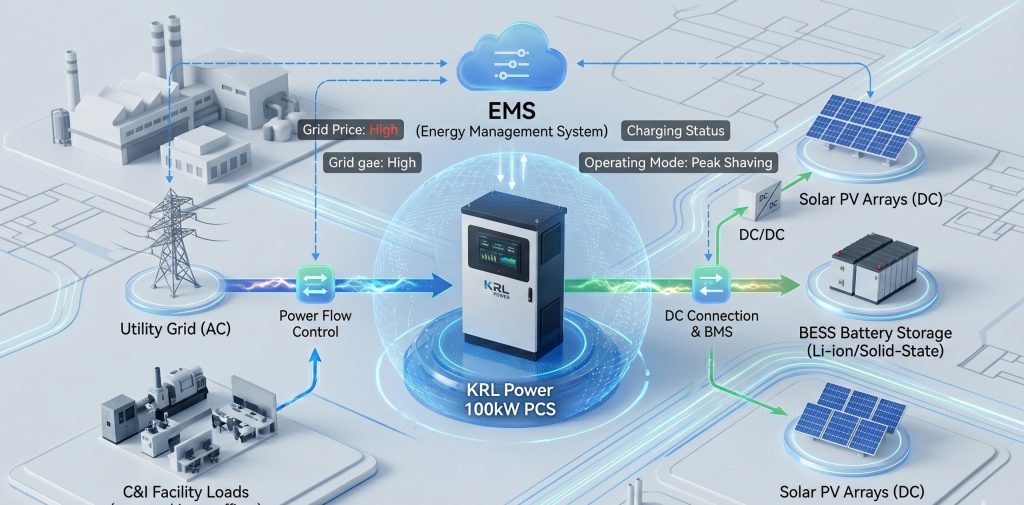
Working Principles of a 100kW Energy Storage Inverter
- DC-AC Inverter: Converts direct current (DC) from energy storage devices into alternating current (AC) to supply power to loads or feed into the grid.
- AC-DC Converter: Converts alternating current (AC) from the grid or other AC power sources into direct current (DC) for storage in the energy storage devices.
- Control Unit: Responsible for monitoring and controlling the operating status of the entire inverter, including the regulation and protection functions for parameters such as voltage, current, and frequency.
- Communication Unit: Enables data communication with energy management systems and monitoring systems, supporting remote monitoring and control.
Technical Features of the KRL Power 100kW Energy Storage Inverter: Engineered for C&I Excellence
1. Industry-Leading Conversion Efficiency
At KRL Power, we leverage proprietary R&D to push the boundaries of energy conversion. Our 100kW energy storage inverters feature optimized circuit designs and cutting-edge inverter technology, delivering a peak efficiency of over 98%. By minimizing energy loss far beyond standard industry benchmarks, KRL Power ensures maximum performance and a higher Return on Investment (ROI) for commercial battery energy storage system (BESS).
2. Seamless Bidirectional Power Flow
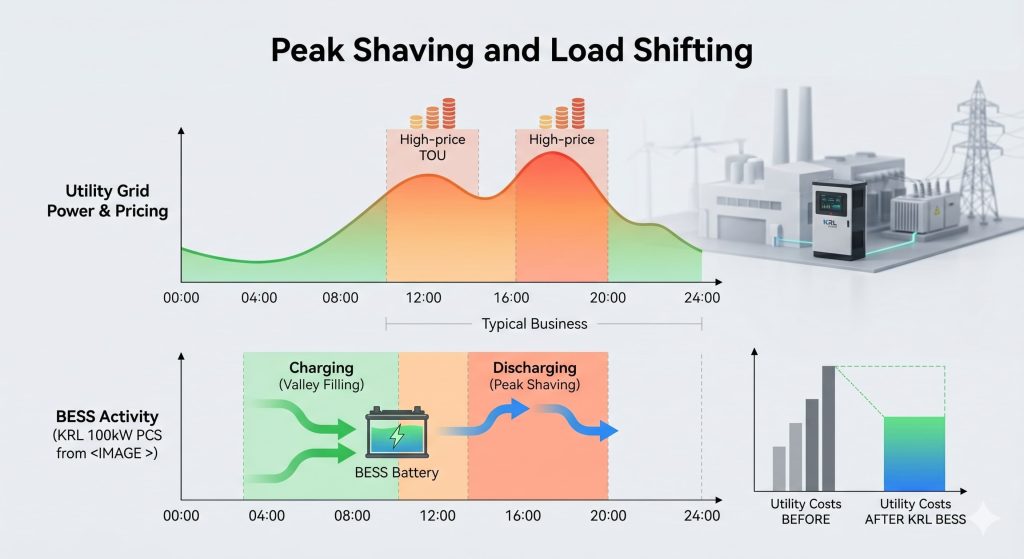
Engineered for grid resilience, the KRL Power energy storage inverter features advanced bidirectional charging and discharging capabilities. It intelligently stores surplus power during off-peak hours or periods of abundant renewable generation. Conversely, during peak energy demand, it reliably discharges the stored power. This seamless two-way conversion makes KRL Power systems ideal for peak shaving, load shifting, and overall grid stabilization.
3. Intelligent Grid-Interactive Control
Built with a highly responsive smart control system, KRL Power inverters autonomously regulate charging and discharging based on real-time power demands and storage capacity. Supporting standard industrial communication protocols such as Modbus and CAN, our inverters guarantee flawless integration into smart grids and enterprise-level Energy Management Systems (EMS), enabling optimal, automated energy management.
4. Comprehensive Multi-Layered Safety Protection
System safety and operational reliability are the cornerstones of KRL Krag's engineering. To ensure uninterrupted operation, our 100kW inverters are equipped with rigorous, multi-layered protection mechanisms. These include overvoltage, undervoltage, overcurrent, short-circuit, and advanced over-temperature protections. These robust safeguards proactively prevent equipment damage and mitigate any safety risks to your commercial energy assets.
5. Universal Compatibility & Flexibility
The KRL Power 100kW energy storage inverter is designed for ultimate system adaptability. It boasts exceptional compatibility with a wide spectrum of energy storage mediums (including lithium-ion batteries, solid-state-battery, lead-acid, and supercapacitors) and diverse power generation sources (such as solar PV arrays, wind turbines, and diesel generators). This universal compatibility makes KRL Power the perfect core component for various complex C&I application scenarios and microgrids.
Core Application Scenarios for the KRL Power 100kW Energy Storage Inverter
To maximize Return on Investment (ROI) and system reliability, the KRL Power 100kW energy storage inverter is meticulously engineered to adapt to a diverse range of complex environments. Here are the six primary application scenarios where our technology excels:
1. Industrial Manufacturing Facilities
- SME Processing & Machinery Workshops: Leverages peak shaving and valley filling to significantly reduce electricity bills, smooths out heavy equipment startup surges, and lowers peak demand power charges.
- Precision Electronics & Food Processing Plants: Provides seamless emergency backup power to protect sensitive production lines and precision instruments, effectively preventing costly downtime and material losses.
- Distributed Solar PV Integration: Maximizes the local consumption of onsite solar generation, minimizes grid-export power losses, and dramatically increases the PV self-consumption rate for the facility.
2. Commercial Buildings & Facilities
- Corporate Offices & Commercial Towers: Guarantees uninterruptible, high-quality power supply for critical infrastructure such as elevators, fire protection systems, and enterprise server rooms.
- Shopping Malls, Supermarkets & Hotels: Reduces peak load stress on the local grid, stabilizes power consumption, and strategically mitigates premium peak-hour electricity pricing (Time-of-Use tariff management).
- Resort Clusters & Boutique Hotels: Capitalizes on energy arbitrage through peak-valley price differences, while optimizing daily power quality via consistent voltage and frequency stabilization.
3. Public Infrastructure & Essential Services
- Industrial Parks & Sub-Districts: Empowers localized, building-specific energy storage with flexible, multi-unit parallel capabilities for easy capacity expansion.
- Healthcare Clinics & Community Centers: Serves as a highly reliable emergency backup power source, ensuring the continuous, uninterrupted operation of essential medical and life-support equipment.
- Data Centers & Monitoring Hubs: Delivers ultra-stable, utility-grade power, completely eliminating the risk of data loss, server crashes, or security breaches caused by sudden grid outages.
4. EV Charging & Transportation Hubs
- Compact EV Charging Stations & Ride-Hailing Hubs: Stores off-peak energy to be deployed during high-demand charging times, effectively alleviating grid capacity limitations and transformer bottlenecks.
- Port Terminals & Fleet Depots: Acts as a robust power buffer to smooth out the severe transient surges caused by simultaneous, high-power commercial fast charging.
5. Remote & Off-Grid Environments
- Remote Factories & Mining Camps: Actively compensates for highly unstable or weak grid connections, serving as a dependable primary or auxiliary power source for continuous operations.
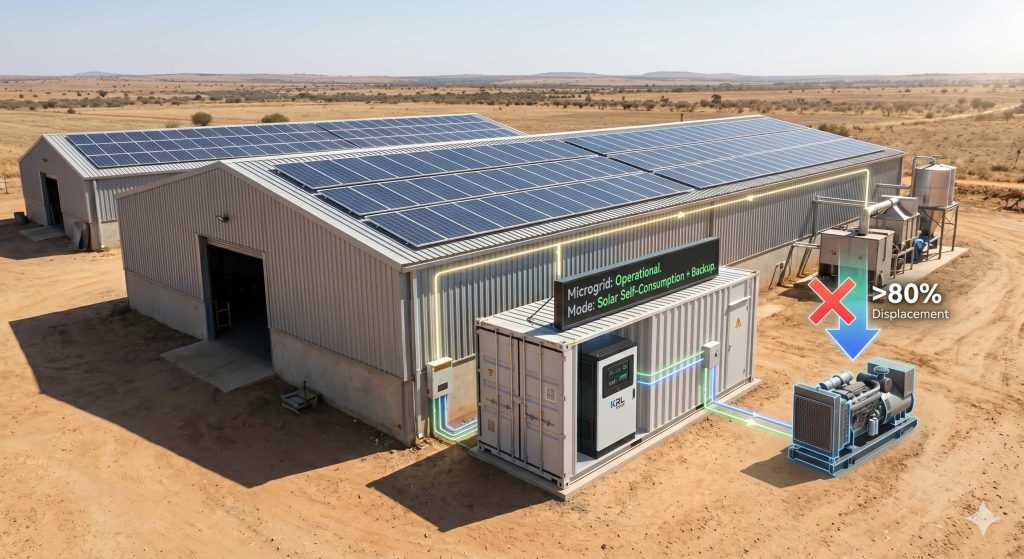
- Agriculture, Farming & Field Operations: Pairs seamlessly with solar PV arrays to form self-sufficient, off-grid microgrids, ensuring independent and sustainable power generation.
6. Specialized Grid Services & Advanced Applications
- Integrated Solar-Storage-Charging Stations: Provides dynamic grid capacity expansion for locations strictly constrained by limited utility transformer capacity.
- Grid Ancillary Services: Enables asset owners to actively participate in utility demand response and frequency regulation programs, unlocking new revenue streams and policy subsidies.
- Aging Power Distribution Networks: Actively regulates local voltage, reduces transmission line losses, and comprehensively corrects three-phase power imbalances in older grid infrastructures.
Proven Success: KRL Power 100kW PCS Case Study in South Africa
Real-world experience and measurable results define our authority in the energy sector.KRL Power has established a deep, long-term presence in South Africa's C&I energy storage market. Throughout 2025–2026, we have successfully delivered our high-performance 100kW energy storage inverter (PCS) systems to over 20 local enterprises, covering key economic and agricultural hubs including Johannesburg, Pretoria, Cape Town, and the Paarl agricultural parks.
After evaluating multiple options on the market, these clients ultimately selected the KRL Power 100kW PCS paired with a robust 200kWh Lithium Iron Phosphate (LiFePO4) battery system. Designed for a 380V low-voltage grid connection, the system requires no expensive high-voltage modifications, offering a true plug-and-play solution.
Our Core Technological Advantages
- 10ms Seamless Switching (UPS-Grade): Automatically transitions to off-grid mode within 10 milliseconds during sudden grid failures or load shedding, ensuring zero interruption to manufacturing processes.
- Over 98% Efficiency in Extreme Climates: Engineered to operate flawlessly in high altitudes and extreme temperatures ranging from -30°C to 60°C, perfectly adapting to the demanding South African climate.
- Dual-Mode Operation (Peak Shaving + Backup): Intelligently stores power during off-peak hours and discharges during peak hours to drastically slash utility bills, while maintaining a reliable backup reserve.
- Diesel Generator Displacement: Reduces reliance on diesel generators by over 80%, saving facilities over one million Rand in fuel costs annually.
- IP55 Rugged Protection: The dustproof and waterproof enclosure is purpose-built to withstand South Africa's harsh, dusty, and high-temperature environments.
Measurable Project Results & ROI
- 100% Production Continuity (Zero Downtime): Completely eradicates the impact of frequent load shedding by providing 6 to 8 hours of continuous power. By keeping production lines running, clients prevent estimated monthly losses of ZAR 300,000 to 500,000.
- 30%+ Reduction in Utility Bills: By combining Time-of-Use (TOU) tariff arbitrage with solar PV self-consumption, average monthly electricity bills plummeted from ZAR 120,000 to under ZAR 80,000.
- Massive Diesel Savings: With generators relegated to extreme emergency use only, facilities save approximately ZAR 1.2 million in diesel fuel costs every year.
- Rapid Return on Investment: With an initial capital expenditure (CAPEX) of ZAR 1.8 to 2.2 million, the payback period is exceptionally short—just 3.5 to 4.5 years. Coupled with a battery lifespan of over 10 years, the system guarantees stable, long-term profitability.
- Enhanced Equipment Lifespan (Power Quality): The inverter provides advanced voltage stabilization and filtering, restricting voltage fluctuations to <±2%. This clean power delivery has reduced the failure rate of sensitive precision equipment by an impressive 60%.
Partner with KRL Power for Future-Proof Energy Resilience
To date, KRL Power energy storage inverters have been successfully deployed and are operating reliably across more than 50 commercial and industrial (C&I) projects throughout South Africa. Our systems are fully certified to comply with local utility grid standards and are backed by a rapid-response, localized after-sales support team to ensure maximum system uptime.
Perfectly tailored for mid-sized facilities ranging from 500 to 2,000 square meters—such as manufacturing plants, logistics warehouses, and agricultural parks—the system features a direct 380V low-voltage grid connection. This completely bypasses the need for lengthy, complex, and costly high-voltage grid approvals. Furthermore, our highly flexible, modular architecture allows up to four inverters to be seamlessly connected in parallel, scaling your power capacity up to 400kW. This future-proof design ensures that as your enterprise expands production, your energy infrastructure grows with you—eliminating the need for redundant capital reinvestment.
V&A
Q1.What core function does a 100kW energy storage inverter perform?
It realizes bidirectional AC-DC power conversion. It charges power into batteries during off-peak time and discharges stored electricity to supply loads or grid, serving as the core hub for commercial and industrial energy management.
Q2.Is this 100kW inverter suitable for South African power conditions?
Yes. It adapts to local frequent load shedding, wide temperature variation and unstable grid voltage. It supports 380V low-voltage grid access and fully meets local grid access standards.
Q3.What benefits can enterprises gain after installing the system?
It cuts electricity bills by peak-valley arbitrage, avoids production loss from power cuts, greatly reduces diesel generator consumption, improves power quality and extends service life of production equipment.
Q4.What kinds of scenarios can the 100kW energy storage inverter be applied to?
It fits manufacturing factories, commercial buildings, public service facilities, EV charging stations, remote off-grid sites, and can also participate in grid auxiliary regulation services.
Q5.Can the power capacity be expanded later when business grows?
Certainly. Up to 4 units can be connected in parallel to reach 400kW total power. No extra major transformation is needed, supporting flexible capacity expansion matching enterprise development.
