 Skip to content
Introduction: Why Industrial Electricity Bills Are Out of Control (And How to Fix It)
For industrial operators—from manufacturing plants and data centers to mining facilities and chemical factories—electricity costs are one of the largest operational expenses, often accounting for 20–35% of total overhead. What’s more alarming is that a significant portion of these costs comes not from the total energy consumed, but from demand charges: fees imposed by utilities based on your facility’s highest power draw (peak demand), even if those peaks last only a few minutes per day. In many regions, demand charges make up 30–40% of monthly electricity bills, creating a hidden financial burden that erodes profit margins and limits growth.
Add to this the global trend of rising energy tariffs, increasing grid instability, and stricter environmental regulations, and it’s clear that industrial users need a proactive solution to take control of their energy costs. Enter battery energy storage system (BESS) peak shaving—a proven technology that allows industrial facilities to store cheap off-peak electricity and discharge it during periods of high demand, effectively flattening load profiles, eliminating excessive demand charges, and unlocking significant cost savings.
As the Director of Energy Storage Technology at KRL Power—a 2025 “High-Quality Energy Storage Enterprise” and a fast-growing leader in China’s energy storage industry—I’ve overseen the design, deployment, and optimization of more than 50 industrial BESS projects across Asia and Europe. In this guide, I’ll break down exactly how peak shaving works, why it’s critical for industrial users in 2025 and beyond, and how KRL’s advanced solutions deliver unmatched ROI, safety, and reliability. By the end, you’ll have a clear, actionable roadmap to reduce your electricity costs by 20–40%—without sacrificing production efficiency or grid reliability.
What Is Peak Shaving & How Does It Work for Industrial Users?
Defining Peak Shaving for Industry
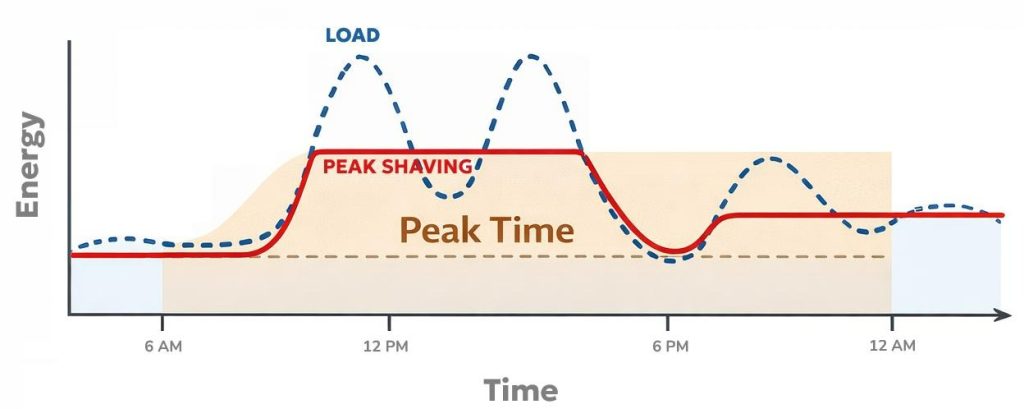
Peak shaving is a demand-side management strategy that uses battery energy storage to “shave off” the highest peaks of your facility’s power consumption, ensuring your energy draw stays below a predefined threshold. This threshold is set just below your historical peak demand—high enough to avoid disrupting production, but low enough to eliminate or drastically reduce demand charges.
Unlike residential or commercial applications, industrial peak shaving requires robust, high-capacity systems that can handle the variable, high-load demands of manufacturing, processing, and heavy industry. Industrial facilities often have unpredictable load spikes—for example, a steel mill firing up an additional furnace, a data center scaling up server capacity, or a chemical plant starting a new production batch—making peak shaving both a technical and strategic challenge.
The KRL Peak Shaving Process: 4 Steps to Maximum Savings
At KRL Power, we’ve refined our peak shaving process over years of industrial deployment, combining proprietary software, high-performance hardware, and expert engineering to deliver consistent, measurable results. Here’s how our system works for industrial users:
- AI-Powered Load Profile Analysis & Peak Forecasting: First, our team collects 12+ months of your facility’s 15-minute interval energy data (from utility bills, smart meters, or on-site monitoring systems). We then use KRL’s proprietary Energy Management System (EMS)—developed in-house by our team of software and energy experts—to analyze this data, along with your production schedules, weather patterns, and local tariff structures. Our AI algorithms predict peak demand events with 99% accuracy, identifying when and how your facility’s load will spike, and for how long.
- Custom Threshold Setting: Based on your historical peak demand, utility tariff structure, and production needs, we work with you to set a “power ceiling”—a maximum grid draw threshold that avoids excessive demand charges. For example, if your facility’s historical peak is 1,200 kW, we might set a threshold of 800 kW, ensuring you stay below the utility’s demand charge tier while maintaining full production capacity.
- Intelligent Charging During Off-Peak Hours: During valley hours—periods when electricity rates are lowest (typically 10 PM–6 AM, depending on your region)—KRL’s BESS automatically charges using grid power. Our EMS optimizes charging to take advantage of the lowest possible tariffs, while also ensuring the battery is fully charged and ready to discharge when peaks occur. We also account for battery health and degradation, using smart charging algorithms to extend battery lifespan.
- Millisecond-Response Discharge During Peaks: When your facility’s load nears the predefined threshold, KRL’s BESS discharges instantly—within milliseconds—to supplement grid power, capping your grid draw at the target threshold. This eliminates the excess demand that would otherwise trigger high demand charges. Our system also adjusts in real time: if a peak lasts longer than expected, the EMS dynamically balances discharge rates to ensure the battery has enough capacity to see you through the peak, while avoiding over-discharge.
Why Industrial Users Lose Money Without Peak Shaving (The Hidden Costs)
Many industrial operators underestimate the financial impact of not implementing peak shaving. It’s not just about paying higher demand charges—there are hidden costs that compound over time, eroding profitability and competitiveness. Here are the key reasons why peak shaving is no longer optional for industrial users:
1. Demand Charges Are a Brutal Financial Burden
Demand charges are calculated based on your facility’s highest 15–30 minute power draw during the month, multiplied by a per-kW rate (which can range from $0.30 to $0.80/kW, depending on your region and utility). Even a single short peak can drastically increase your monthly bill. For example, consider a chemical plant with a historical peak of 1,500 kW and a demand charge rate of $0.50/kW. A single 30-minute peak at 1,500 kW costs $750. If that peak occurs daily, the monthly demand charge alone is $22,500—equating to $270,000 per year. Without peak shaving, this cost is unavoidable.
2. Peak-Valley Tariff Spreads Are Widening Globally
To encourage energy conservation and balance grid load, utilities worldwide are implementing wider peak-valley tariff spreads. In 2025, the average global tariff for off-peak electricity is $0.10–$0.30/kWh, while peak tariffs range from $0.40–$0.80/kWh—a difference of $0.30–$0.50/kWh. This creates massive arbitrage opportunities for industrial users with BESS: store cheap off-peak power, then use it during peak hours to avoid paying premium rates. For a facility consuming 10,000 kWh per day, this can translate to $3,000–$5,000 in monthly savings from energy arbitrage alone.
3. Grid Instability Risks Production Downtime
Peak demand periods are often when the grid is most unstable, leading to voltage sags, frequency fluctuations, and even blackouts. For industrial users, unplanned downtime can be catastrophic: a single hour of downtime in a manufacturing plant can cost $10,000–$100,000, depending on the industry. KRL’s BESS not only reduces demand charges but also provides uninterruptible backup power, seamlessly switching to off-grid mode during grid outages to protect critical loads and prevent production losses.avings from energy arbitrage alone.
4. Missed Opportunities for Demand Response Revenue
Many utilities and grid operators offer demand response programs, where industrial users are paid to reduce their grid load during peak periods. With a BESS, you can participate in these programs by discharging your battery during demand response events, earning additional revenue while also reducing your own electricity costs. KRL’s EMS is fully integrated with global demand response platforms, allowing you to maximize this additional income stream.
KRL’s 4 Core Advantages for Industrial Peak Shaving (Why We Stand Out)
As one of China’s most dynamic emerging players in the energy storage industry, KRL Power has earned the title of “High-Quality Energy Storage Enterprise 2025” for our technological innovation, safety, and customer-centric solutions. Our focus on commercial and industrial (C&I) energy storage systems means we design every product with the unique needs of industrial users in mind—maximum ROI, extreme safety, and minimal operational disruption. Here are the key competitive advantages that set KRL apart from other providers:
1. Extreme Safety Architecture: Protect Your Facility & Investment
Industrial facilities operate in complex, high-risk environments—safety is non-negotiable. KRL’s BESS is built with an industry-leading safety architecture that ensures stable operation even under the most challenging conditions:
- High-Quality LiFePO4 Battery Cells: We use non-flammable, long-life LiFePO4 cells with a cycle life of 10,000+ cycles (retaining 80% capacity after 10,000 cycles), eliminating the risk of thermal runaway—a common concern with other battery chemistries.
- Advanced Liquid Cooling System: Our liquid cooling technology maintains a consistent operating temperature of 25–30°C, reducing battery degradation by 30% compared to air-cooled systems and ensuring safe operation in extreme temperatures (from -20°C to 60°C).
- Intelligent BMS & Multi-Layer Fire Protection: Our proprietary Battery Management System (BMS) monitors each cell in real time, detecting anomalies and triggering protective measures before issues escalate. We also include multi-layer active fire protection, including inert gas suppression and temperature-sensitive fire extinguishers, to prevent and contain fires.
2. Self-Developed EMS: The Brain Behind Maximum ROI
The key to effective peak shaving is not just the battery—it’s the software that controls it. KRL’s self-developed Energy Management System (EMS) is the heart of our solution, designed specifically to maximize ROI for industrial users:
- Dynamic Peak Shaving & Valley Filling: The EMS adjusts charge/discharge rates in real time based on your production schedule, grid tariffs, and peak demand predictions, ensuring you always get the maximum possible savings.
- AI-Powered Peak Forecasting: Our algorithms learn from your facility’s load patterns over time, improving prediction accuracy and allowing the system to anticipate peaks 24 hours in advance—critical for industrial facilities with variable production schedules.
- Multi-Revenue Optimization: The EMS balances peak shaving, energy arbitrage, and demand response revenue, ensuring you maximize all possible income streams from your BESS.
3. Highly Integrated “All-in-One” Modular Design: Fast Deployment & Flexibility
Industrial users can’t afford long downtime for system installation. KRL’s All-in-One modular architecture is designed for plug-and-play deployment, minimizing disruption to your operations:
- Fast Deployment: Our modular systems can be fully installed and commissioned in 7–10 days, compared to 4–6 weeks for custom-built solutions. We handle all permits, grid connection, and testing, so you can start saving sooner.
- Scalable Capacity: Our systems range from 100 kW/200 kWh to 2 MW/4 MWh, with the ability to scale up or down as your production needs change. This flexibility means you don’t have to over-invest in capacity upfront—you can expand as your business grows.
- Cloud-Based AI Monitoring: Our cloud platform provides 24/7 remote diagnostics, predictive maintenance, and real-time performance tracking. You can monitor your BESS from anywhere, receive alerts for potential issues, and access detailed reports on savings and performance.
4. Superior Cost Optimization: Industry-Leading ROI
At KRL, we understand that industrial users need solutions that deliver measurable, fast ROI. Our BESS is designed to minimize upfront costs and maximize long-term savings:
- 20–40% Reduction in Electricity Costs: Our clients typically see a 20–40% reduction in total electricity costs, with demand charge savings accounting for the majority of this reduction.
- 3–5 Year Payback Period: Thanks to our cost-optimized design and high-efficiency systems, KRL’s BESS has an industry-leading payback period of 3–5 years—far shorter than the 15-year lifespan of the system.
- Flexible Financing Options: We offer a range of financing solutions to eliminate upfront costs, including operating leases, Power Purchase Agreements (PPAs), and equipment loans with 5–7 year terms. This allows you to start saving without tying up capital.
How to Size Your BESS for Peak Shaving (KRL’s Proven 4-Step Method)
Sizing your BESS correctly is critical to maximizing savings and avoiding over-investment. Many providers use a one-size-fits-all approach, but at KRL, we use a data-driven method to size your system based on your unique load profile, tariff structure, and production needs. Here’s our proven 4-step process:
Step 1: Analyze Your Load Profile
The first step is to collect and analyze 12 months of your facility’s energy data, including 15-minute interval load data (kW) and energy consumption (kWh). This data helps us identify: your historical peak demand (kW), the duration of peak events (how long each peak lasts), the frequency of peaks (how often they occur), and the peak-valley tariff spread. We also consider your production schedule—for example, if you have seasonal peaks or shift-based production—to ensure the system is sized to handle your busiest periods.
Step 2: Calculate Required Power (kW)
The power rating of your BESS (kW) determines how much power it can discharge at once—critical for shaving peaks. The formula is simple:
Peak Shaving Power = Historical Peak (kW) – Target Threshold (kW)
For example, if your facility’s historical peak is 1,200 kW and you want to set a target threshold of 800 kW, you’ll need a BESS with a power rating of 400 kW. This ensures the system can discharge 400 kW to cap your grid draw at 800 kW during peaks.
Step 3: Calculate Required Energy (kWh)
The energy capacity of your BESS (kWh) determines how long it can discharge at the required power level. The formula includes a 20% buffer to account for battery efficiency and degradation:
Energy Capacity (kWh) = Power (kW) × Peak Duration (hours) × 1.2 (buffer)
Using the previous example: 400 kW × 2 hours (average peak duration) × 1.2 = 960 kWh. We would recommend a 1 MWh energy capacity to ensure the system can handle longer peaks if needed.
Step 4: KRL’s Expert Optimization
Our team goes beyond basic sizing to optimize your system for maximum ROI. We account for: local tariff structures (including time-of-use rates and demand charge tiers), production variability (e.g., shift changes, seasonal fluctuations), battery degradation over its 15-year lifespan, and grid code compliance. We also consider future growth—ensuring the system can be scaled up as your facility expands.
Real-World ROI Example: Automotive Parts Factory (Case Study)
To illustrate the impact of KRL’s peak shaving solution, let’s look at a real client case study: a 24/7 automotive components factory in Eastern China with 500 employees, producing parts for major automakers.
Client Challenges
- Historical peak demand: 1,400 kW
- Average load: 800 kW
- Daily peak duration: 2 hours (9 AM–11 AM, 2 PM–4 PM)
- Tariffs: Peak = $0.65/kWh, Valley = $0.18/kWh
- Monthly electricity bill: $145,000 (40% from demand charges)
- Grid instability: 3–4 unplanned outages per year, each causing 2–3 hours of downtime (costing $50,000 per outage)
KRL Solution
After analyzing the client’s load profile and goals, we deployed a 500 kW/1 MWh All-in-One BESS with our proprietary EMS, liquid cooling system, and cloud monitoring platform. We set a target threshold of 900 kW, ensuring the client avoided the highest demand charge tier while maintaining full production capacity.
Results (First 12 Months)
- Demand Charge Savings: Reduced from $58,000/month to $14,500/month (75% savings)
- Energy Arbitrage Savings: $12,000/month (by storing valley power and using it during peaks)
- Downtime Reduction: Zero unplanned outages (BESS provided backup power during 2 grid failures)
- Total Monthly Savings: $40,500
- Annual Savings: $486,000
- Payback Period: 3.2 years
- 15-Year Net Savings: $6.2 million
This client not only reduced their electricity costs by 34% but also eliminated costly downtime, improved operational reliability, and positioned themselves for long-term growth in a competitive industry.
FAQ: Industrial Peak Shaving with KRL BESS (Answered by KRL’s Technology Director)
As a technology director with 15+ years of experience, I’ve heard every question industrial users have about peak shaving. Below are the most common FAQs, answered with practical, actionable information:
What industries benefit most from peak shaving?
Peak shaving is most beneficial for high energy-consuming industries with variable loads and high demand charges. This includes: manufacturing (steel, automotive, chemicals, food & beverage), data centers, mining, pharmaceutical plants, and large commercial facilities (e.g., shopping malls, hospitals). Any facility with unpredictable load spikes or high demand charges will see significant savings from peak shaving.
How much can I realistically save with peak shaving?
The amount you save depends on your load profile, tariff structure, and the size of your BESS. However, our clients typically see a 20–40% reduction in total electricity costs. For facilities with high demand charges (30–40% of their bill), savings can be even higher—like our automotive client, who saved 34% in their first year. KRL’s free load profile analysis will give you a precise savings estimate for your facility.
What is the lifespan of KRL’s BESS, and how does it impact ROI?
KRL’s BESS has a lifespan of 15+ years with proper maintenance. Our LiFePO4 cells retain 80% capacity after 10,000 cycles, and our liquid cooling system extends battery life by 30% compared to air-cooled systems. This means your system will continue to deliver savings for 15+ years, far exceeding the 3–5 year payback period. We also offer maintenance plans to ensure your system operates at peak efficiency for its entire lifespan.
How long does installation take, and will it disrupt my operations?
KRL’s modular, plug-and-play design allows full deployment in 7–10 days, compared to 4–6 weeks for custom solutions. Our installation team works around your production schedule—often during off-hours or weekends—to minimize disruption. We handle all permits, grid connection, and commissioning, so you can focus on your core business while we set up your system. Most clients experience zero downtime during installation.
What happens if the grid fails? Will my production stop?
No—KRL’s BESS provides uninterruptible backup power for critical loads during grid outages. The system seamlessly switches to off-grid mode within milliseconds, ensuring your critical equipment (e.g., production lines, servers, refrigeration) continues to operate. This eliminates downtime losses and protects your business from grid instability.
Is financing available, or do I need to pay upfront?
Yes, we offer flexible financing options to eliminate upfront costs. Our options include: operating leases (0% upfront cost, monthly payments), Power Purchase Agreements (PPAs)—where we own and operate the system, and you pay a fixed rate for the energy it provides—and equipment loans with 5–7 year terms. We work with you to choose the financing solution that best fits your cash flow and business goals.
How does KRL’s BESS comply with local grid codes?
KRL’s BESS is designed to comply with grid codes worldwide, including China’s GB/T standards, the EU’s EN standards, and the US’s IEEE standards. Our team of engineers ensures your system meets all local requirements for grid connection, safety, and performance. We also handle all grid connection applications and testing, so you don’t have to navigate complex regulations on your own.
Conclusion: Take Control of Your Electricity Costs with KRL Power
In today’s competitive industrial landscape, controlling electricity costs is not just about saving money—it’s about staying competitive, improving operational reliability, and future-proofing your business. Battery storage peak shaving is a proven, cost-effective solution that delivers immediate savings, reduces downtime, and unlocks new revenue streams.
As a 2025 “High-Quality Energy Storage Enterprise,” KRL Power combines industry-leading technology, expert engineering, and customer-centric service to deliver BESS solutions that maximize ROI for industrial users. Our extreme safety architecture, self-developed EMS, modular design, and flexible financing options make us the trusted partner for 50+ industrial clients worldwide.
If you’re ready to reduce your electricity costs by 20–40%, eliminate demand charge burdens, and protect your production from grid instability, contact KRL Power today. Our team of industrial energy storage experts will provide a free load profile analysis and customized ROI proposal, helping you take the first step toward energy independence and long-term profitability.
