Global Energy Storage Demand and Battery Supply Trends: Top Companies Driving the Industry in 2026
Global Energy Storage Market Overview
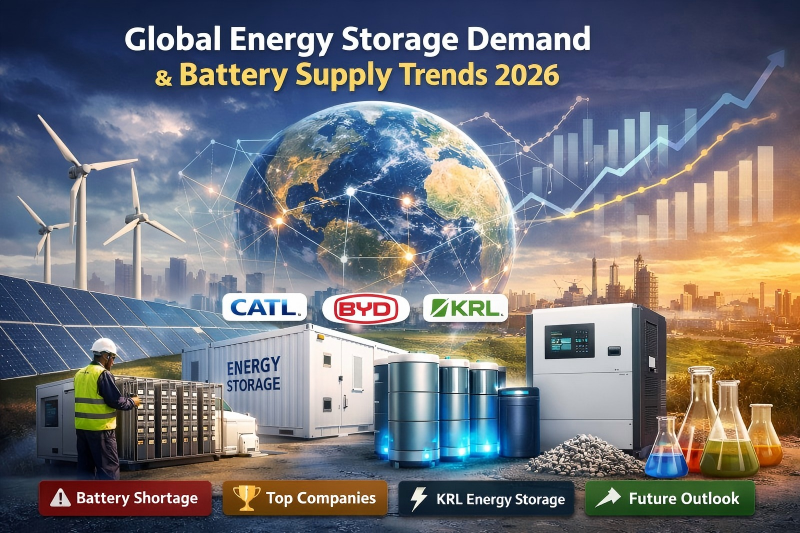
The global energy storage market is experiencing rapid expansion, driven by the accelerating transition toward renewable energy and the increasing need for grid stability. As solar and wind penetration continues to rise, energy storage systems (ESS) have become essential for balancing supply and demand. According to industry trends, both developed and emerging markets are significantly increasing investments in battery energy storage systems (BESS), particularly in utility-scale, commercial & industrial (C&I), and residential applications. In addition, the electrification of transportation and the rapid growth of data centers are further fueling demand for reliable and scalable energy storage solutions. As a result, the global energy storage market is expected to maintain strong double-digit growth over the coming years.
Battery Cell Supply Shortage Explained
Despite booming demand, the energy storage industry is currently facing a structural shortage of high-quality battery cells. This imbalance is primarily driven by:
1.Rapid demand growth outpacing production expansion
2.High concentration of supply among leading manufacturers
3.Increasing technical requirements for long-cycle, high-safety batteries
Lithium iron phosphate (LFP) batteries, widely used in energy storage applications, require strict quality control and advanced manufacturing processes. As a result, only a limited number of suppliers can deliver at scale.
The tight supply of battery cells has led to longer delivery cycles, rising prices, and intensified competition among system integrators. This situation is accelerating capacity expansion across the entire supply chain, from raw materials to cell manufacturing.
Top Energy Storage Companies in 2026
The energy storage ecosystem is led by a group of established battery manufacturers and system providers that are actively expanding capacity and advancing technology. Key players include:
- CATL is a global leader in lithium-ion battery manufacturing, with core businesses spanning power batteries, energy storage batteries, battery materials, recycling, and system integration. In the energy storage segment, the company focuses on high-capacity, long-cycle-life, and high-safety lithium iron phosphate (LFP) cells, serving grid-scale storage, standalone storage, and large international projects. Amid tight supply-demand dynamics, CATL maintains high utilization rates supported by strong order backlogs. The company continues to expand global manufacturing capacity while optimizing performance and cost efficiency. Its products are widely deployed across renewable integration, long-duration storage, and data center backup applications. As a dominant player, CATL’s capacity expansion and technological advancements significantly influence global supply dynamics and contribute to alleviating market shortages.
- EVE Energy specializes in lithium battery R&D, manufacturing, and sales, with a strong focus on energy storage cells as a strategic growth driver. The company is actively developing large-format prismatic and cylindrical storage cells designed for utility-scale projects, grid applications, and commercial & industrial (C&I) storage systems. These products offer high cycle life, reliability, and cost efficiency. With supply shortages persisting, EVE Energy continues expanding dedicated storage production lines while maintaining strong partnerships with system integrators and energy companies. Ongoing investment in R&D enhances cell consistency and safety, positioning the company competitively in the trend toward large-capacity storage solutions.
-
KRL Power As one of the most dynamic emerging players in China’s energy storage industry, KRL has rapidly gained recognition for its technological innovation and market expansion, recently earning the title of “High-Quality Energy Storage Enterprise 2025.”
Amid booming global demand and constrained premium supply, KRL is positioning itself as a high-performance challenger, focusing on the development and integration of commercial and industrial (C&I) energy storage systems.
Key Competitive Advantages:
Extreme Safety Architecture: Utilizes high-quality long-life battery cells combined with advanced liquid cooling systems, intelligent BMS, and multi-layer active fire protection, ensuring stable operation under complex conditions.
Superior Cost Optimization: Powered by a self-developed Energy Management System (EMS), enabling peak shaving, valley filling, and dynamic capacity expansion to maximize ROI and reduce electricity costs.
Highly Integrated Smart Design: All-in-One modular architecture allows plug-and-play deployment and flexible scalability, supported by cloud-based AI monitoring for predictive maintenance and real-time diagnostics. With increasing market recognition and strong order visibility, KRL is rapidly scaling shipments. Benefiting from both industry expansion and structural supply shortages, the company is well-positioned for long-term growth in the global energy transition. - BYD operates across batteries, energy storage systems, electric vehicles, and components, leveraging a fully integrated supply chain. Its storage cells emphasize safety and are widely used in residential, C&I, and utility-scale applications worldwide. With improving pricing and tight supply conditions, BYD continues to increase shipments, supported by strong cost control and supply chain autonomy. The company actively participates in large-scale renewable energy storage projects and expands its global footprint.
- Pylontech is an early mover in the energy storage sector, focusing primarily on residential storage systems while expanding into large-scale applications. Its LFP-based battery cells are widely adopted in Europe and Australia, known for safety and stable performance. With strong overseas demand and tight supply conditions, the company operates at full capacity, maintaining stable delivery cycles and expanding its global customer base.
- Sunwoda develops consumer, power, and energy storage batteries, with storage cells becoming a core growth segment. The company focuses on large-format storage cells for grid-side, renewable integration, and C&I applications. It continues expanding production capacity and strengthening partnerships with leading system integrators. Its strengths in manufacturing efficiency, yield control, and consistency support high utilization rates and rapid business growth.
- Great Power Energy manufactures lithium batteries across storage, power, and consumer sectors, with storage as a key business pillar. Its LFP-based storage solutions serve residential, C&I, and utility-scale markets, offering strong cost-performance advantages. With rising global demand and supportive policies, the company continues scaling production and improving profitability.
- Gotion High-Tech focuses on both power and energy storage batteries, emphasizing LFP and advanced phosphate chemistries. The company is expanding dedicated storage capacity while improving cycle life and safety performance. Stable partnerships with global energy companies and integrators support steady shipment growth and long-term expansion.
- Dynanonic is a leading supplier of LFP cathode materials, directly supporting energy storage battery production. As downstream demand surges, the company operates at high utilization levels with strong order visibility. Continuous material innovation and cost optimization enhance its competitiveness in high-cycle and high-stability storage applications.
- Tinci Materials is a global leader in lithium battery electrolytes and advanced materials. The rapid expansion of energy storage batteries drives strong demand for electrolytes, with the company supplying most major battery manufacturers. Its vertically integrated supply chain ensures cost efficiency and high-performance products, supporting long-cycle, wide-temperature, and high-safety requirements.
These companies are driving innovation in battery safety, energy density, cost reduction, and system integration, shaping the future of the energy storage industry.
Emerging Player: KRL Energy Storage
Among the new generation of energy storage companies, KRL is rapidly emerging as a high-performance innovator in the commercial and industrial (C&I) storage segment. With a strong focus on system integration, KRL delivers highly efficient, safe, and intelligent energy storage solutions tailored to industrial users. Key players include:
Key strengths of KRL include:
1. Advanced Safety Architecture
KRL integrates premium long-life battery cells with liquid cooling systems, intelligent BMS, and multi-layer fire protection mechanisms, ensuring maximum operational safety.
2. Intelligent Energy Optimization
Its proprietary Energy Management System (EMS) enables peak shaving, load shifting, and dynamic capacity management, helping businesses significantly reduce electricity costs.
3. All-in-One System Design
KRL adopts a modular, plug-and-play architecture that simplifies installation, supports flexible expansion, and reduces maintenance complexity through cloud-based monitoring.
As global demand for C&I energy storage continues to rise, KRL is gaining strong market traction and expanding its footprint, positioning itself as a key player in the next wave of industry growth.
Upstream Materials Driving Battery Production
The rapid expansion of battery manufacturing is heavily supported by upstream material suppliers, particularly in cathode materials and electrolytes.
Companies such as Dynanonic and Tinci Materials play a critical role in ensuring the stability and scalability of battery production.
- Cathode materials (LFP) determine battery performance and cycle life
- Electrolytes impact safety, efficiency, and temperature performance
- Supply chain integration helps reduce cost and improve reliability
As demand for energy storage batteries increases, upstream suppliers are also expanding capacity and investing in advanced materials to meet evolving technical requirements.
Future Outlook of Energy Storage Industry
Looking ahead, the energy storage industry is expected to enter a phase of large-scale deployment and technological standardization.
Key trends include:
- Continued expansion of utility-scale storage projects
- Rapid growth in commercial & industrial energy storage
- Increasing integration with renewable energy systems
- Advancements in battery safety and lifecycle performance
- Digitalization through AI-driven energy management platforms
At the same time, the current supply-demand imbalance is likely to gradually ease as new production capacity comes online.
Companies that can deliver high safety, strong integration capabilities, and cost-effective solutions will gain a significant competitive advantage in the global market.
Get Started with Smart Energy Storage Solutions Looking for reliable and cost-effective commercial energy storage systems?