
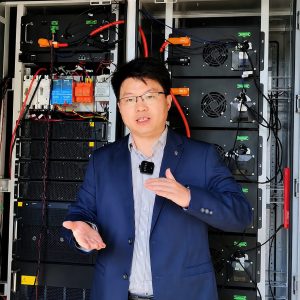
The first factory site survey starts at the gate. The EPC checks the delivery route, turning space, buried services, unloading area, foundation, cable path and spare transformer capacity. Those checks can move more money than a small difference in battery price per kilowatt-hour.
For a factory that needs 500kWh to 2MWh, modular cabinets often give the buyer finer capacity steps, smaller lifting loads and a practical route to phased expansion. A 5MWh container fits a different brief: a large, standardized energy block on a site prepared for heavy transport, utility-scale balance of plant and a high initial energy requirement.
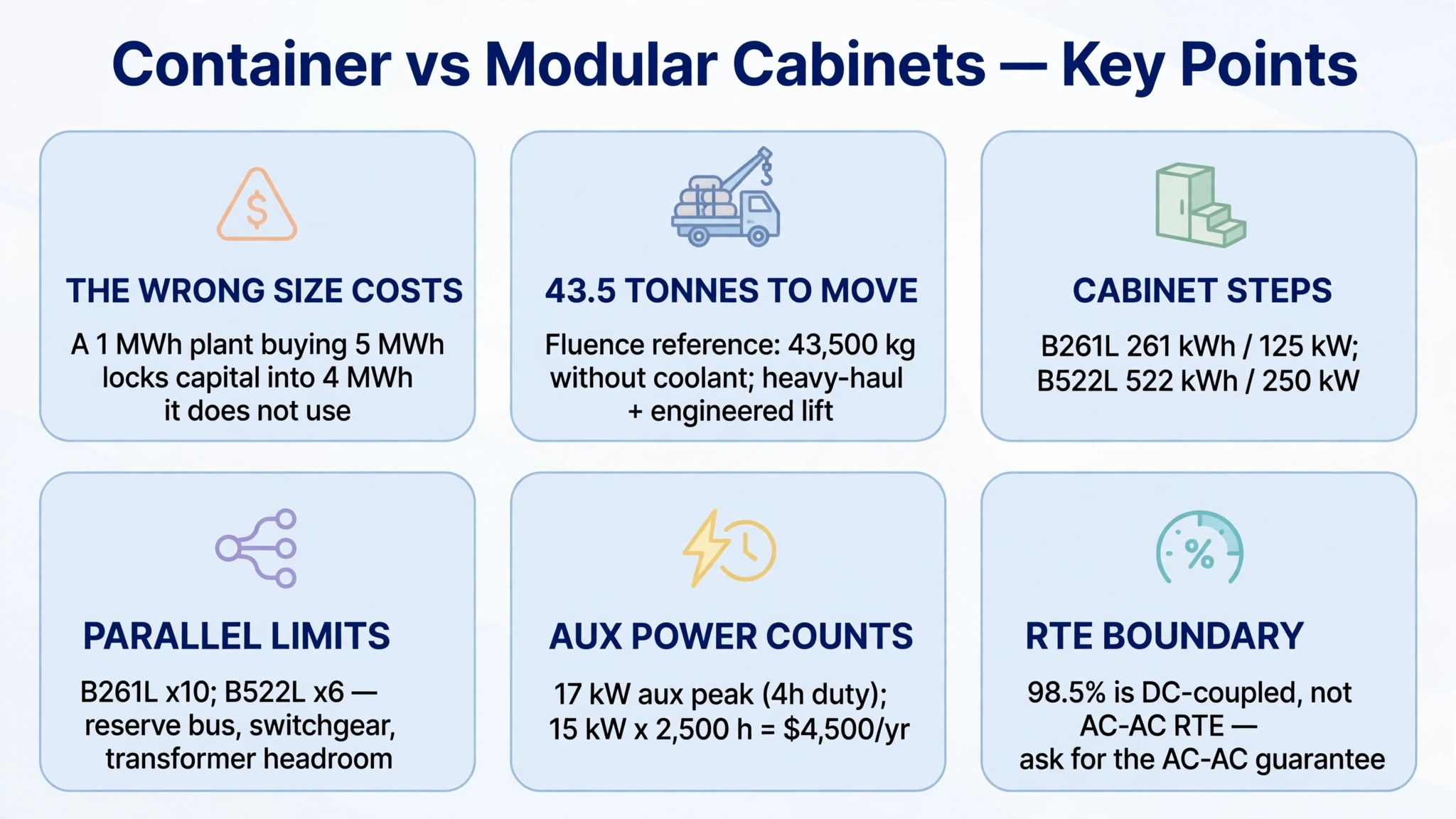
Compare both options at the same usable energy, AC power, duty cycle and supply boundary. If the plant needs about 1MWh, buying 5MWh because its factory price per kWh looks attractive can lock capital into 4MWh that the operating plan does not use.
If the plant will use 5MWh from day one and the site can accept the equipment, the container may deliver the cleaner project.
Plant engineers should let load data and site constraints govern a containerized BESS vs modular cabinets decision.
Define Both Offers Before Comparing Price
A utility-scale containerized BESS groups a large battery block into a transportable enclosure. Some products include the PCS and thermal system inside the enclosure.
Others are DC battery enclosures that need separate power conversion equipment. The quotation may leave the transformer, medium-voltage switchgear, EMS, fire works, cabling and commissioning to the EPC.
A modular all-in-one C&I cabinet divides the project into smaller outdoor units. KRL describes its integrated C&I architecture as combining battery packs, PCS, BMS, EMS, thermal management and fire protection.
The B261L and B522L product tables list on-grid and off-grid PCS power, liquid battery cooling, PV input, a generator port, communications and a fire-protection system. The exact project still needs switchgear, protection, cabling, controls and site works.
That difference in supply boundary can distort a bid comparison. A low container price may cover a battery enclosure only. A higher cabinet price may include power conversion and controls that sit elsewhere in the container offer. Every bidder should mark the same single-line diagram with its supply scope before the buyer compares dollars per kilowatt-hour.
Use these four quantities as the common baseline:
- Guaranteed usable AC energy at beginning and end of warranty
- Continuous and short-duration AC power at the project temperature and altitude
- Equipment and services included at the agreed point of connection
- Annual operating profile, including cycles, standby hours and ambient conditions
Compare a commercial energy storage cabinet vs container on this common baseline, with each supply scope defined.
5MWh Container vs KRL Modular Cabinets
The utility-container column below uses a published 4.872–5.016MWh Fluence Gridstack Pro enclosure as a reference for mass and auxiliary peak load. Utility products differ, so the project data sheet remains the controlling document. The KRL column uses the current B261L and B522L product pages.
| Factor | 5MWh container | KRL cabinets | Buyer check |
|---|---|---|---|
| Best fit | Large fixed-energy block | 261/522kWh steps | Required usable kWh and kW |
| Energy step | 4.872–5.016MWh reference | 261 or 522kWh | SOC, reserve and degradation |
| AC power | PCS-dependent | 125/250kW per unit | Continuous, peak and overload |
| Mass and lift | 43,500kg reference | 2,600/4,900kg | Route, lift plan and slab |
| Expansion | Add another large block | Add cabinets within limits | Reserve bus, switchgear and space |
| Service | Architecture-dependent | Cabinet-level option | Residual output and sequence |
| Auxiliary/RTE | >87% RTE; 17kW peak reference | AC-AC RTE not public | Use one meter boundary |
| Fire/layout | Model and AHJ-dependent | Model and AHJ-dependent | Reports, clearances and access |
Modular architecture changes the size of each investment and each physical move. Structural, electrical and fire engineering still apply.
Plan Delivery for a 43.5-Tonne Enclosure
Fluence publishes 43,500kg without coolant for its 4.872–5.016MWh enclosure. CATL lists about 45 tonnes for a 6.25MWh liquid-cooled container. A project team cannot treat either load like an ordinary delivery.
The site team should trace the full route from the public road to the final pad. Engineers need axle-load data for the delivery vehicle, bridge or culvert limits, gate dimensions, turning geometry, pavement condition and the position of buried water, gas and electrical services.
The lifting contractor also checks crane setup area, outrigger reactions, rigging weight, lift radius, wind limit and exclusion zones.
A 43.5-tonne enclosure does not imply a 43.5-tonne crane. Crane capacity falls as lift radius grows, and the rigging adds weight. The lifting contractor selects the crane from the load chart and site geometry.
KRL's cabinets split that operation into smaller moves. The B261L weighs about 2,600kg and measures 980 × 1,300 × 2,320mm. Its equipment footprint is about 1.27m² before service and fire clearances. The B522L weighs about 4,900kg and measures 2,480 × 1,400 × 2,050mm, giving an equipment footprint of about 3.47m².
The B261L may fit an industrial forklift plan after the contractor checks rated capacity at the required load center. The B522L needs a forklift, telehandler or crane rated for its 4.9-tonne mass and actual load geometry. Calling both models "ordinary forklift delivery" would understate the B522L lift.
Several smaller lifts can keep a shipping lane open and let the EPC stage installation by area. They also create more cable runs and more pad interfaces. The EPC should price both effects.
Design Foundations and Fire Access
Container projects concentrate a large load on one equipment footprint. Modular layouts spread the installed mass across several points. That can help a constrained factory use separate strips of land or complete work in phases, but the existing yard slab is not an automatic foundation.
The structural engineer should check soil bearing, slab thickness, reinforcement, anchor forces, settlement, drainage and flood level for each option. If new concrete is required, the construction schedule should follow the approved mix design and the strength required before equipment placement. A generic 28-day delay is not a sound universal estimate.
The project team should set fire separation from product evidence and the locally adopted code edition. NFPA 855 committee material uses 3ft (914mm) in an individual-unit spacing provision, while outdoor exposure provisions can use 10ft and allow reductions under defined conditions.
A universal 10–25ft rule would misstate the standard. The installation category, test reports, manufacturer instructions and authority having jurisdiction set the final layout.
Other countries apply their own codes and approval process.
KRL lists a fire-protection system for both cabinet models, but the public product tables do not identify a UL 9540A report or authorize installation against a wall. The EPC should request the test evidence, installation manual and permitted clearances for the exact order code.
A compact cabinet gives the layout designer more placement options; the approved drawings decide where it can stand.
Include Auxiliary Power in TCO
Thermal management, pumps, controls, communications and safety systems consume energy. A large enclosure can carry a sizable auxiliary load, yet the number changes with operating state and ambient temperature.
The Fluence Gridstack Pro data sheet lists a 17kW auxiliary peak load for its 4-hour 5MWh-class enclosure and 34kW for 2-hour duty. CATL publishes 46.5kW as the maximum auxiliary supply power for its 6.25MWh TENER C2-L625. Neither number is a universal standby draw.
Ask each supplier for a schedule with at least three states:
| Operating state | Supplier value |
|---|---|
| Standby | Average/peak kW by ambient |
| Charging | Auxiliary kW at rated and part load |
| Discharging | Auxiliary kW at rated and part load |
Then calculate annual auxiliary energy from the plant schedule:
Annual auxiliary energy = Σ (auxiliary kW in each state × hours in that state)
Consider a quoted system that averages 15kW across 2,500 idle hours in a year. It consumes 37,500kWh before a productive cycle begins. At $0.12/kWh, those idle hours cost $4,500 per year. Each input comes from the supplier guarantee or the factory's utility bill. Replace the 15kW scenario input with the supplier's guaranteed value.
Apply the same measurement boundary to round-trip efficiency. Sungrow publishes 89.5% RTE for PowerTitan 2.0, while Fluence publishes more than 87% for Gridstack Pro.
Both figures exceed 82%. A lightly used system can produce a lower site result when fixed auxiliary energy is divided by limited discharged energy, especially if auxiliaries sit outside the quoted meter boundary.
Use one definition across bids:
Net plant RTE = metered AC energy delivered ÷ (metered AC charging energy + external auxiliary energy)
KRL's C&I page states 98.5% DC-coupled efficiency. That value is not an AC-AC RTE and should not be placed in the same comparison column. Ask KRL and the container supplier for an AC-AC guarantee at the proposed operating point, with auxiliary loads included.
KRL Cabinet Steps from 500kWh to 2.6MWh
KRL publishes two useful liquid-cooled cabinet sizes for this decision.
The KRL-B261L-125H3S-120M1-HX1 carries 261kWh of rated LiFePO4 energy and 125kW of rated on-grid or off-grid AC power. It includes up to 120kW of PV input, a diesel-generator port, RS485/WiFi communication, IP65 protection for the battery section, a fire-protection system and liquid battery cooling. KRL publishes a parallel number of 10.
The KRL-B522L-250H3S-240M2-HX1 doubles the nameplate block to 522kWh and 250kW. It has 240kW of PV input across two MPPT channels and a published parallel number of 6. KRL lists the same 400/230Vac three-phase interface, generator port, RS485/WiFi communication, IP65 battery protection, fire-protection system and liquid battery cooling.
These ratings create capacity steps for 500kWh to 2MWh commercial battery storage:
| Target | B261L | B522L | Combined rating |
|---|---|---|---|
| ~500kWh | 2 | 1 | 250kW / 522kWh |
| ~1MWh | 4 | 2 | 500kW / 1.044MWh |
| ~1.5MWh | 6 | 3 | 750kW / 1.566MWh |
| ~2MWh | 8 | 4 | 1,000kW / 2.088MWh |
| ~2.5MWh | 10 | 5 | 1,250kW / 2.610MWh |
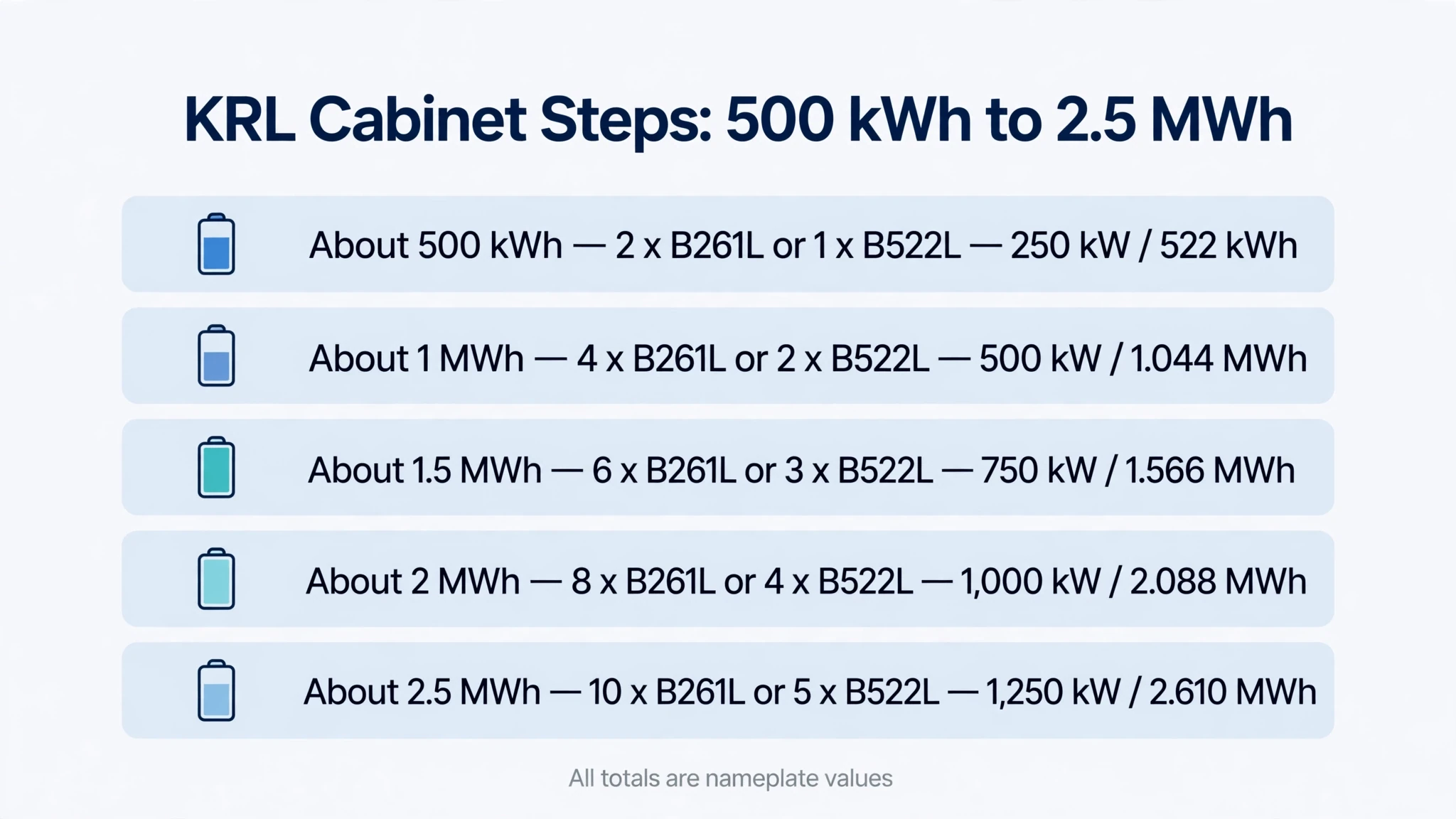
All totals in the table are nameplate values. The project engineer still sets the operating power, SOC window and reserve.
Two B522L cabinets can support a 250kW, four-hour operating target at a 1.044MWh nameplate, subject to usable-energy, temperature, ageing and auxiliary-load guarantees. Their combined PCS nameplate is 500kW, which gives the engineer headroom but also affects cost and protection design.
Projects approaching 1.5–2MWh or serving several high-power feeders should compare parallel cabinets with KRL's exact B2M6L container configurations on the same feeder and site design.
Plant owners can review KRL Power's modular all-in-one C&I battery storage cabinets when the project needs cabinet-sized capacity increments and an integrated outdoor architecture.
Use Phased Expansion to Protect Cash Flow
A 1MWh requirement does not earn revenue from 5MWh of installed nameplate unless the plant can cycle or reserve the extra energy. Financing, warranty time and calendar ageing still apply to the full purchase.
Cabinet increments let the buyer align capital with the load plan. A plant can start with two B522L units at 1.044MWh, then add another unit when a new production line, PV array or charging load creates a measured need.
That plan works only if the first phase reserves bus capacity, switchgear ways, transformer headroom, communications addresses and physical clearances.
KRL publishes parallel limits of 10 B261L cabinets or 6 B522L cabinets. A project above those limits needs a reviewed plant architecture or another product class.
Calculate service continuity from the installed cabinet count. Five equal cabinets retain 80% of installed nameplate power after one cabinet is isolated. Six retain 83.3%. Two cabinets retain 50%. The remaining units must still cover the protected load, and the EMS, switchgear and protection scheme must permit isolation without shutting down the common bus.
Modern utility containers may use rack-level controls and string PCS architecture that limit the effect of one subsystem fault. A buyer should compare the failure modes on both single-line diagrams instead of assigning a blanket single-point-failure label to the container.
Specify Liquid-Cooling Performance
Long coolant loops can create balancing challenges, while short cabinet circuits can make service isolation easier. Product design matters more than enclosure size alone.
KRL publishes a cell temperature difference within 3°C for the B261L. It does not publish a 2°C value for the B522L on the current product page. Sungrow publishes a 2.5°C cell/module temperature difference for its 5MWh PowerTitan 2.0. A blanket 5°C–8°C spread for large containers conflicts with these published figures.
The project specification should state the permitted temperature spread, ambient range, charge and discharge rate, measurement locations and acceptance test. It should also cover coolant leak detection, pump redundancy, isolation valves, service access and the power consumed by thermal control.
A narrow temperature spread can support consistent cell ageing. Include the claimed 25% life extension only after the supplier defines the test method, baseline product and operating profile.
Worked 1MWh Installed-Cost Scenario
This C&I BESS installation cost comparison uses commercial assumptions supplied for a worked example. KRL does not publish a list price for the B522L on its product page. Replace each cost with current vendor, logistics and EPC quotations before publishing a customer proposal.
Assume the plant needs about 1MWh and can use 250kW for a four-hour window. The two offers are:
| Cost item | 5MWh container | 2 × B522L |
|---|---|---|
| Equipment | $450,000 | $130,000–$150,000 |
| Local works | $30,000 | $3,000 |
| Installed subtotal | $480,000 | $133,000–$153,000 |
| Calculation midpoint | $480,000 | $143,000 |
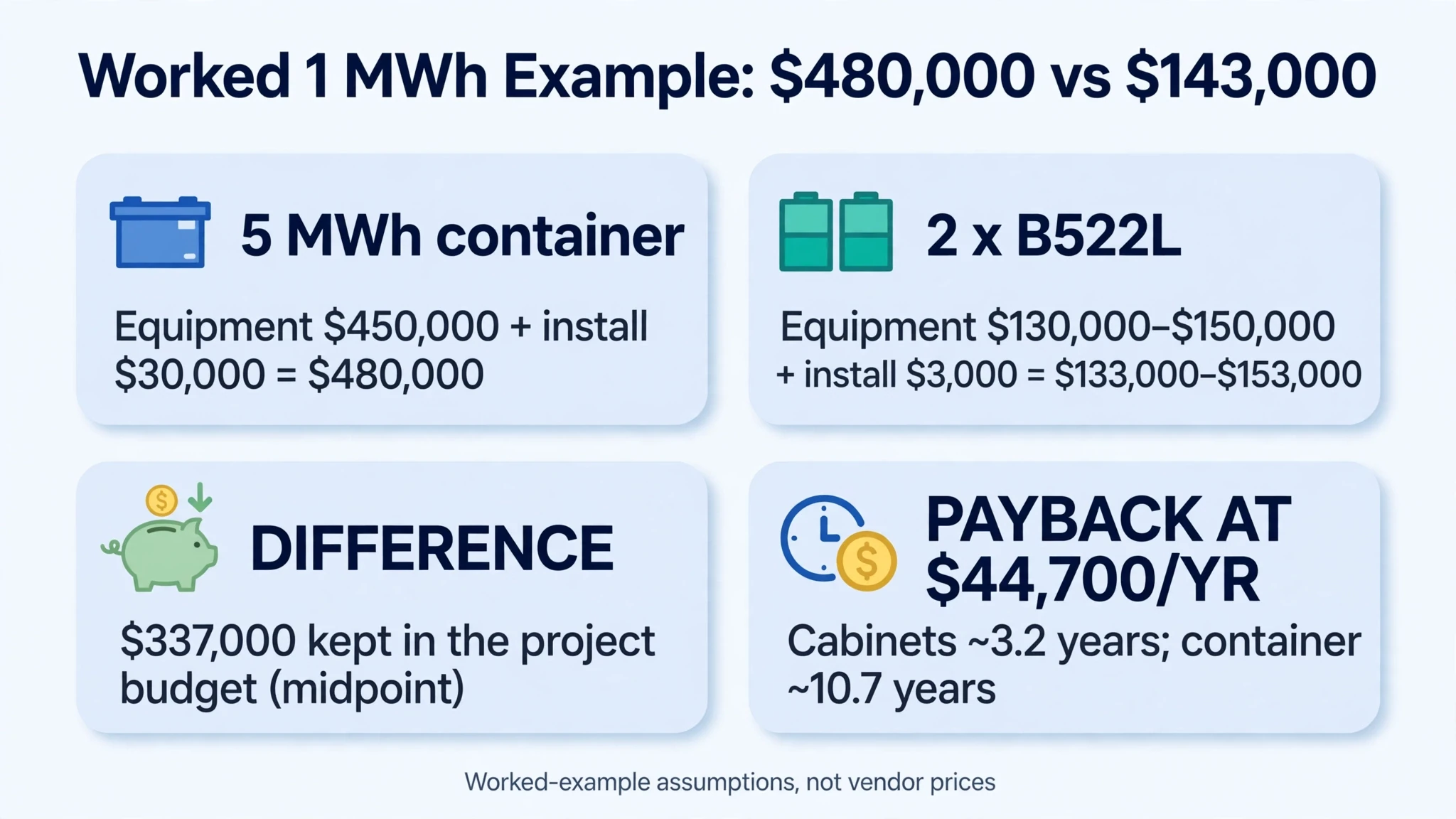
This narrow subtotal excludes any common transformer, switchgear, permitting, freight, tax, commissioning or grid work unless a quotation states otherwise. The comparison must add those items on the same boundary.
At the midpoint, the cabinet option keeps $337,000 in the project budget. If the container's final installed subtotal reaches $500,000, the difference becomes $347,000–$367,000 across the stated cabinet range. The buyer preserves this cash by purchasing capacity close to the plant's requirement.
Calculate payback from the annual net benefit:
Annual net benefit = energy-arbitrage savings + demand-charge reduction + PV self-consumption value + demand-response revenue − auxiliary energy cost − O&M
Simple payback = installed CAPEX ÷ annual net benefit
If the load model supports $44,700 in annual net benefit, the $143,000 midpoint returns in about 3.2 years. The $480,000 option takes about 10.7 years at the same annual benefit. An 8–9 year result for the container requires roughly $53,000–$60,000 per year, so the model should identify the extra usable revenue or avoided cost.
The complete year-zero comparison should include:
Installed CAPEX = equipment + freight + unloading + foundation + drainage + cables and trenches + transformer and switchgear + EMS and metering + fire works + permitting + commissioning + production disruption
Add auxiliary electricity, scheduled service, software, inspections, insurance, augmentation, component replacement, expansion and decommissioning to the lifecycle analysis. Use net present value when the two architectures produce different expense timing.
Decision Path for Plant Engineers
1. Is the Initial Requirement Near a Large Block?
A plant with a firm 3MWh–5MWh requirement, a high load factor and planned growth should price a utility-scale block. A project approaching 1.5–2MWh should compare cabinet and container configurations on the exact feeder and site design. Below that range, cabinet increments deserve an early place in the bid set.
2. Can the Site Accept Delivery and Foundations?
Check the full route, unloading equipment, ground reactions, shutdown window and cable path. A prepared substation yard may favor a container. A constrained operating factory may gain more from several smaller placements.
3. Will the Project Expand in Stages?
Cabinets align well with staged investment if phase one reserves electrical and physical capacity. A single container can be cleaner when the plant needs the full block at commissioning.
4. Is Cabinet-Level Service Isolation Required?
Ask each supplier to mark the smallest isolatable block and the residual output after the listed failure cases. Cabinet-level isolation helps only when the remaining cabinets, common bus and control logic keep the protected load online.
5. Do Both Bids Include the Same Scope?
Normalize battery, PCS, transformer, switchgear, EMS, metering, fire works, installation, testing and warranty. A price comparison made before this step has little procurement value.
The winning architecture is the one with the lower site-specific lifecycle cost and the clearer delivery boundary, subject to EPC, utility and fire-authority approval.
Factory BESS Procurement Checklist
Use one turnkey factory BESS procurement package for every bidder.
| RFQ item | What to confirm |
|---|---|
| Performance | Usable kWh, AC kW and overload |
| Efficiency and auxiliaries | AC-AC RTE plus operating-state kW |
| Operating envelope | Temperature, altitude and derating |
| SLD and supply boundary | PCS, EMS, transformer, switchgear and metering |
| Civil and lifting | Loads, anchors, drainage and lift points |
| Fire and controls | Test evidence, clearances, protocols and SCADA |
| Warranty and service | Degradation, throughput, spares and response |
| Acceptance | FAT, SAT, commissioning and performance proof |
For KRL, request the order-specific data sheet and certificate set. The public B261L and B522L pages establish the main electrical and physical ratings; the bidder should document the remaining items.
FAQ
Is a 5MWh container too large for a 1MWh factory project?
How many KRL cabinets make 500kWh, 1MWh or 2MWh?
Are modular cabinets cheaper to install?
Do KRL cabinets need a concrete foundation?
Can a factory add more cabinets later?
Which option has better round-trip efficiency?
Can modular cabinets replace a Sungrow 5MWh container?
What should an EPC request before comparing quotations?
How should buyers compare auxiliary power and RTE?
What must be reserved for later expansion?
Build the System Around Factory Data
Size a 500kWh–2MWh project from its measured load and site conditions. Send KRL the following inputs:
- Twelve months of 15-minute load data and the electricity tariff
- Transformer rating, spare capacity and the current single-line diagram
- Target kW, usable kWh, backup loads and operating strategy
- Site dimensions, photographs and the delivery route
- PV, generator and EV-charging interfaces
- Expansion plan, project country and applicable codes
KRL's application team can use those inputs to prepare a cabinet configuration and a like-for-like TCO scenario. KRL's product pages state a 24-hour expert response; the engineering deliverables and schedule should follow the agreed project scope.
Review KRL Power's turnkey factory liquid-cooled BESS solutions and submit the site data for an application review.
Technical Sources
- KRL-B261L 125kW/261kWh product page
- KRL-B522L 250kW/522kWh product page
- KRL commercial and industrial energy storage systems
- KRL B261L, B522L and B2M6L selection guide
- KRL C&I BESS cost, sizing and ROI guide
- Fluence Gridstack Pro technical specifications
- CATL energy storage product brochure, including TENER C2-L625
- Sungrow PowerTitan 2.0 product performance announcement
- NFPA 855 stationary energy storage system standard page
- NFPA technical committee material for the 2026 edition of NFPA 855
- UL Solutions FAQ on ESS installation codes and UL 9540A
Product specifications and web pages checked on November 13, 2026. Project quotations, installation drawings, certificates and local approvals control the final design.