By the KRL Power Cold-Chain & Industrial Storage Engineering Team · Last reviewed: October 2026
At a beef export abattoir in Athi River, Nairobi or Nakuru, a KPLC outage at 01:00 combined with a standby generator that fails to take load puts an entire night's kill at risk. When 150 freshly dressed carcasses sit in a chiller with the evaporator fans stopped, deep round temperatures quickly drift off the validated chilling curve.
By morning, the quality assurance team has a HACCP critical-limit deviation to record, and carcasses scheduled for airfreight to Dubai or Riyadh are placed on hold — facing local-market downgrades or condemnation.
Because a carcass chiller removes high biological heat under strict time limits, sizing its battery backup using standard cold-storage rules of thumb regularly leads to mid-outage battery depletion or inverter trips. Below is the engineering method for sizing a battery energy storage system (BESS) and power conversion system (PCS) around real abattoir thermal and motor-starting loads in Kenya.
1. Why the Carcass Chiller Cannot Tolerate an Outage
Maintaining the post-slaughter chilling curve
A dressed beef carcass enters the chiller at a deep muscle temperature of 38–40°C. The slowest-cooling point is the deep round near the hip joint. Export food-safety regulations and Gulf buyer specifications require continuous heat extraction: EU-aligned export standards require a core temperature of ≤7°C before cutting or dispatch, while chilled halal beef buyers in the UAE and Saudi Arabia generally specify 0–4°C. Most Kenyan export abattoirs validate a 20- to 24-hour chilling cycle so sides can move to boning and boxing the next day.
The thermal load is heavily concentrated in the first 6 to 12 hours after loading. During this pull-down phase, the refrigeration compressors operate at or near 100% duty cycle, and the evaporator fans run continuously at high air velocity to strip heat from the carcass surface.
What happens to the carcass when airflow stops
If power fails during early pull-down and the generator fails to pick up the load:
- Deep tissue cooling stalls. Internal heat continues conducting outward from the femur and hip joint, but with no cold airflow across the surface, the deep round stays above 15–20°C under anaerobic conditions. Those conditions allow Clostridium and other anaerobic bacteria to multiply near the bone, causing bone taint (deep souring that is often only detected when the primal cut is opened). A brief five-minute interruption rarely spoils a load, but a two- to three-hour stoppage during the first 10 hours of pull-down can push the entire rail outside the validated HACCP curve.
- Surface moisture and bacterial counts rise. High-velocity cold air dries the carcass surface during initial chilling, which suppresses Salmonella and E. coli growth. When evaporator fans stop, warm moisture condenses on the meat surface.
Even when a spoiled consignment is avoided, repeated temperature excursions show up during buyer and Directorate of Veterinary Services (DVS) audits, putting the plant's export licence at risk.
Technical clarification on Dark Cutting (DFD) beef: Some equipment brochures claim that chiller outages cause dark, firm and dry (DFD) meat. In meat science, DFD is caused by pre-slaughter stress that depletes muscle glycogen before stunning, preventing normal post-mortem pH drop. Chiller power failures do not cause DFD; the real refrigeration risks are bone taint, surface microbial proliferation, excessive drip loss and HACCP non-compliance.
How KPLC voltage events damage refrigeration compressors
Grid disturbances on industrial feeders around Nairobi, Athi River and Nakuru rarely occur as clean switching events. Brownouts, single-phasing and voltage unbalance often precede an outage, followed by a 15- to 45-second transfer gap while the automatic transfer switch (ATS) starts the diesel generator. Semi-hermetic reciprocating and screw compressors (such as Bitzer, Copeland and Frascold units) suffer in three ways:
- Voltage sags and phase unbalance increase stator current and overheat motor windings, a primary cause of semi-hermetic compressor burnouts.
- Short-cycling against high head pressure occurs when power drops briefly and restores before suction and discharge pressures equalise, drawing 6 to 8 times full-load current (locked-rotor amps, LRA) on direct-on-line starters.
- Simultaneous compressor restarts when the generator closes onto the busbar can pull generator frequency down and trip the breaker before the chillers stabilise.
2. Three Variables That Standard Cold-Room Sizing Misses
Variable 1: Pull-down load vs holding load
A frozen or chilled distribution warehouse holding pre-cooled goods typically runs its compressors at a 50–60% duty factor. A carcass chiller during the first 12 hours after slaughter runs at a 90–100% duty factor, dropping to 50–60% only in the final holding stage.
Sizing battery capacity on a 24-hour average load factor guarantees that the battery will run flat if a KPLC outage hits on the evening of a full kill. Battery energy must be calculated against the peak pull-down load.
Variable 2: Overlapping inductive and resistive loads
| Subsystem | Electrical characteristic during backup operation |
|---|---|
| Primary compressors | Continuous high kW draw plus 3× to 8× starting kVA depending on starter type |
| Evaporator fans | Continuous inductive load; must run uninterrupted throughout pull-down |
| Condenser fans | Variable load peaking during hot afternoon ambient conditions |
| Electric defrost heaters | 10–30 kW resistive load per room; pulls heavy energy if triggered during an outage |
In a properly integrated abattoir BESS, the energy management system (EMS) inhibits electric defrost elements while running off-grid on battery power and staggers compressor start sequences by 10–15 seconds per rack. Inhibiting electric defrost during a three-hour outage preserves battery capacity for the compressors and evaporator fans.
Variable 3: Kenyan ambient temperature and Rift Valley altitude
- Coastal and low-altitude sites (Mombasa, Mariakani): Ambient temperatures above 32°C raise condensing pressures, increasing compressor shaft power per kW of refrigeration. Use the upper bound of electrical kW per HP when sizing.
- Athi River, Machakos and Nairobi (~1,500–1,800 m): Warm dry-season afternoons and heavy industrial dust require regular condenser cleaning and IP54+ cabinet filtration.
- Rift Valley highlands (Nakuru, Eldoret, Nanyuki at 1,850–2,200 m+): Cooler ambient air reduces condensing head pressure, but lower air density above 2,000 metres reduces convective cooling inside power electronics. Most industrial PCS units derate output power above 2,000 metres, so verify the manufacturer's altitude derating curve before selecting inverter capacity.
3. Step-by-Step Sizing Formulas: Chiller Tonnage to BESS and PCS
Step 1: Calculate total active running power during pull-down (Ptotal)
Ptotal = Σ(Pcomp × kload) + Pevap_fans + Pcond_fans + Pcontrols
During the first 12 hours of carcass pull-down, set the compressor load factor kload to 0.9–1.0.
Engineering benchmark: A 0–2°C beef carcass chiller typically requires 15 to 25 HP of compressor capacity per 10 tonnes of hot carcass (equivalent to roughly 12 to 20 kW of electrical input, depending on ambient condensing temperature). Blast freezers operating at –28°C to –35°C require roughly double that electrical input per tonne. Always use your refrigeration contractor's heat-load sheet for final sizing.
Step 2: Calculate required battery storage capacity (EBESS)
EBESS = (Ptotal × Tbackup) / (DoD × ηsys)
For industrial LFP battery cabinets, use a depth of discharge DoD = 0.90 and round-trip system efficiency ηsys = 0.92. Select the backup duration Tbackup based on your generator risk profile:
| Target backup window (Tbackup) | Operational role | Required nominal BESS per 100 kW pull-down load |
|---|---|---|
| 2 hours | Seamless ride-through for KPLC outages and generator start failures; gives maintenance time to fix a faulted genset | ~242 kWh |
| 4 hours | Carries the chiller plant through a prolonged night-time outage without generator support | ~483 kWh |
| 8 hours | Solar-plus-storage night shifting with diesel kept strictly for emergencies | ~966 kWh |
Step 3: Verify PCS peak apparent power against compressor starting surge (SPCS_peak)
SPCS_peak ≥ (ksurge × Plargest_comp) / (cos φstart) + Sbase_load
- ksurge: 6–8 for direct-on-line (DOL) starters; 3–4 for electronic soft starters or part-winding start; 1.0–1.5 for variable-frequency drives (VFDs).
- cos φstart: typically 0.35–0.50 during locked-rotor motor starting.
- Sbase_load: apparent power (kVA) of all other compressors and fans already running when the largest compressor starts.
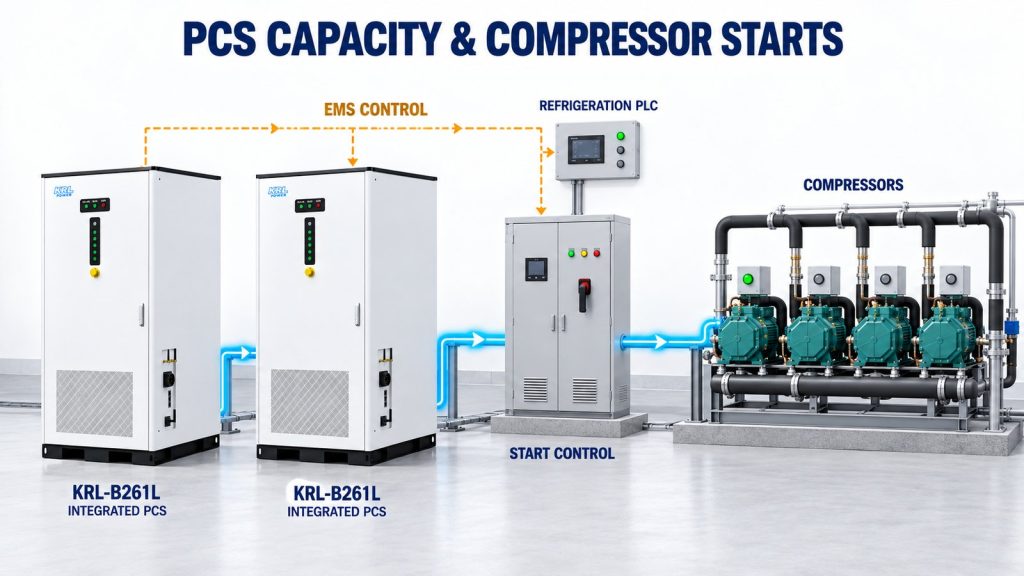
Check SPCS_peak against the PCS's 10-second or 1-minute overload kVA rating, and programme the refrigeration PLC so that two compressors cannot start simultaneously.
Worked Example: 150-Head-per-Day Export Abattoir (Athi River)
- Chiller load: 150 cattle at ~270 kg hot carcass weight = ~40 tonnes of hot beef loaded across four chillers.
- Installed refrigeration: 4 × 25 HP semi-hermetic compressors (~20 kW electrical draw each during pull-down = 80 kW), evaporator fans (12 kW), condenser fans (8 kW), controls and lighting (3 kW).
- Total pull-down running load (Ptotal): 103 kW (with electric defrost inhibited during off-grid operation).
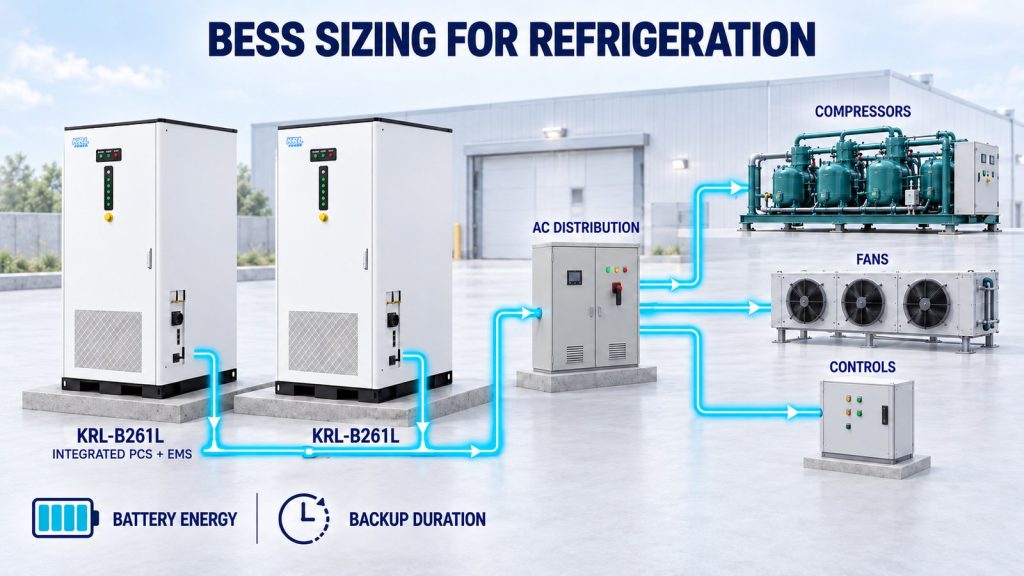
- Battery sizing (3-hour pull-down protection): EBESS = (103 × 3) / (0.90 × 0.92) ≈ 373 kWh. Installing two KRL 125 kW / 261 kWh cabinets provides 250 kW / 522 kWh nominal capacity — delivering roughly 4.1 hours of full pull-down backup with headroom for end-of-life capacity fade.
- PCS surge check: A single 25 HP compressor started DOL draws ~180 kVA at start, pushing total peak demand with base loads to ~270 kVA. By fitting electronic soft starters (ksurge ≈ 3.2), single-compressor starting surge drops to ~85 kVA, keeping total peak demand near 180 kVA — well within the 250 kW nominal (and 150% short-time overload) rating of the two paralleled KRL cabinets.
4. Combining Rooftop Solar with Storage to Cut KPLC Tariffs
Abattoirs have wide, unshaded steel roofs, and Kenya's solar irradiation averages 1,500 to 1,700 kWh/kWp/year. Because chiller and blast-freezer compressors work hardest during hot midday hours, solar generation aligns naturally with the plant's refrigeration curve.
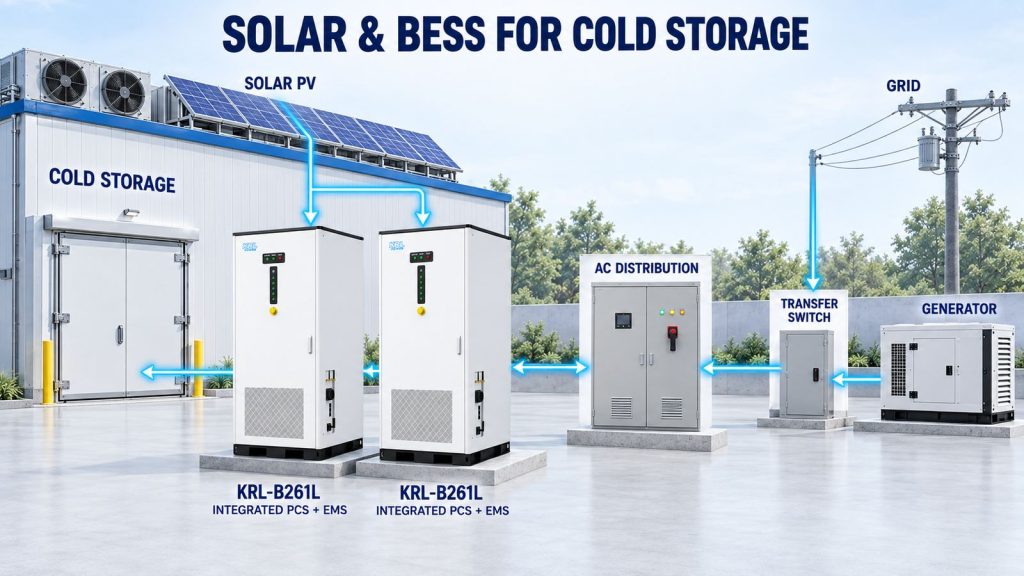
Pairing rooftop PV with the KRL BESS delivers three financial benefits:
- Direct daytime solar refrigeration: Daytime PV powers the compressor racks directly, cutting daytime kWh purchases from KPLC and reducing exposure to the monthly Fuel Energy Cost Charge (FCC) and Foreign Exchange Fluctuation Adjustment (FERFA) pass-throughs.
- Guaranteed evening backup reserve: Solar charges the battery bank to 100% state of charge before the late-afternoon kill enters the chillers.
- Protected minimum SoC floor: The EMS reserves a dedicated capacity floor (for example, 50% SoC) strictly for outage backup, using only the upper capacity band for tariff cycling.
5. How the KRL Power 125 kW / 261 kWh Cabinet Fits Kenyan Abattoirs
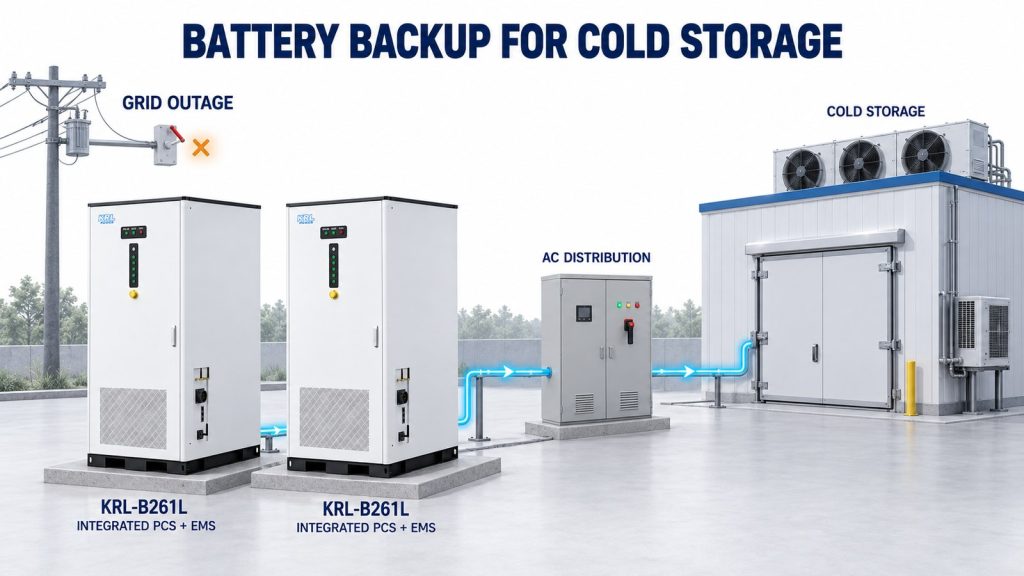
- Millisecond off-grid switchover: Operating online between KPLC, your solar array and your standby generator, the system islands in under 20 ms during a grid failure. Evaporator fans never stop, and compressors avoid high-pressure locked-rotor restarts.
- Modular 125 kW / 261 kWh blocks: Start with one or two outdoor cabinets matched to your current carcass chillers, and parallel additional units as you add blast freezers or expand slaughter capacity.
- Engineered for East African site conditions: IP54+ outdoor enclosure with liquid or forced-air thermal management, dust filtration suited to Athi River and Machakos industrial zones, and documented PCS derating data for Rift Valley sites above 2,000 metres.
- Refrigeration-friendly EMS interfaces: Dry-contact and Modbus TCP/RTU outputs signal the refrigeration PLC to shed defrost heaters and sequence compressor starts automatically whenever the site transitions to battery power.
6. Request a Custom Chiller BESS Sizing & Payback Sheet
A single spoiled export consignment or a burnt-out screw compressor costs a substantial fraction of a commercial battery system. Size your backup system around your actual pull-down thermal load and compressor starting currents before the next grid failure.
Submit your chiller tonnage and compressor HP to receive a customised Kenyan Abattoir Chiller BESS Configuration & ROI Calculation Sheet prepared by KRL cold-chain electrical engineers for your specific site elevation and KPLC tariff band.
For Kenyan HVAC-R contractors and solar EPCs: Looking for a 125 kW / 261 kWh industrial storage cabinet with 150% short-time overload capability at factory-direct pricing? Contact KRL Power for distributor pricing and engineering support.
For meat processors and export abattoir owners: Need a complete solution — from refrigeration load logging and rooftop solar sizing to seamless BESS-and-generator integration? Contact KRL Power for an engineering assessment and project proposal.
Engineering note: Rule-of-thumb benchmarks in this guide are for preliminary feasibility only. Final BESS and PCS selection must be based on refrigeration heat-load calculations, compressor nameplate Locked Rotor Amps (LRA), starter topology and logged 15-minute load profiles.