 Skip to content

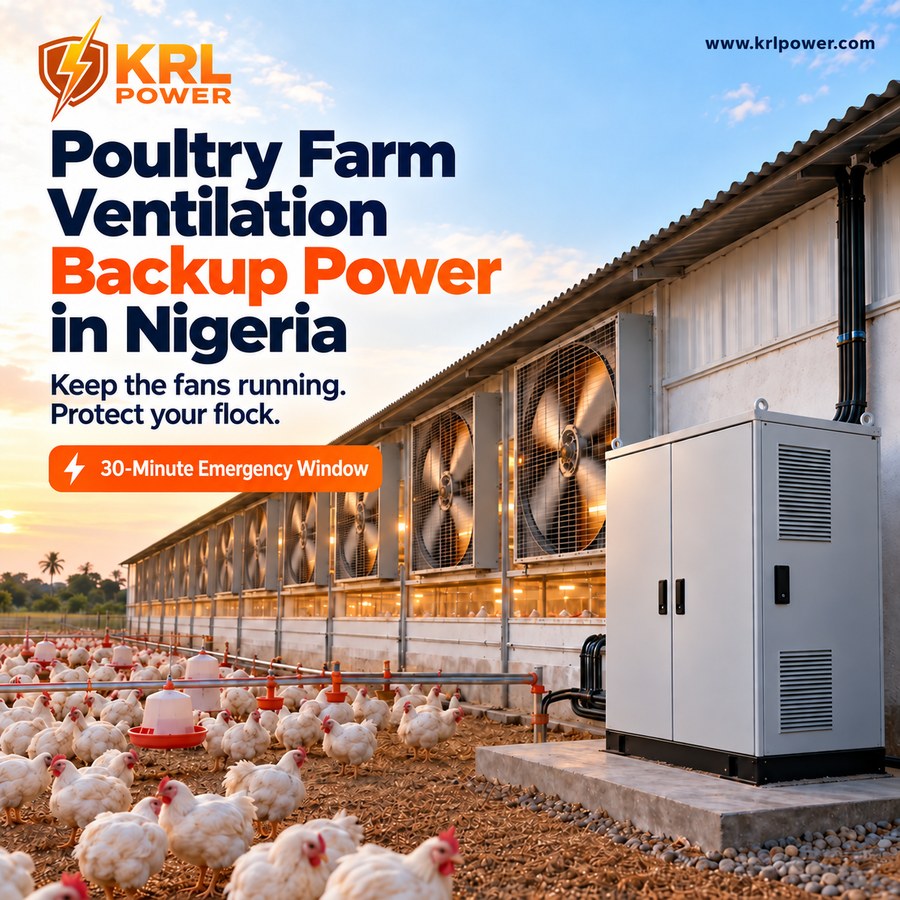
On a Nigerian closed-house poultry farm, the damage can start before anyone has finished asking why the generator did not crank. The grid drops out, the diesel set stays silent, and the house immediately loses the fans that were carrying away heat, moisture and contaminated air. The birds keep producing all three. That gap is where KRL Power battery storage belongs: on the critical ventilation bus, carrying the house until the generator is genuinely available.
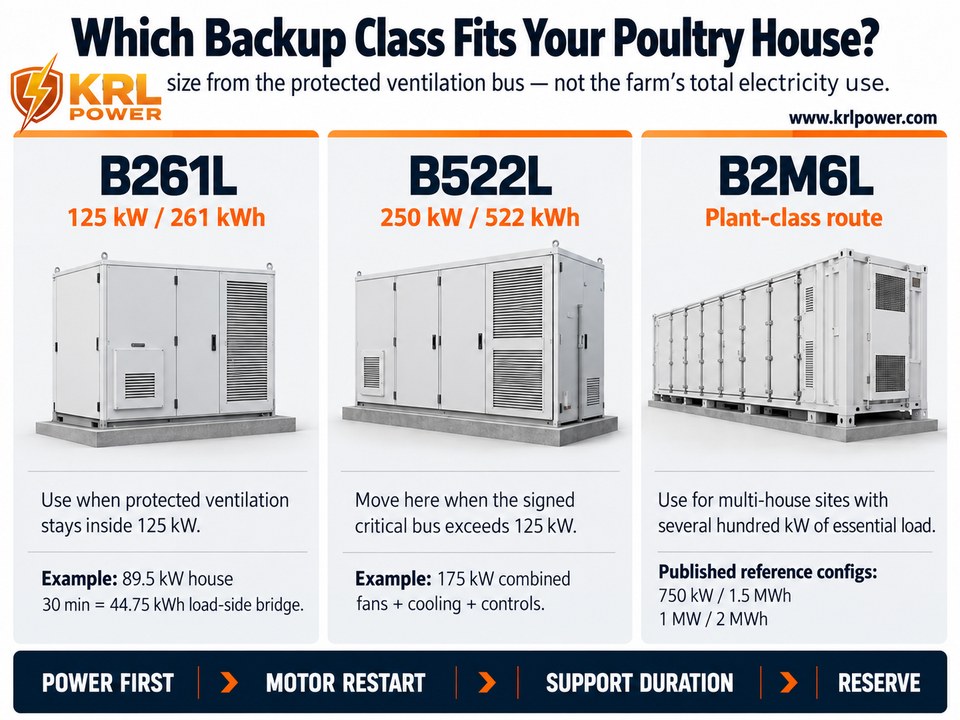
For a protected ventilation load inside the 125 kW class, the KRL-B261L provides a published 125 kW / 261 kWh platform. Once the signed emergency load exceeds 125 kW, the KRL-B522L raises the power class to 250 kW / 522 kWh. Multi-house farms with several hundred kilowatts of essential load belong in the KRL-B2M6L plant-class range.
Start with the ventilation load that cannot be allowed to disappear. Battery capacity comes after that.
The 30-Minute Deadline: The Reality of Closed-House Poultry Farming
The Danger of Heat Stress and Ammonia Build-up
A stocked closed house lives on controlled airflow. Birds keep releasing heat and moisture, litter keeps releasing ammonia, and carbon dioxide continues to build. Mechanical ventilation removes those loads while maintaining the pressure and air speed that the house was designed around.
When the fans stop, the house loses the mechanism that was holding temperature and air quality in check.
In Nigerian heat, that margin can disappear fast. Tunnel air speed disappears, evaporative cooling loses effectiveness, birds begin panting harder, and heat produced inside the house continues to accumulate. Humidity, carbon dioxide and ammonia also keep rising while the ventilation system is unavailable.
The first 30 minutes should therefore be treated as an emergency design window, not as a promise that every flock has exactly 30 safe minutes. Bird age, stocking density, outside temperature, humidity, insulation, airflow and cooling design all affect how fast conditions deteriorate. The electrical target should be much stricter: the critical ventilation system should remain powered from the moment the grid fails.
Size the protected bus around the equipment that keeps the house environmentally viable. Do not drag every farm load into the emergency calculation.
Typical protected loads include:
- required tunnel or exhaust fans;
- environmental controllers;
- inlet actuators;
- essential cooling-water pumps;
- control power;
- essential sensors and communications.
Let the office go dark if necessary. Stop the workshop. Delay non-critical work. Keep the ventilation bus alive.
Consider a 50,000-bird house with the following measured emergency load:
| Critical ventilation load | Example running power |
|---|---|
| 10 tunnel fans | 75 kW |
| Auxiliary circulation fans | 6 kW |
| Cooling-water pump | 5.5 kW |
| Environmental controls and actuators | 3 kW |
| Total protected running load | 89.5 kW |
That 89.5 kW running duty sits inside the KRL-B261L's 125 kW power class.
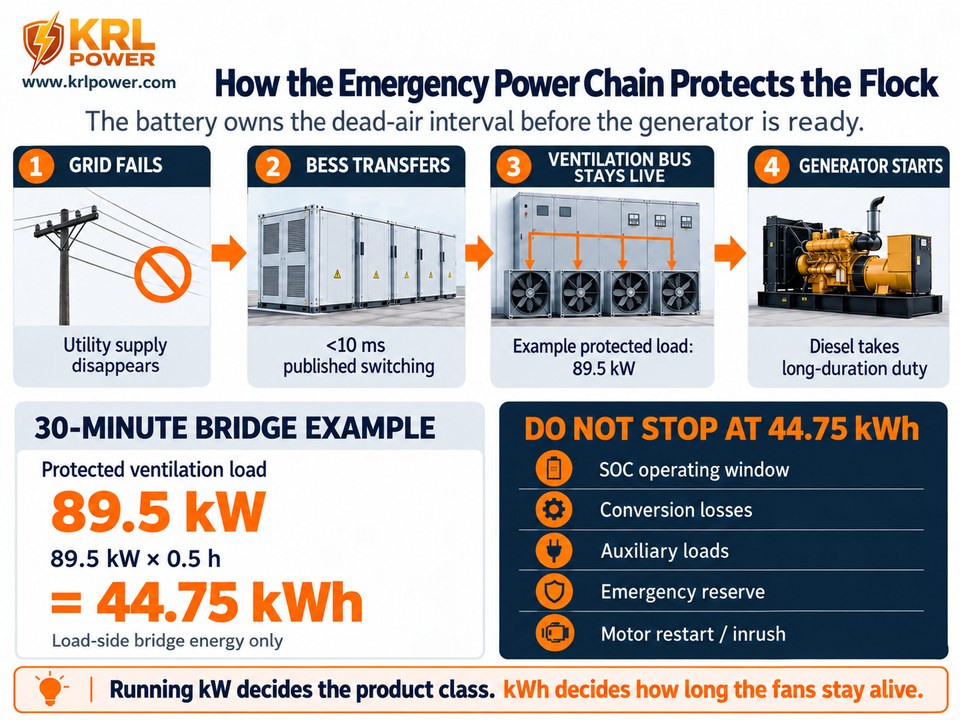
A 30-minute bridge requires:
89.5 kW × 0.5 h = 44.75 kWh
That number is not the final battery size. Motor restart behavior, the allowed SOC window, conversion losses, auxiliaries and emergency reserve still have to be included. It does establish the first buying decision: this house belongs in the 125 kW class before there is any reason to jump to a 250 kW cabinet.
The Grid Unreliability Crisis in Nigeria
The grid-risk argument is already familiar to Nigerian poultry operators. The useful question is what remains powered after the failure.
Supply interruptions do not wait for cooler weather or an empty house. They can arrive at noon, during the hot dry season, at night with fewer staff on site, or while the generator is already due for service. A mechanically ventilated poultry house has to be designed around that reality.
A warehouse can often shut down and recover later. A stocked poultry house keeps generating heat while the power is gone. The emergency power system has to survive a much harsher scenario: the grid fails, the generator start is delayed, and the first generator start attempt may fail completely.
Before a battery is ordered, the farm should be able to answer five questions:
- Which fans must stay on first?
- What is their measured running kW?
- How do those motors start after transfer?
- How long must the battery carry the house before diesel support is dependable?
- How much SOC must remain reserved for ventilation?
If those answers are missing, the farm is still relying on hope rather than a designed backup architecture.
The Fatal Flaws of Relying Solely on Diesel Generators
The Start-Up Delay
Diesel is useful once the engine is running and stable. It is weak in the seconds before that point.
When utility power disappears, the generator has to detect the failure, receive a start command, crank, reach operating speed, stabilize voltage and frequency, close the transfer path and accept load. Even a properly maintained automatic system has a gap between grid loss and stable generator supply.
The house does not care whether the delay comes from cranking, warm-up or transfer logic. Air is moving, or it is not.
KRL-B261L and B522L both publish under-10 ms on-grid/off-grid switching. That figure should not be rewritten as 0 ms, and it does not prove that every fan shaft will maintain exactly the same speed through every installation. The final result still depends on the electrical topology, transfer equipment, VFDs, contactors and control logic.
What matters on the farm is that the battery can carry the signed ventilation bus before the engine is ready.
Write the transfer sequence this way:
grid fails → BESS carries the critical ventilation bus → generator starts and stabilizes → generator and BESS move into the approved long-duration operating mode.
Then check the fan restart, because running load is only half the problem. An 89.5 kW running load does not automatically mean an 89.5 kW restart event. If multiple large tunnel fans drop out and restart at the same time, the PCS can see a much harder transient than the normal running demand.
The farm should not size the converter by adding fan horsepower alone. It should know how many motors restart together, whether they use direct-on-line starting, soft starters or VFDs, and what the PCS sees during that sequence.
If the restart event is too aggressive, fix the sequence first. Buying a larger battery to compensate for poor motor coordination is the wrong solution.
The "Failure to Start" Nightmare
The failure that kills the backup plan is often embarrassingly ordinary: a weak starter battery, a blocked filter, bad fuel or a breaker that never closes.
A weak starter battery, blocked fuel filter, starter-motor failure, contaminated diesel, an empty fuel tank, maintenance work, a breaker fault or a control problem can all prevent the engine from taking the load. Fuel handling and theft add another layer of risk on remote sites.
An AMF panel cannot eliminate those failure modes. It can send a start command; it cannot force a failed engine to run.
That ordinary failure is exactly what the battery bridge is there to cover.
Take the 89.5 kW ventilation example again:
- 30-minute bridge: 44.75 kWh
- 1-hour bridge: 89.5 kWh
- 2-hour bridge: 179 kWh
KRL-B261L publishes 125 kW / 261 kWh / 189 A, which makes it the first logical KRL class to screen for this duty, subject to the final usable-energy and motor-start checks.
Now move to a larger emergency bus:
- tunnel and exhaust fans: 150 kW;
- cooling pumps: 18 kW;
- controls and auxiliaries: 7 kW.
Total protected load:
175 kW
One B261L is immediately too small on power. The first screen moves to KRL-B522L at 250 kW / 522 kWh / 375 A.
The running ventilation duty gives the first KRL screen:
| Critical ventilation duty | KRL route |
|---|---|
| ≤125 kW | B261L |
| >125 kW to 250 kW | B522L |
| Several houses / hundreds of kW | B2M6L plant-class system |
Power decides whether the system can carry the fans; energy decides how long the support lasts. A farm that confuses those two numbers can buy a cabinet with plenty of kWh and still fail the first restart event.
Skyrocketing Diesel Costs
Even when the generator starts every time, relying on it heavily is expensive.
A poultry farm that repeatedly falls back to diesel pays for fuel, transport, storage, service, filters, lubricants, engine wear and fuel security. When the grid is unreliable, those costs stop looking like rare emergency expenses and begin behaving like part of the farm's normal production cost.
Keep the generator. Let it do the long-duration work it is good at once voltage and frequency are stable.
Split the jobs instead of forcing diesel to do everything:
BESS handles the immediate failure. Solar carries available daytime load. Diesel carries the long outage.
KRL-B261L and B522L both publish diesel-generator integration capability. That lets the battery and generator work as different layers of the same emergency system instead of forcing one engine to solve every event from the first millisecond onward.
A generator-only design leaves one mechanical start as the last barrier before ventilation loss. A hybrid design adds an electrical bridge before that point.
The Ultimate Failsafe: How Battery Storage Protects Your Ventilation System
Instantaneous Cut-Over (Zero Interruption)
While the diesel set is cranking, stabilizing or being checked, the ventilation bus should already be live.
KRL-B261L publishes:
- 125 kW rated AC power;
- 261 kWh rated battery energy;
- 189 A maximum AC current;
- 400/230 Vac output;
- <10 ms switching;
- 120 kW maximum PV input;
- diesel-generator port;
- liquid battery cooling.
KRL-B522L raises the platform to:
- 250 kW rated AC power;
- 522 kWh rated battery energy;
- 375 A maximum AC current;
- 240 kW maximum PV input;
- <10 ms switching;
- diesel-generator port;
- liquid battery cooling.
These figures only become useful when they are tied to the poultry-house duty.
A 90 kW protected ventilation bus belongs in the 125 kW class.
A 180 kW protected bus belongs in the 250 kW class.
A 600 kW multi-house emergency network has moved beyond one C&I cabinet and belongs in the B2M6L plant-class review.
Buy against the real emergency duty: running kW, required support time and restart behavior.
The under-10 ms switching figure is important because it allows the BESS to occupy the gap before the generator is ready. It is not a universal promise that every fan maintains identical RPM through every topology. ATS/STS arrangement, contactor behavior, VFD ride-through, critical-bus segregation, protection coordination and restart sequencing still have to be closed in the design.
The ventilation controls need to stay on a live emergency bus through the transfer.
Bridging the Gap to the Generator
Rejecting BESS because it cannot run the whole farm for eight hours misses the actual poultry-house risk.
Its first job is much narrower and more urgent.
The battery's first job is to erase the dead-air interval before diesel becomes dependable.
On the operating sheet, the sequence should read:
0–10 ms: grid fails and the KRL BESS carries the critical ventilation bus.
First seconds: required fans, controls and cooling auxiliaries remain energized.
First minutes: the diesel generator follows its normal start sequence while staff verify fuel, voltage, frequency and alarms.
If the generator does not start: the battery continues carrying the protected load for its designed bridge window while staff intervene.
Once the generator is stable: the approved generator/BESS control mode takes over the long-duration duty.
That changes the outage from a race against a dead house into a controlled troubleshooting event. Staff can work on the generator while the fans are still running.
Diesel remains useful. It simply stops being the only device standing between grid failure and a dead house.
Solar + Storage: Running a Zero-OPEX Poultry Farm
Utilizing Nigeria's Solar Potential
Poultry ventilation and solar generation overlap unusually well: the hottest daylight hours are often the hours when the fans work hardest.
That gives the farm a chance to use daytime PV for normal fan load while preserving battery energy for the event that matters most: grid failure.
For this application, the hybrid order is:
PV → poultry loads → BESS reserve → grid / diesel support
During normal daylight operation, solar can carry part of the active ventilation load. When PV output exceeds the approved simultaneous demand and the battery has SOC headroom, surplus generation can restore the battery.
That recharge function matters because the battery is also emergency reserve. A battery that reaches the next blackout half empty because it spent the afternoon on a lower-priority task has failed the operating philosophy.
B261L publishes up to 120 kW of PV input. B522L raises that to 240 kW. Larger KRL plant-class configurations extend PV input into the hundreds of kilowatts.
Scale the system by the protected duty:
| Poultry operation | KRL route |
|---|---|
| One house, protected load ≤125 kW | B261L |
| Large house / combined bus ≤250 kW | B522L |
| Multi-house complex | B2M6L |
Solar earns its place when daytime PV carries ventilation and restores emergency SOC before the next outage.
“Zero-OPEX” should remain a target rather than a literal promise. Panels need cleaning, batteries age, switchgear needs inspection and diesel may still be needed during prolonged low-solar outages.
The commercial gain is lower routine generator dependence without spending the reserve needed for a ventilation failure.
ROI: The Cost of Batteries vs. The Catastrophic Loss of 50,000 Birds
A Brutal Financial Calculation
LCOS is not the first number a farm owner needs here.
Start with the asset at risk: the flock.
Take 50,000 birds.
Using a broad market-reference range of ₦7,000–₦15,000 per bird:
50,000 × ₦7,000 = ₦350,000,000
50,000 × ₦12,000 = ₦600,000,000
50,000 × ₦15,000 = ₦750,000,000
That puts the gross live-bird value in the range of ₦350 million to ₦750 million before counting feed already consumed, veterinary cost, labor, financing, lost production time, disposal and the delay before the house is earning again.
Now look at the failure chain the backup system is supposed to stop:
grid gone → generator unavailable → ventilation stopped → 50,000 birds still producing heat
That is the exposure the backup system has to contain.
The BESS is being compared with a catastrophic-loss exposure, not just an electricity tariff.
Compare the exposure with the installed protection cost:
Potential flock-loss exposure versus installed protection-system cost.
Do not promise that every battery pays for itself during the first outage. The result depends on installed cost, bird value, protected load, weather conditions, outage duration and how much loss is actually prevented.
A farm with hundreds of millions of naira tied up in one stocked house should not judge critical backup power on cost per kilowatt-hour alone.
The first financial question is whether the farm can carry that uninsured failure at all.
Conclusion: Secure Your Flock and Your Investment
The grid can fail on the same day the generator refuses to start. A commercial poultry farm should be wired for that combination instead of assuming one mechanical backup source will always save the house.
KRL Power adds that missing layer. B261L covers the first 125 kW class, B522L moves the protected bus to 250 kW, and larger multi-house duties move into B2M6L. Solar can carry daytime ventilation and restore SOC, while diesel remains the long-outage source.
Size the system from the ventilation load that must stay alive through the outage.
Before the next outage, record:
- total critical fan kW or HP;
- site voltage;
- motor starting method;
- simultaneous restart sequence;
- control and pump loads;
- required emergency bridge time;
- generator start time;
- required battery reserve.
Those figures, not the farm's total monthly kWh, determine whether the project starts with B261L, B522L or B2M6L.
Do not wait for the next blackout to discover that the generator has a dead starter battery while a stocked poultry house is sitting behind stopped fans.
Send KRL Power the total ventilation HP/kW, voltage, starting method and required emergency runtime. That is enough to begin matching the poultry-house duty to the correct battery-backup class.
