1. Customer Energy Challenge in KwaDukuza, South Africa
Based on the real customer scenario in KwaDukuza (KZN Province, South Africa), the energy requirement comes from a commercial guesthouse operator with 16 rooms and mixed facility loads:
Customer Profile
- Location: KwaDukuza, KwaZulu-Natal, South Africa
- Business Type: Guesthouse / Small Commercial Hospitality
- Capacity: 16 rooms + kitchen + lighting + entertainment systems
- Load characteristics:
- 24-hour continuous operation requirement
- High sensitivity to power interruption (guest experience impact)
- Mixed AC + lighting + kitchen load
- Existing issues:
- Load shedding interruptions
- High electricity cost from grid
- Diesel generator dependency (noisy, high fuel cost)
- No unified energy management system
Core Requirement
“24-hour uninterrupted power supply with optimized cost control and system integration”
2. Engineering Diagnosis (KRL R&D Perspective)
From a 20-year ESS system engineering standpoint, this is a typical small C&I hospitality microgrid scenario with three core challenges:
2.1 Load Continuity Risk
Guesthouse operations cannot tolerate:
- Blackouts during night hours
- Air conditioner interruption
- Refrigeration shutdown
- Internet/WiFi failure
Even 1–3 seconds of outage impacts customer satisfaction and revenue
2.2 Energy Cost Pressure
South African electricity structure leads to:
- High peak tariff periods
- Unstable grid supply (load shedding cycles)
- Increasing diesel backup cost
Without optimization, OPEX increases rapidly.
2.3 System Fragmentation Problem
Typical setups rely on:
- PV inverter (independent)
- Diesel generator (manual switching)
- Backup batteries (uncoordinated)
Result:
- Low efficiency
- Poor energy utilization
- High maintenance complexity
3. KRL Power Integrated ESS Solution Architecture
KRL Power proposes a fully integrated Commercial Energy Storage System (C&I ESS) designed specifically for small business and hospitality microgrids.
Core Architecture Concept
PV + Battery Storage + Diesel Backup + Smart EMS = 24h Autonomous Energy System
4. System Topology Design (Visual Engineering Solution)
A. Guesthouse 24h Microgrid System Architecture
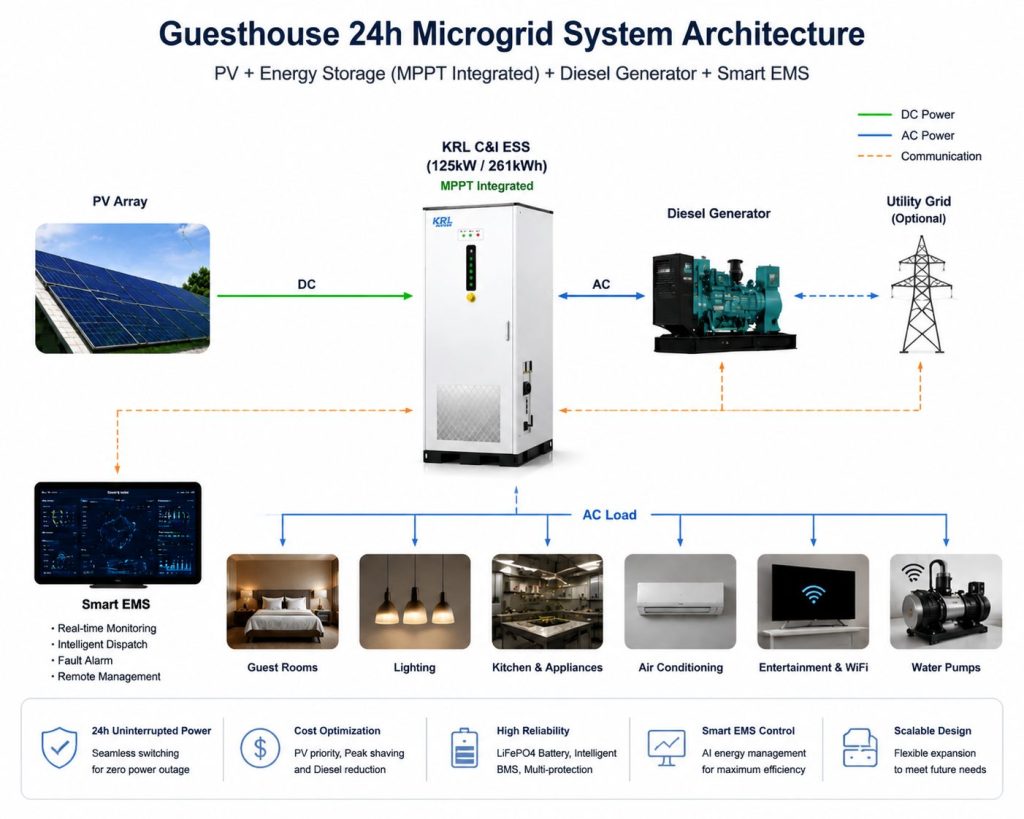
System Features:
- PV system for daytime energy supply
- Battery storage for night-time stability
- Diesel generator for emergency backup
- Smart EMS for automatic switching and load control
B. KRL C&I ESS Cabinet Solution (Core Equipment)
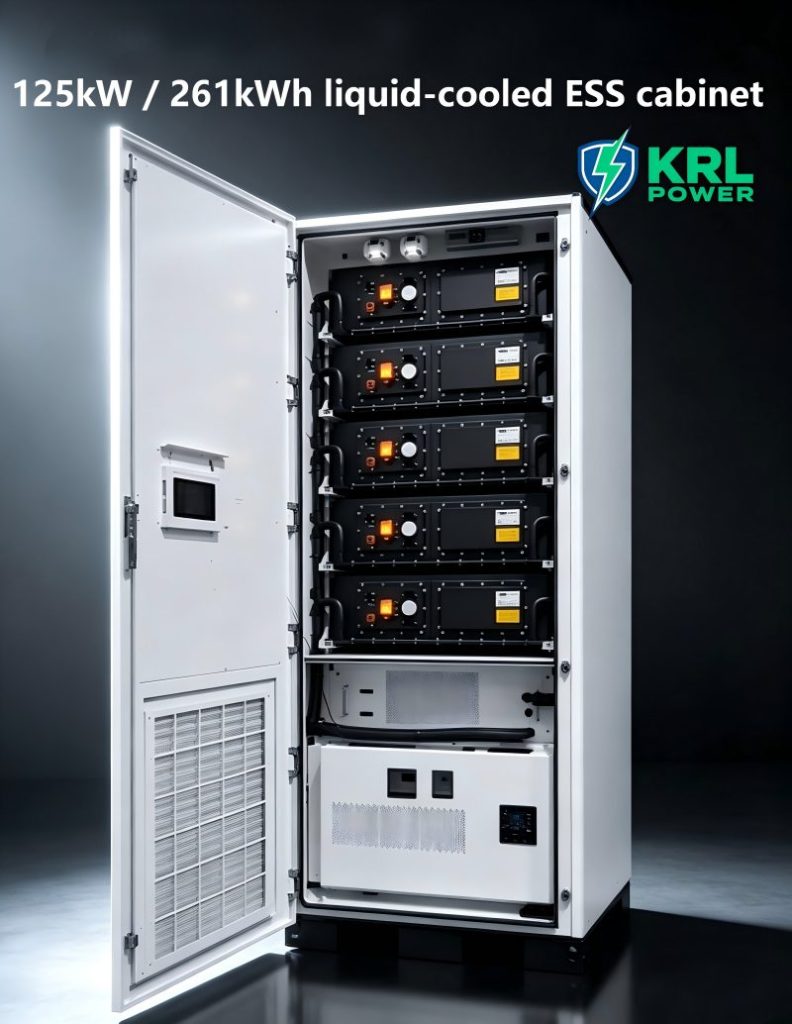
Recommended Configuration:
- KRL 125kW / 261kWh liquid-cooled ESS cabinet (scalable down option available)
- Integrated PCS + BMS + EMS architecture
- Modular expansion capability
- High cycle life for daily operation
C. PV + Diesel Hybrid Backup Integration
Key Advantages:
- PV priority consumption during daytime
- Battery handles peak load shifting
- Diesel generator runs only during extreme conditions
- Fuel consumption reduced by 30–60%
D. Smart EMS Control & Remote Monitoring System
Smart Functions:
- Real-time load monitoring
- Automatic peak shaving
- Diesel start/stop automation
- Remote fault diagnosis
- Energy cost optimization algorithm
5. Recommended System Configuration for KwaDukuza Guesthouse
Based on load estimation for 16-room guesthouse:
Option A: Standard 24h Backup System
- Battery: 80–120kWh LiFePO4 ESS
- PV: 20–40kWp rooftop solar
- Diesel generator: 20–40kVA backup
- EMS: KRL Smart Energy Controller
Best for:
- Small guesthouses
- Boutique hotels
- Remote lodges
Option B: Enhanced Commercial ESS System
- Battery: 125kW / 261kWh KRL liquid-cooled ESS
- PV: 40–80kWp
- Diesel integration: Smart hybrid control
- Supports future expansion
Best for:
- Medium guesthouses
- Multi-building resorts
- Mixed commercial facilities
6. Why KRL Power is the Best Fit for South African Hospitality Sector
6.1 Extreme Safety Architecture
- High-quality LiFePO4 battery cells
- Intelligent liquid cooling system
- Multi-layer fire protection
- Smart BMS protection system
6.2 Energy Cost Optimization
- Self-developed EMS optimization engine
- Peak shaving & load shifting
- Diesel reduction strategy
6.3 High Reliability for 24/7 Operation
- Designed for continuous cycling
- Stable voltage output for sensitive loads
- Seamless grid/diesel switching
6.4 Scalable Modular Design
- Start from 80kWh system
- Expand to MWh-level system later
- Plug-and-play architecture
7. Implementation Process
- Load profile analysis (guesthouse consumption)
- PV generation design
- Battery sizing optimization
- Diesel backup integration plan
- System simulation & ROI calculation
- Factory pre-configuration
- On-site installation
- EMS optimization tuning
8. Economic Value Analysis (Business ROI)
For KwaDukuza hospitality scenario:
- Electricity cost reduction: 25%–45%
- Diesel reduction: 30%–60%
- Revenue protection (no blackout loss): High impact
- Payback period: 2.5–4.5 years
Key value: Not only energy saving, but guest experience protection
9. Frequently Asked Questions (FAQ)
Q1: Can the system fully eliminate power outages?
Yes. The system supports seamless switching between PV, battery, and diesel to ensure uninterrupted 24-hour power supply.
Q2: Is diesel generator still necessary?
Yes, but usage is significantly reduced. Diesel is only for emergency backup or extended cloudy conditions.
Q3: Can the system reduce electricity bills?
Yes. Through peak shaving and PV optimization, electricity cost can be reduced by up to 45%.
Q4: Is the system suitable for small guesthouses?
Yes. KRL provides scalable configurations starting from 80kWh for small hospitality businesses.
Q5: Can the system be expanded later?
Yes. Modular design allows easy expansion from small systems to multi-MWh commercial systems.
10. Conclusion
The KwaDukuza guesthouse energy challenge is not just a power supply issue—it is a business continuity and customer experience problem.
KRL Power’s C&I ESS solution provides a fully integrated microgrid architecture combining:
- Solar PV generation
- Battery energy storage
- Diesel backup optimization
- AI-based EMS control
This ensures:
- 24-hour uninterrupted operation
- Lower operational cost
- Higher guest satisfaction
- Long-term scalable energy independence