
1. Real Eskom Billing Problem Analysis (From Uploaded Invoice Data)
Based on the actual Eskom invoices provided, the customer exhibits a typical high-demand industrial tariff structure in South Africa.
Key Observations:
- Monthly electricity cost: R 913,000 – R 1,085,000
- Contract demand: 1,000 kVA – 1,500 kVA
- Load profile: fluctuating industrial consumption
- Load factor: ~50–55%
- Major cost drivers:
- Network demand charges (kVA-based)
- Peak energy pricing (time-of-use)
- Reactive power penalties
- Legacy capacity charges
Key Engineering Insight
From an electrical engineering perspective, the problem is NOT energy consumption.
The real cost driver is peak power demand volatility (kW spikes) and poor load shaping strategy.
A few short peak events per month are responsible for disproportionate billing increases.
2. Core Technical Problem
The Eskom tariff structure creates three hidden cost traps:
2.1 Demand Charge Lock-in (kVA Peak Penalty)
Even short load spikes define monthly fixed cost.
2.2 Peak Tariff Exposure
Industrial production overlaps with expensive tariff windows.
2.3 Low Load Factor (~0.5)
Indicates inefficient power utilization and uncontrolled load swings.
3. Engineering Solution: KRL Power 2MWh C&I Energy Storage System
3.1 System Overview
The recommended solution is a:
KRL Power 2MWh / 1MW C&I Energy Storage System (ESS)
Core Configuration:
- Energy Capacity: 2MWh
- Power Output: 1MW PCS (scalable 500kW–2MW)
- Battery Type: LFP high-cycle industrial cells
- Cooling System: Liquid cooling thermal management
- EMS: AI-driven peak shaving + tariff optimization engine
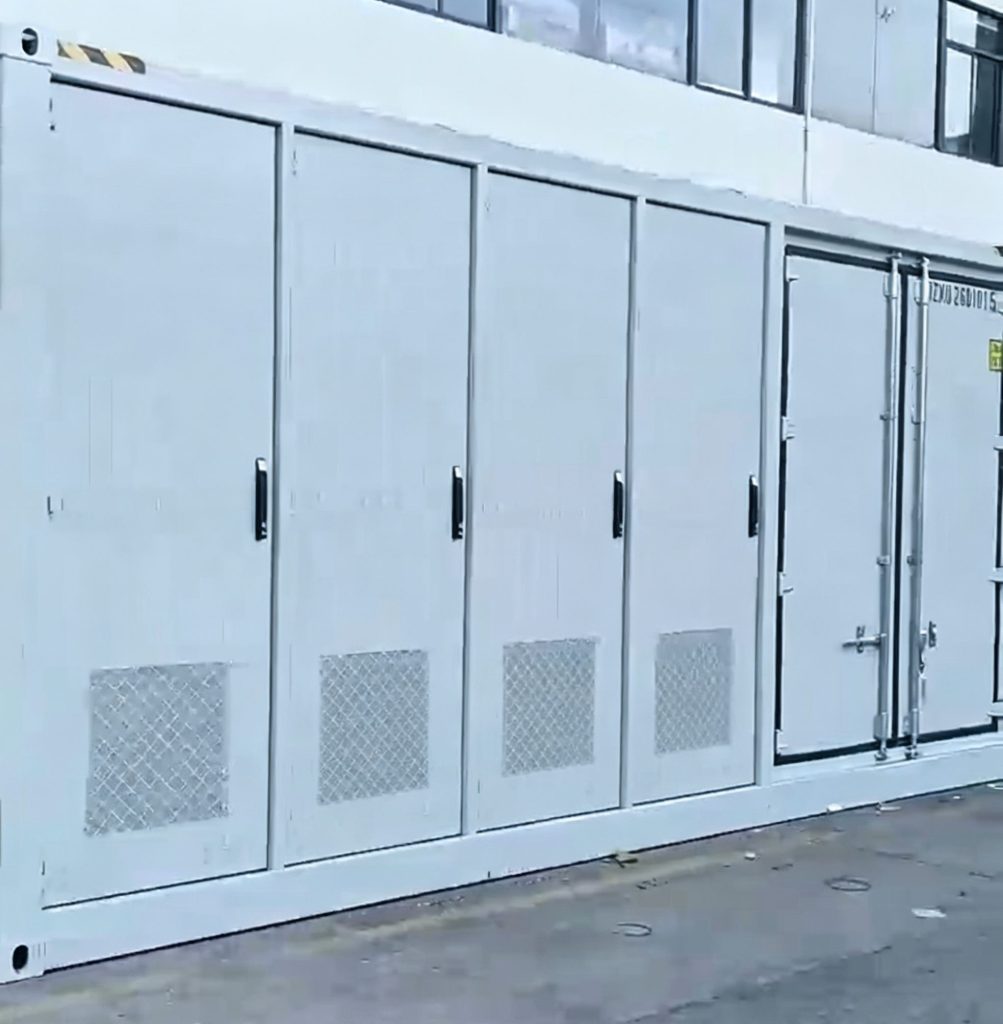
- Installation: Containerized plug-and-play architecture
4. How 2MWh ESS Solves Eskom Billing Problem
4.1 Peak Shaving (Demand Charge Elimination)
The system discharges during peak load events:
- Detects real-time demand spikes
- Injects 1MW power within milliseconds
- Caps grid import below contract threshold
Result:
- 20–45% reduction in demand charges
4.2 Time-of-Use Optimization
Operation Logic:
- Charge during off-peak (low tariff periods)
- Discharge during Eskom peak pricing windows
Result:
- 15–30% energy cost reduction
4.3 Reactive Power & Power Factor Optimization
KRL PCS inverter provides:
- Real-time reactive compensation
- Power factor correction (PF improvement)
- Reduced penalty exposure
Result:
- Lower hidden Eskom penalties
4.4 Load Stabilization
Eliminates:
- Motor startup surges
- Compressor spikes
- Production ramp instability
5. System Architecture (Engineering Design View)
Key Components:
- Battery rack system (2MWh scalable design)
- 1MW bidirectional PCS
- AI EMS optimization platform
- Fire suppression multi-layer safety system
- Cloud-based remote monitoring
6. Economic Analysis (Based on Eskom Case Study)
Monthly baseline:
- Electricity bill: ~R1,000,000+
- Demand-heavy tariff structure
Expected Savings:
| Optimization Layer | Savings |
|---|---|
| Peak Shaving | 20–45% |
| Energy Arbitrage | 10–25% |
| PF Correction | 3–8% |
| Load Optimization | 5–10% |
Total System Impact:
30% – 60% monthly electricity cost reduction
7. Why KRL Power 2MWh ESS
KRL Power differentiates through three engineering pillars:
7.1 Extreme Safety Architecture
- Thermal runaway prevention system
- Liquid cooling stability control
- Multi-layer fire suppression design
7.2 AI Energy Management System (EMS)
- Predictive load forecasting
- Dynamic tariff optimization
- Real-time dispatch control
7.3 Modular Scalability
- 500kWh → multi-MWh expansion
- Fast deployment (<30 days typical)
- Hybrid PV + ESS ready
8. Ideal Applications in South Africa
- Mining operations
- Manufacturing plants
- Industrial parks
- Cold storage logistics
- Commercial malls
- Data centers
- Renewable hybrid microgrids
9. Implementation Process
- Eskom bill + load data analysis
- ESS sizing simulation (EMS optimization model)
- Engineering design (PCS + battery configuration)
- Installation & commissioning
- AI optimization tuning (2–4 weeks learning phase)
10. ROI Expectation
- Typical ROI: 2.5 – 4.5 years
- Stronger ROI under high demand volatility
- Faster payback for 24/7 industrial loads
FAQ
Q1: Can the 3×1MW/2MWh KRL storage system lower my Eskom NMD capacity rating permanently?
A: Yes, fully guaranteed. The 3,000kW total discharge power fully absorbs your factory’s 1,500kW instantaneous peak load, locking grid power draw below 1,000kVA around the clock. Our R&D team provides complete load curve data and technical documentation to support your formal Eskom NMD downgrade application, permanently cutting monthly excess capacity fees. Smaller single or dual storage setups cannot achieve this result.
Q2: Will this system fully eliminate all Eskom power factor reactive fines?
A: Yes. Three synchronized four-quadrant PCS modules dynamically inject or absorb reactive power 24 hours a day, controlled by KRL’s EMS to stabilize your site’s power factor above 0.95 at all times. For facilities with heavy impact loads like large compressors and production motors, our technical team provides complimentary low-voltage capacitor bank auxiliary design to further optimize reactive compensation performance with zero extra charge.
Q3: What PV capacity matches the 3×1MW/2MWh storage system best?
A: Our R&D team recommends a 2.6MWp solar PV array, which sits under the total 2,880kWp MPPT limit of three cabinets. This solar size fully covers all daytime standard-shift power demand and generates sufficient surplus energy to fully cover peak consumption without purchasing large volumes of off-peak grid power. We reserve 280kWp of MPPT capacity for future PV expansion if your factory scales production.
Q4: Do I need to purchase separate solar inverters when pairing PV with KRL X-Series storage cabinets?
A: No additional PV inverters are required. Each 1MW/2MWh cabinet integrates a native 960kW MPPT solar charge controller, allowing direct wiring of PV strings into the storage unit. This reduces extra equipment investment, on-site wiring complexity, and long-term system failure points.
Q5: Does KRL provide full overseas technical support for South African industrial microgrid projects?
A: We deliver end-to-end global technical support for all Southern African clients. Our professional energy storage team provides free pre-sales load analysis, customized single-line topology drawing design, Eskom grid interconnection guidance, on-site commission training, and lifetime cloud EMS remote monitoring support for the full 3×1MW/2MWh storage and matched PV microgrid system.
12. Conclusion (Engineering Decision Perspective)
- Typical ROI: 2.5 – 4.5 years
- Stronger ROI under high demand volatility
- Faster payback for 24/7 industrial loads
The Eskom tariff structure is fundamentally a peak power problem rather than an energy consumption problem.
Without energy storage:
Without energy storage:
- Demand charges remain uncontrollable
- Peak tariffs cannot be avoided
- Power factor penalties continue
With KRL Power 2MWh C&I ESS:
- Load is reshaped intelligently
- Peak demand is controlled
- Electricity cost becomes predictable