Hybrid Solid-State Battery Technology: How KRL Is Building Safer and More Scalable Energy Storage Systems
As global energy storage demand accelerates, the battery industry is entering a new phase where safety, thermal stability, cycle life, and manufacturing scalability matter more than ever before. Traditional liquid lithium-ion batteries have enabled rapid market growth, but increasing concerns around thermal runaway, fire risk, lifespan degradation, and high-temperature instability are driving the industry toward next-generation battery technologies.
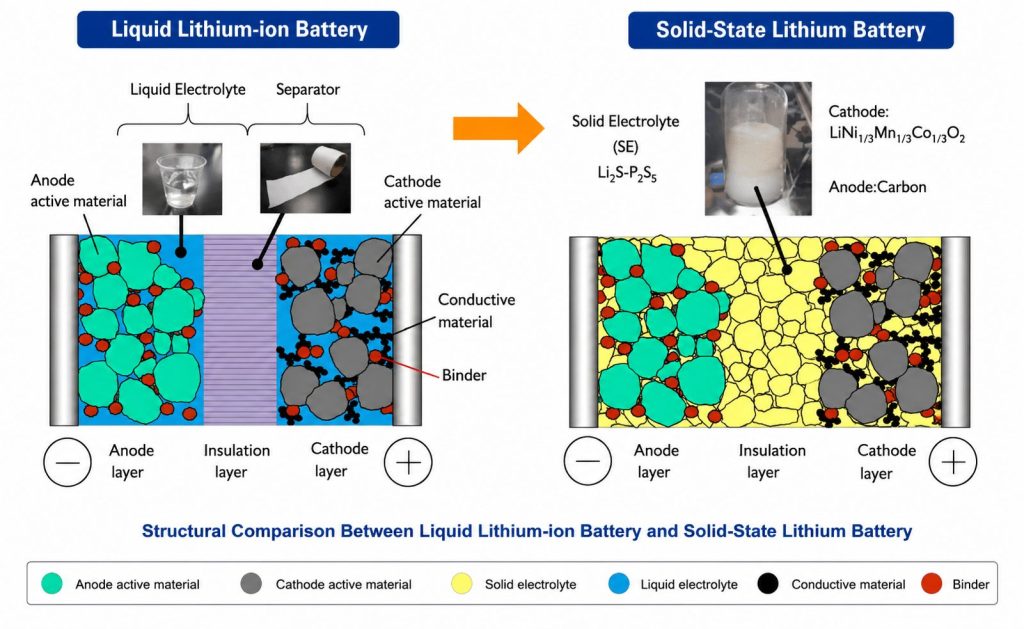
Among these technologies, solid-state batteries have become one of the most discussed innovations in energy storage and electric mobility. However, fully solid-state batteries still face significant technical and manufacturing challenges. A single solid electrolyte material often struggles to simultaneously deliver excellent ionic conductivity, mechanical strength, electrochemical stability, interface compatibility, and scalable production capability.
KRL Power has developed a practical solution to bridge the gap between laboratory innovation and large-scale commercial deployment: hybrid solid-state battery technology.
By combining the advantages of solid electrolytes and optimized liquid-phase engineering, KRL has successfully created a safer, high-performance, and mass-producible energy storage battery platform designed for commercial and industrial ESS applications.
Why Pure Solid-State Batteries Still Face Technical Limitations
Although pure solid-state batteries are widely recognized as the future of advanced energy storage, current electrolyte materials each contain critical trade-offs.
Polymer electrolytes offer relatively good chemical compatibility and flexibility but often suffer from lower ionic conductivity and weaker thermal stability.
Oxide-based solid electrolytes provide strong thermal and electrochemical stability but can face interface resistance and manufacturing complexity.
Oxide-based solid electrolytes provide strong thermal and electrochemical stability but can face interface resistance and manufacturing complexity.
Sulfide electrolytes deliver excellent ionic conductivity but may encounter moisture sensitivity and long-term durability concerns.
NASICON-type materials demonstrate high ionic transport capability but still face practical engineering limitations during large-scale commercialization.
These material constraints explain why many battery manufacturers remain in the pilot-stage development phase rather than achieving true industrial-scale deployment.
For energy storage projects where safety, reliability, production scalability, and lifecycle economics are critical, a balanced engineering approach becomes more valuable than relying on a single electrolyte system.
KRL’s Hybrid Solid-State Strategy: Combining Safety with Commercial Scalability
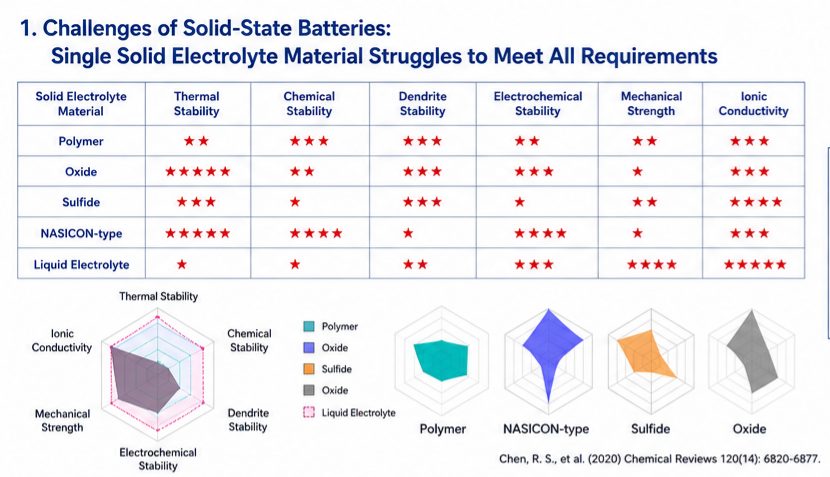
KRL’s hybrid solid-state battery architecture is designed specifically to overcome the limitations of single-electrolyte systems.
Instead of pursuing theoretical laboratory performance alone, KRL focuses on real-world commercial deployment requirements for large-scale energy storage systems.
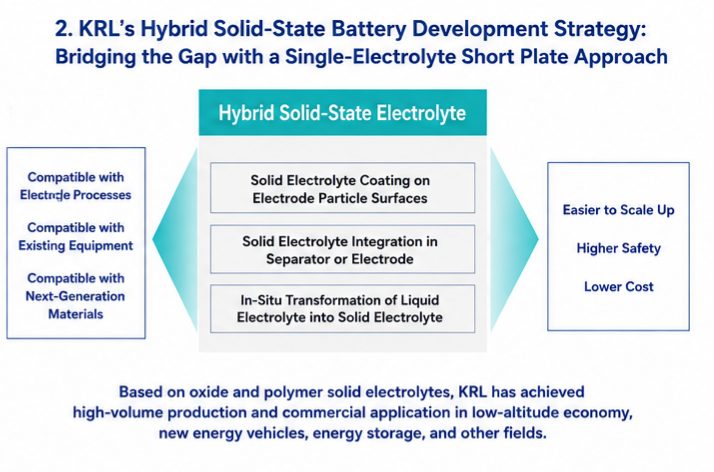
The company integrates solid electrolyte technologies into multiple layers of the battery structure, including:
- Solid electrolyte coating on electrode particle surfaces
- Solid electrolyte integration within separator and electrode structures
- In-situ transformation of liquid electrolyte components into solid-state protective layers
- Advanced interface optimization for stable ion transport
This hybrid architecture significantly improves battery safety while maintaining compatibility with existing production equipment and scalable manufacturing processes.
The result is a next-generation energy storage battery platform that combines:
The result is a next-generation energy storage battery platform that combines:
- Higher thermal stability
- Enhanced puncture resistance
- Improved cycle life
- Reduced thermal runaway risk
- Better structural integrity
- Commercial-scale manufacturability
- Lower overall system cost compared with fully solid-state solutions
For large commercial and industrial energy storage projects, this balance between innovation and manufacturability is essential.
KRL 314Ah Hybrid Solid-State Battery: Engineered for High-Safety Energy Storage
KRL’s 314Ah hybrid solid-state battery platform was specifically developed for modern ESS applications including:
- Commercial & industrial energy storage systems
- Renewable energy integration
- Solar-plus-storage projects
- Utility-scale peak shaving
- Backup power systems
- Microgrid applications
- EV charging infrastructure support
- High-load industrial power management
Unlike conventional liquid lithium batteries, KRL’s hybrid solid-state platform introduces multiple protective mechanisms that improve battery stability under extreme conditions.
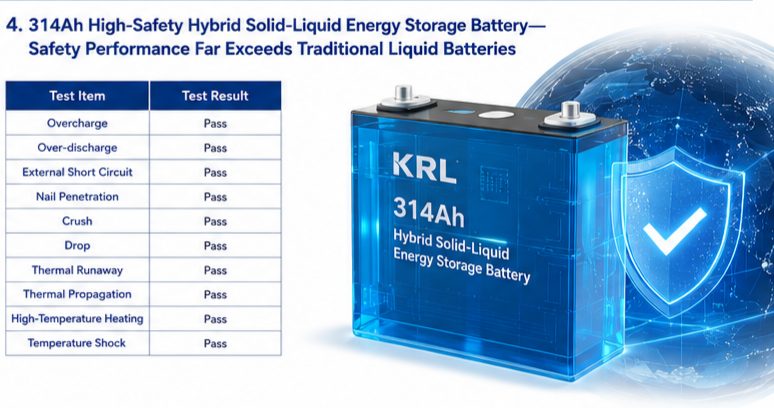
According to KRL internal and third-party validation data, the battery system successfully passes multiple stringent safety tests, including:
- Overcharge testing
- Over-discharge testing
- External short-circuit testing
- Nail penetration testing
- Crush testing
- Drop testing
- Drop testing
- Thermal runaway testing
- Thermal propagation prevention testing
- High-temperature heating testing
- Temperature shock testing
One of the most critical breakthroughs is thermal runaway suppression.
Traditional liquid lithium batteries can experience chain-reaction thermal propagation after a single-cell failure. KRL’s hybrid solid-state design dramatically reduces this risk by forming stable protective interfaces and improving thermal resistance inside the battery cell.
This makes the technology particularly attractive for high-density commercial ESS installations where safety regulations and insurance requirements are becoming increasingly strict worldwide.
Four Core Technology Innovations Behind KRL Solid-State Batteries
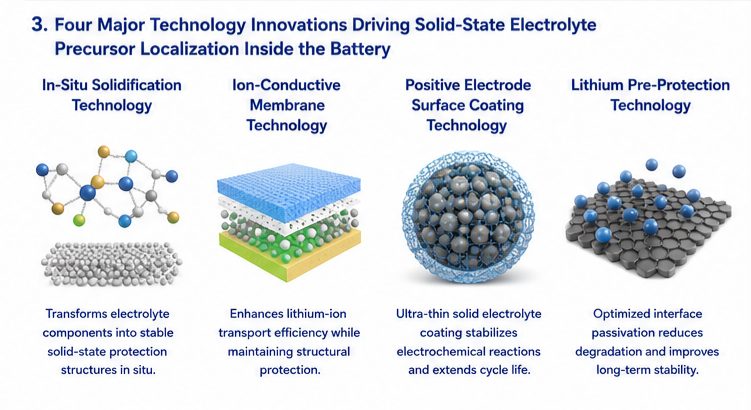
1. In-Situ Solidification Technology
KRL utilizes advanced in-situ solidification processes that transform electrolyte components into stable solid-state protection structures directly inside the battery.
This technology improves interface stability while reducing side reactions and long-term degradation.
2. Ion-Conductive Membrane Technology
The company’s ion-conductive membrane engineering enhances lithium-ion transport efficiency while maintaining structural protection under demanding operating conditions.
This contributes to higher battery reliability and improved charge-discharge consistency.
3. Positive Electrode Surface Coating Technology
KRL applies ultra-thin solid electrolyte protective coatings on cathode materials to stabilize electrochemical reactions and extend battery lifespan.
The coating technology also improves thermal resilience during high-load operation.
4. Lithium Pre-Protection Technology
By optimizing surface passivation and lithium interface protection, KRL minimizes degradation pathways that commonly affect conventional lithium-ion batteries during repeated cycling.
Together, these technologies create a battery system optimized for both performance and industrial-scale deployment.
Designed for the Future of Commercial & Industrial Energy Storage
Global energy infrastructure is rapidly evolving toward distributed energy systems, renewable integration, and decentralized power management.
Commercial and industrial customers are increasingly seeking battery systems capable of delivering:
- Long operational lifespan
- Stable daily cycling performance
- High safety standards
- Predictable maintenance costs
- Scalable deployment capability
- Reliable operation in high-temperature environments
KRL’s hybrid solid-state batteries are designed specifically around these operational realities.
For businesses investing in long-term energy infrastructure, battery reliability directly affects ROI, operational continuity, and insurance compliance.
This is especially important in sectors such as:
- Manufacturing facilities
- Data centers
- Telecom infrastructure
- Industrial parks
- Solar farms
- Logistics hubs
- EV charging stations
- EV charging stations
As governments worldwide tighten battery safety regulations, advanced hybrid solid-state technology is expected to become one of the most commercially viable pathways for next-generation ESS deployment.
Manufacturing Compatibility Creates Faster Commercial Adoption
One major challenge facing pure solid-state battery commercialization is manufacturing incompatibility.
Many next-generation solid-state concepts require entirely new production lines, new processing methods, and substantial capital expenditure.
KRL’s hybrid solid-state approach is different.
The technology is intentionally designed to remain compatible with existing lithium battery manufacturing equipment and industrial supply chains.
This provides several key advantages:
- Faster production scalability
- Lower manufacturing transition costs
- Higher yield stability
- Reduced commercialization risk
- Improved global deployment potential
For energy storage developers and EPC partners, this means projects can benefit from advanced battery safety without waiting years for fully experimental manufacturing ecosystems to mature.
Why Hybrid Solid-State Batteries May Become the Mainstream ESS Solution
While fully solid-state batteries remain an important long-term research direction, hybrid solid-state batteries are increasingly viewed as the practical transition technology for the next decade.
They combine many of the safety advantages of solid-state chemistry with the scalability and economic feasibility required for global energy storage deployment.
For commercial ESS buyers, the most important question is no longer simply energy density.
The real decision factors are:
- Safety
- Stability
- Bankability
- Long-term operating cost
- Project reliability
- Compliance readiness
- Manufacturing maturity
KRL’s hybrid solid-state battery platform is engineered precisely around these priorities.
Conclusion
The future of energy storage will not be defined by laboratory concepts alone. It will be shaped by technologies capable of delivering safety, scalability, reliability, and commercial practicality at the same time.
KRL Power’s hybrid solid-state battery platform represents a significant step toward that future.
By integrating advanced solid electrolyte technologies with scalable manufacturing strategies, KRL is creating a new generation of safer and more commercially deployable energy storage batteries for global ESS markets.
As commercial and industrial energy storage demand continues to expand worldwide, hybrid solid-state technology may become one of the most important pathways toward safer, smarter, and more sustainable power infrastructure.
FAQ
Q1. What is a hybrid solid-state battery?
A hybrid solid-state battery combines solid electrolyte materials with optimized liquid electrolyte engineering to improve battery safety, thermal stability, and manufacturability while maintaining strong electrochemical performance.
Q2. Why are hybrid solid-state batteries safer than traditional lithium batteries?
Hybrid solid-state batteries reduce flammable liquid content and create more stable internal battery structures, significantly lowering the risk of thermal runaway, fire, and explosion during abnormal operating conditions.
Q3. What are the advantages of KRL’s 314Ah hybrid solid-state battery?
KRL’s 314Ah battery offers enhanced thermal stability, improved puncture resistance, long cycle life, advanced thermal runaway suppression, scalable manufacturing compatibility, and optimized performance for commercial energy storage systems.
Q4. Can hybrid solid-state batteries be mass-produced?
Yes. One of the major advantages of KRL’s technology is compatibility with existing lithium battery manufacturing infrastructure, enabling scalable and cost-effective mass production.
Q5. What applications are suitable for KRL hybrid solid-state batteries?
These batteries are ideal for commercial & industrial ESS, renewable energy storage, microgrids, utility-scale storage, telecom backup systems, EV charging infrastructure, and distributed energy projects.
Q6. How does KRL improve thermal runaway prevention?
KRL integrates solid electrolyte coatings, ion-conductive membranes, and interface stabilization technologies that help suppress heat propagation and improve structural stability during abnormal conditions.
Q7. Are hybrid solid-state batteries better than fully solid-state batteries?
Hybrid solid-state batteries currently offer a more practical balance between safety, cost, scalability, and manufacturability. Fully solid-state batteries still face major commercialization and production challenges.
Q8. Why is battery safety becoming more important in energy storage?
As ESS installations grow larger and regulations become stricter, developers, insurers, and end-users increasingly prioritize fire prevention, thermal stability, and long-term operational reliability.